

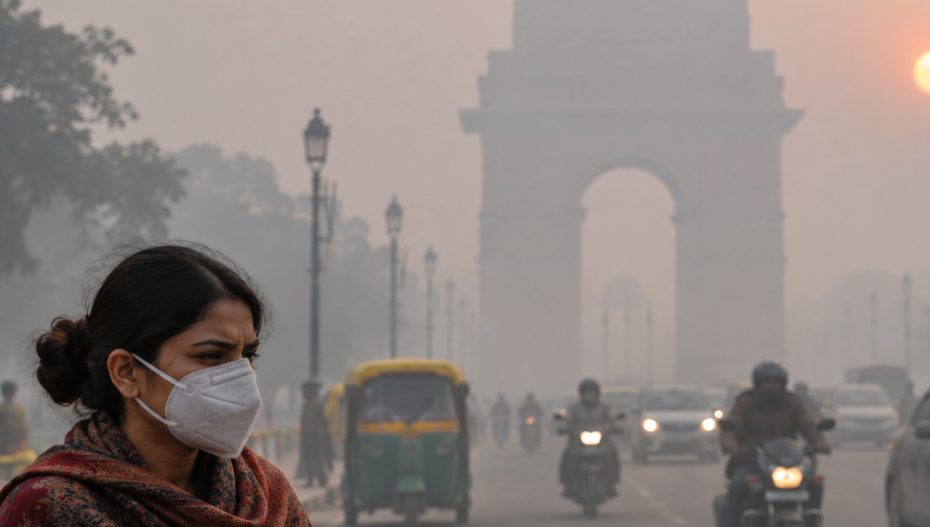
For people living in Delhi-NCR, breathing clean air has become a growing concern, and Diwali has made an already difficult situation worse. The capital had been struggling with poor air quality even before the festival, with pollution levels rising steadily over several days. After a night of firecrackers and celebrations, the situation took another sharp turn, leaving large parts of the city covered in a thick layer of smog.
On Monday morning, November 9, Delhi’s real-time Air Quality Index (AQI) stood at 663 at 8:01 am, according to AQI.in. The situation had been even worse a few hours earlier. The reading touched 1,331 at 1:31 am, showing how sharply pollution levels rose overnight.
The figures offer a worrying picture of the air residents have been breathing. Smog was visible across several parts of the city, including Inderlok, where a thick haze covered the surroundings.
For residents, this is not just a matter of numbers on an air quality chart. Prolonged exposure to polluted air can make everyday activities difficult, particularly for children, older people and those with existing breathing problems. Even stepping outside, travelling to work or spending time outdoors can become uncomfortable when the air is heavily polluted.
The pollution problem did not begin with the firecrackers. Delhi’s air quality had been deteriorating for days before the celebrations, raising concerns about the conditions residents would face after Diwali.
On October 30, AQI.in recorded a reading of 124. By November 2, it had climbed to 393. On November 3, the reading reached 464 by 11:31 am.
The situation remained concerning as Diwali approached. On November 8, the day of the festival, Delhi’s official 24-hour average AQI, recorded by the Central Pollution Control Board (CPCB), stood at 376. This placed the city in the ‘Very Poor’ category.
Authorities had already anticipated a further deterioration. The official forecast warned that air quality could move into the ‘Severe’ category on November 9.
In response to worsening conditions, the Commission for Air Quality Management (CAQM) brought Stage III restrictions under the Graded Response Action Plan (GRAP) into force across Delhi-NCR on November 6.
However, the restrictions did not prevent another sharp rise in pollution after the festival.
The increase became particularly noticeable late on Sunday night, November 8, as Diwali celebrations continued across the capital.
By 9:31 pm, AQI.in had recorded an AQI of 681. The reading then climbed rapidly, reaching 1,153 by 11 pm. Pollution levels continued to rise after midnight and touched their highest recorded point of 1,331 at 1:31 am on November 9.
The readings gradually came down as the morning approached. But even at 8:01 am, the AQI remained at 663, indicating that the improvement from the overnight peak had not brought the air quality back to a safe level.
The figures are based on AQI.in’s real-time readings and should not be confused with the official CPCB figures. The two sources report different measurements, and their readings are not directly interchangeable.
A comparison with the previous year’s post-Diwali reading makes the situation even more concerning.
According to AQI.in, Delhi recorded an AQI of 393 on October 21, 2025, the day after Diwali. This year, the real-time reading stood at 663 at 8:01 am on November 9. That is nearly 69% higher than the reading recorded after Diwali last year.
The comparison points to a significant worsening of post-Diwali air quality in the capital. For people living in Delhi-NCR, it also raises questions about how long the current spell of polluted air may continue and what it could mean for their daily lives.
Firecrackers have added to the pollution, but they are not the only reason Delhi’s air quality has deteriorated.
The city already faces emissions from vehicles and industries, along with dust from roads and construction sites. Waste burning also contributes to the pollution burden.
Delhi had briefly seen some improvement after rainfall and strong winds towards the end of October. But that relief did not last. As dry weather returned, pollutants began accumulating again.
During Diwali, smoke and fine particles released by firecrackers added another layer to the existing pollution. Weak winds and unfavourable weather conditions also made it harder for the pollutants to disperse.
Smoke from crop-residue burning in neighbouring states could further add to the pollution load during this period.
Although the AQI declined from its overnight high, the morning reading of 663 showed that the situation remained serious. Residents may continue to face poor air quality in the days ahead, making it important to keep track of official advisories and pollution updates.
Delhi’s experience this year also highlights a larger concern. The capital was already dealing with poor air quality before Diwali, and the celebrations pushed pollution to an even more alarming level.
For millions of people living in Delhi-NCR, the question is no longer just how bad the air becomes after Diwali. It is how long they will have to live with it, and when they will finally be able to step outside and breathe easier.
Also Read: 12% To 16% Returns Promised: Gujarati-Origin Businessman Faces US Fraud Charges