


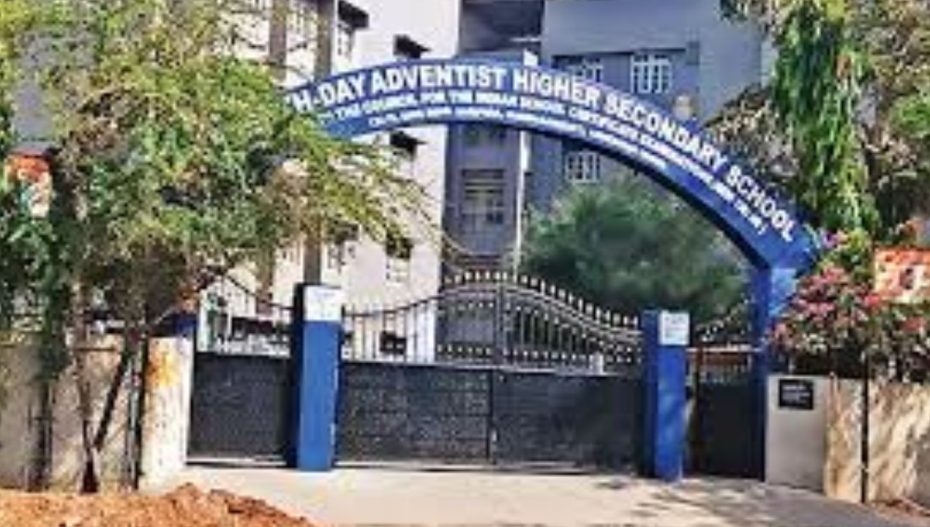
The Seventh Day Adventist School in east Ahmedabad — which had reopened just a month ago after remaining shut following the murder of a Class 10 student — appears to be facing new trouble. An inquiry committee set up under the Right to Education (RTE) Act has flagged several irregularities in the school’s administration and operations.
The District Education Officer (DEO) has forwarded the committee’s report to the state government, recommending appropriate administrative measures in the interest of nearly 10,000 enrolled students. Among the suggestions is the possible transfer of the school’s management to another trust.
According to the report submitted to the Director of Primary Education and the Gujarat Board, the school failed to furnish several mandatory documents required for official verification.
Citing the records available, the report points to multiple discrepancies and violations of rules concerning the school’s recognition and daily functioning. One major issue concerns ownership and management details: while the school’s land was leased in 2003 by the Ahmedabad Municipal Corporation (AMC) to The India Financial Association of Seventh Day Adventists for 99 years, the minority certificate for the higher secondary section lists the managing body as the Council of Adventist Educational Institute.
The DEO also observed that the school had cited several different trusts — including Ashlok Education Society and The Council of Seventh Day Adventist Educational Institute — but failed to clarify which one actually oversees its operations. In addition, the school could not produce a minority status certificate for its primary section or approval records for the expansion of higher classes.
As per the report, the institution originally received permission in 1981 to run Classes 1 and 2 at its Maninagar (East) campus, and was later granted approval for higher grades in 1983. However, it has no documentation supporting later expansions.
The inquiry further points out that the school is functioning from a site different from the one for which it originally received approval. It has also said that textbook sales on campus violate provisions of the Fee Regulation Act.
The report further points out that the institution operates in two shifts but has not obtained mandatory approvals or maintained separate staff and records. It also mentions that the land lessee and the managing trust are separate entities, breaching lease terms.
The report has also highlighted that submitted building plans show only two structures, though three are present on campus. It also states that building-use permission exists solely for the ‘B Block’, while other constructions lack such authorization.
It has also mentioned that for obtaining recognition of Classes 11–12 (Science stream) under the Gujarat Board, the school declared that no other institution operated on the premises, despite an ICSE school (Classes 1–12) already functioning there.
Another point is that the premises also house two colleges — one for Business Studies and another for BSc — for which the school provided an NOC from the ICSE Board for 2025–26, but none from the Gujarat Board.
Based on these findings, the DEO concluded that the school has exhibited serious administrative lapses and breached educational regulations. It called for immediate government action to protect students’ interests.
Also Read: Gujarat: Brawls Not New At Seventh Day School, Past Episodes Of Violence Surface During Investigation https://www.vibesofindia.com/gujarat-brawls-not-new-at-seventh-day-school-past-episodes-of-violence-surface-during-investigation/