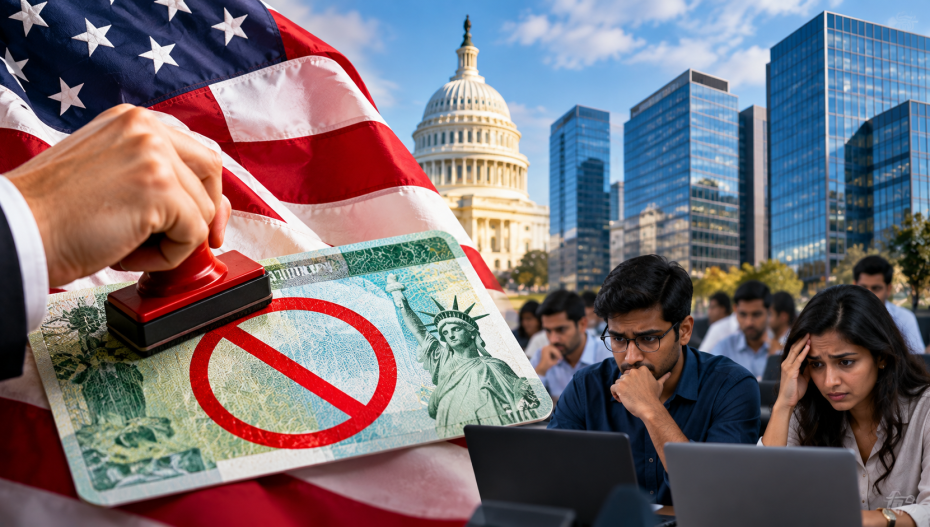
Indian IT companies could face fresh challenges in the United States as the Trump administration reportedly moves to tighten rules for hiring foreign workers and sponsoring them for permanent residency.
Major technology and outsourcing companies, including Infosys, Tata Consultancy Services (TCS), Wipro, HCL and Cognizant, have reportedly been barred from using a key US immigration programme known as PERM. The list also includes global firms Capgemini, Microsoft and Adobe.
The reported move could create uncertainty for Indian professionals working in the US, particularly those waiting for their employers to sponsor their green cards. However, the exact scope of the action and the official list of affected companies need to be confirmed through government records.
What Does the Reported Suspension Mean for Indian Employees?
For many foreign professionals, getting a job in the US is only the first step. Securing permanent residency, commonly known as a green card, can take years, and employer sponsorship is an important part of that process.
The Permanent Labour Certification Program, or PERM, is one of the key steps employers must complete before sponsoring eligible workers for certain employment-based green cards.
Under this process, employers generally need to show that there are not enough qualified, available and willing American workers for the position and that hiring a foreign worker will meet the programme’s requirements.
According to the supplied report, the affected companies would be unable to submit new PERM applications, while pending applications would also face a halt in processing during the suspension.
If confirmed, this could delay green card applications for employees whose companies rely on this route. Professionals who have spent years waiting for permanent residency may face further uncertainty about their future in the country.
The reported action does not, by itself, mean that existing H-1B visas have been cancelled or that current green cards have been revoked. Its precise impact would depend on the official order and each employee’s immigration status.
Microsoft and Adobe Also Reportedly Face Scrutiny
The reported action is not limited to Indian outsourcing companies. US technology firms Microsoft and Adobe have also been named, with the supplied information linking their cases to ongoing federal investigations.
The report says the US government is examining whether companies have followed hiring rules and properly considered American candidates before recruiting foreign workers.
The US Department of Justice has reportedly opened investigations into hiring practices at companies suspected of favouring foreign workers over American applicants.
However, an investigation does not establish that a company has broken the law. The allegations and the status of the investigations would need to be confirmed through official statements or records.
US Administration Signals Tougher Approach to Foreign Hiring
The reported suspensions come amid a wider push by the Trump administration to put American workers first and increase scrutiny of employment-based visa programmes.
Vice President JD Vance has reportedly supported the administration’s position, including the need for companies such as Microsoft to prioritise American workers. The supplied information also says the administration is reviewing the H-1B and J-1 visa systems.
Labour Secretary Keith Sonderling has reportedly outlined the department’s move to stop accepting new applications and processing pending cases for the companies concerned.
The exact statements, legal grounds and duration of the reported suspensions remain important details to verify before treating the action as confirmed.
Why the H-1B Visa Connection Matters
The H-1B visa allows US employers to hire eligible foreign professionals for specialised jobs. Indian technology workers make up a significant part of this workforce.
However, an H-1B visa and a green card are not the same. The H-1B is a temporary work visa, while a green card provides permanent resident status.
Many professionals seek employer-sponsored green cards while working in the US on H-1B visas. Under the standard rules, H-1B status is generally limited to six years, although extensions are possible in certain circumstances, including some cases involving pending or approved employment-based immigration steps.
A delay in the green card process could therefore create additional pressure for workers approaching the end of their permitted H-1B stay. The consequences would vary depending on their individual circumstances and eligibility for extensions.
Nine US Universities Also Reportedly Under Review
The scrutiny may extend beyond corporate hiring. According to the supplied information, the Department of Labor has issued subpoenas to nine US universities over possible weaknesses in their management of the J-1 visa programme.
The five universities named in the report are Harvard University, Yale University, Stanford University, Brown University and the Massachusetts Institute of Technology (MIT). The remaining four institutions have not been identified in the supplied information.
The J-1 programme allows eligible foreign nationals to enter the US for approved exchange activities, including research, teaching and training.
The reported scrutiny suggests that the administration is also examining how institutions manage exchange programmes. However, the details of the subpoenas and the issues under investigation require independent confirmation.
What Could This Mean for Indian IT Companies?
For Indian technology companies, the reported move could mean more uncertainty in managing their US workforce.
Companies that depend on international talent may need to review their immigration compliance practices, employee sponsorship plans and long-term staffing arrangements. Delays in permanent residency applications could also make it harder to retain employees who have built their careers in the US.
Investors are reportedly assessing the possible impact on the affected companies, including additional compliance costs and challenges in retaining skilled employees. The supplied information also points to declines in the shares of some Indian IT companies during early trading, although the market data and the reasons behind the movement need to be verified.
For now, the key question is whether the reported restrictions will be confirmed through formal government orders and how broadly they will apply.
If implemented as described, the move could add another layer of uncertainty for Indian professionals seeking permanent residency in the US and for companies that depend on their skills.
Also Read: EB-1 Green Card Risk Grows For Indians As US Visa Numbers Near Annual Limit