It was never just a roof. When the Calico Dome rose on Relief Road in 1962, there was an argument that geometry alone could hold a structure together, without columns, without mass, without apology. More than six decades later, the dome is at the centre of a different kind of argument. One about whether its restoration is undoing the very logic that made it stand.
The Ahmedabad Municipal Corporation is reportedly reviewing a 15-page technical dossier that raises serious concerns about the ongoing restoration of the dome, widely regarded as India’s first experimental geodesic structure. Senior AMC officials claim the findings are being examined and that the restoration process remains open to consultation and corrective changes.
For context, the dome was built as an exhibition space for Calico Mills. It was conceived by Gautam Sarabhai, then chairman of the mills and a leading patron of modern design in India, along with his sister Gira Sarabhai, co-founder of the National Institute of Design. The Calico dome was actually the site for Ahmedabad’s first high rise but the proposal was rejected by the Municipality and later the iconic dome came up.
The design drew inspiration from the ideas of American architect and futurist Buckminster Fuller, the man who invented and popularised the geodesic dome. The structure was built as a lightweight, self-supporting shell of 380 diamond-shaped plywood panels, held together by geometric precision alone, with no external support.
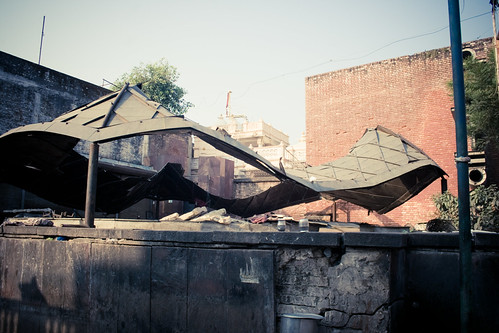
The trouble began when construction activity started without the knowledge or approval of the appointed Project Management Consultant, Vadodara Design Academy. A site inspection was ordered on March 24. What followed was the dossier and a demand for an immediate halt to the restoration.
The report’s findings are pointed. Someone had allegedly replaced the appointed experts with an unauthorised consultant and new drawings were already in use before anyone had approved them.
Rubber gaskets and structural sleeves (components integral to protecting joints and allowing controlled movement) remain unused. The apex cap, which locks the structure at the top, is absent. Without it, the dossier notes, the shell remains structurally unresolved.
According to a media house, the report also questions a proposal to introduce a steel pipe framework above the dome. Such an external intervention, it argues, runs contrary to the core principle of a self-supporting shell.
The dome came into AMC custody in 2009, following a Gujarat High Court directive after Calico Mills went into liquidation. By then, it had already endured decades of neglect, a partial collapse in the 2001 earthquake, and monsoon damage in 2003. The AMC took charge with a mandate to restore it as an industrial heritage landmark.
Officials are at pains to stress that the inspection was the AMC’s own initiative.
It has learnt that the intent was to understand whether the work underway aligned with the original design. If deviations existed, they needed to be discussed and corrected.
To understand why those deviations matter, it helps to understand what the dome is. Its strength does not come from bulk or internal columns. It comes from its curve. The shell was designed to distribute weight evenly across its surface, transferring loads to the ground through compression rather than bending.
An official in the know described it plainly to a section of the media — that it works like an eggshell. Light, hollow, but remarkably strong when forces move as intended.
That logic depends on continuity. Any interruption, added supports, uneven thickness, altered curvature, disturbs the equilibrium. Stresses get rerouted to places never designed to bear them. Sarabhai, engineers familiar with the design note, deliberately minimised reinforcements and avoided intrusive load-bearing elements, letting form do the work that steel typically would.
Restoration, by definition, means intervention. But with a structure this precise, even small deviations carry consequences. If stiffness is added in the wrong place, or if the shell no longer behaves as a single continuous surface, the damage may not be immediate but it will come.
Critics have pointed out that the dossier identifies what went wrong but stops short of saying how to fix it. The AMC has not shied away from that charge. The administration is reportedly open to constructive engagement.
If experts are willing to guide the project forward while respecting the original design, they said, the corporation is ready to listen. Consultation, they added, has to be forward-looking. Any changes must serve the structure, not work against it.
AMC officials, according to reports, are open to engagement. If experts are willing to guide the project forward while respecting the original design, they said, the corporation is willing to listen.
Also Read: Ahmedabad Municipal Corporation Plans To Demolish Iconic Sardar Patel Stadium: Report https://www.vibesofindia.com/ahmedabad-municipal-corporation-plans-to-demolish-iconic-sardar-patel-stadium-report/