

The Gujarat Secondary and Higher Secondary Education Board (GSEB) may have recorded its best Class 10 performance in 33 years this year, but the achievement has been overshadowed by the massive number of repeater and private candidates who failed once again.
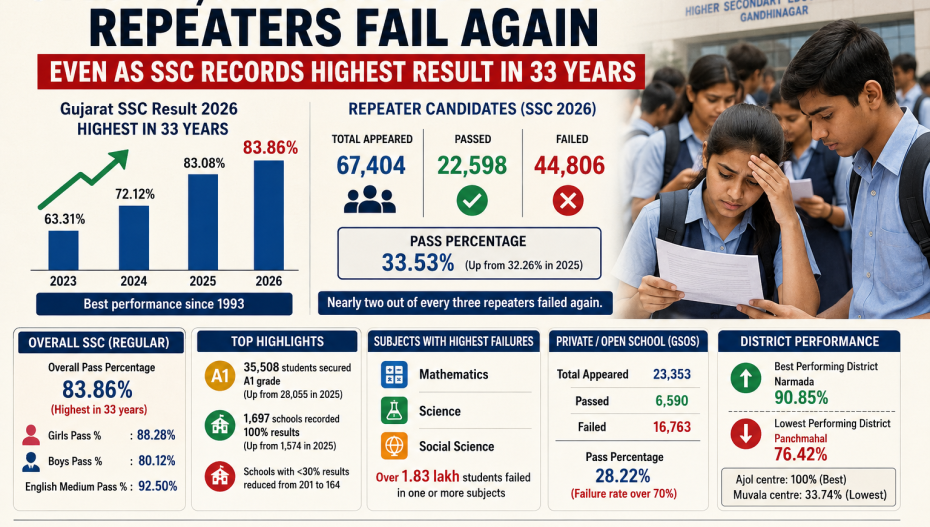
The overall pass percentage for regular students in the Secondary School Certificate (SSC) examination rose to 83.86 per cent in 2026 — the highest recorded by Gujarat since 1993. The figure marks a steady rise from 83.08 per cent last year and a dramatic recovery from the post-pandemic years when the pass percentage had crashed to nearly 64 per cent in 2023.
Yet, behind the record-breaking headline lies a far harsher reality for thousands of struggling students.
Board data shows that 67,404 repeater candidates appeared for the SSC examinations this year, but only 22,598 managed to clear the exam. More than 44,800 repeater students failed again despite appearing for the board examination for another attempt. The repeater pass percentage stood at just 33.53 per cent, only marginally higher than last year’s 32.26 per cent.
The contrast is striking: while Gujarat celebrated its highest SSC result in over three decades, nearly two out of every three repeater students could still not pass the examination.
Education experts say the numbers expose a widening divide in Gujarat’s education system — between regular school students benefiting from structured preparation and academically vulnerable students who continue to remain trapped in the failure cycle.
More than 1.83 lakh students overall failed in one or more subjects this year despite the historic statewide result. Mathematics, Science and Social Science emerged as the subjects with the highest number of failures, continuing a trend that educators say reflects weak conceptual learning and poor foundational understanding.
The state also witnessed a sharp rise in high scorers. A total of 35,508 students secured the top A1 grade this year, up significantly from 28,055 last year. Schools with 100 per cent results also increased from 1,574 to 1,697, while schools recording less than 30 per cent results dropped from 201 to 164.
Girls once again outperformed boys by a significant margin. The pass percentage among girls stood at 88.28 per cent compared to 80.12 per cent among boys. English-medium schools also recorded exceptionally strong performance, with a pass percentage of 92.50 per cent.
District-wise, Narmada emerged as the best-performing district with a pass percentage of 90.85 per cent, while Panchmahal recorded the lowest at 76.42 per cent. Ajol centre achieved a perfect 100 per cent result, whereas Muvala centre recorded the lowest centre-wise performance at 33.74 per cent.
The situation remained grim among students appearing through the Gujarat State Open School (GSOS) system. Out of 23,353 private and open-school candidates who appeared, only 6,590 passed, resulting in a pass percentage of just 28.22 per cent.
Officials said supplementary examinations for students who failed in one or more subjects will begin from June 11 under the board’s second examination system. Students securing Grade E1 — marks between 21 and 32 — will be eligible to appear for the Purak Pariksha.
Education observers argue that while Gujarat’s record-breaking SSC performance reflects improving outcomes among mainstream students, the continuing failure of tens of thousands of repeaters points to a deeper structural problem involving learning gaps, weak remediation systems and unequal access to academic support.
Also Read: Gujarat Bans Shoes, Socks In Exam Halls To Curb Cheating https://www.vibesofindia.com/gujarat-bans-shoes-socks-in-exam-halls-to-curb-cheating/