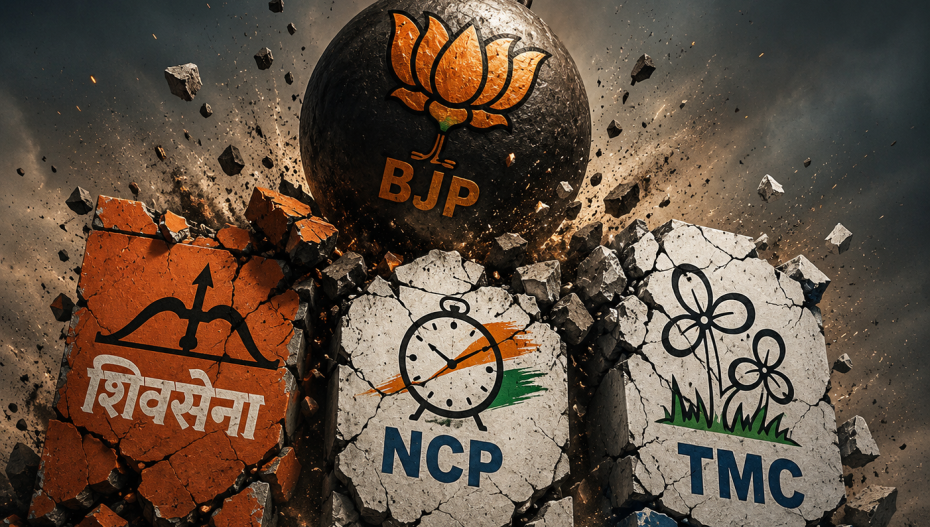
The BJP is apt at delivering master strokes, as likes it to say. But sometimes the BJP forewarns. One instance was then BJP president J.P. Nadda declaring in 2023 that regional parties rooted in dynastic rule and corruption were “destined to be wiped out”. It is now apparent he simply conveying a message his party bosses Prime Minister Narendra Modi and Home Minister Amit Shah may have already decided to go public with.
From Shiv Sena and Nationalist Congress Party (NCP) in Maharashtra to TMC in W Bengal, regional parties are biting the dust. In systematic, scientifically designed strategies that are aimed not just rupturing an opposition, or a rival party but decimating those who lead it. And in all cases, the dissent came from within. The first crumbles were from those closest to the regional satraps.
India’s political scene is shifting dramatically. Once-invincible regional leaders are losing power, facing electoral routs, or battling internal chaos
This unraveling began incrementally. In Bihar, Nitish Kumar’s resignation opened the door for the BJP to claim the chief minister’s office for the first time, while Tejashwi Yadav’s Rashtriya Janata Dal faltered at the polls. In Delhi, Arvind Kejriwal’s decade of control ended abruptly with a resounding defeat in the 2025 Assembly elections, restoring BJP dominance in the capital.
The 2026 Assembly elections delivered even bigger shocks: West Bengal’s Mamata Banerjee and Tamil Nadu’s M.K. Stalin, both leading figures, suffered unprecedented setbacks.
While Stalin lost governmental power, Mamata Banerjee now confronts a graver threat: the potential collapse of her authority within the very party she created.
The Maharashtra Blueprint
Observers see striking parallels between Maharashtra’s political convulsions and the current turmoil in West Bengal.
The template was first established in 2022 when the Shiv Sena, then a key constituent of the Maha Vikas Aghadi government, witnessed an unprecedented rebellion led by Eknath Shinde. Once considered one of Uddhav Thackeray’s most trusted lieutenants, Shinde mobilised a majority of Shiv Sena MLAs against the party leadership.
The revolt did not simply bring down the government. It radically changed the balance of power within the party itself.
Uddhav Thackeray lost the chief ministership. More significantly, he eventually lost effective control over the Shiv Sena’s organisational structure. The rebellion quickly spread beyond the Assembly to the parliamentary wing, eventually resulting in a vertical split of the party. Shinde aligned with the BJP and became chief minister, while the BJP regained a pathway back to power in Maharashtra.
Months later, Maharashtra witnessed another political earthquake.
The Nationalist Congress Party underwent a similar rupture when Ajit Pawar broke ranks with his uncle and party founder Sharad Pawar. The split weakened one of India’s most influential regional political formations and significantly reduced Sharad Pawar’s influence within Maharashtra’s opposition politics.
For the BJP, the dual splits served a strategic purpose. The Shiv Sena rebellion helped dismantle the coalition that had kept the party out of power despite being the single-largest force in Maharashtra. The NCP’s split further weakened the opposition ecosystem by fragmenting one of its most experienced political organisations.
Bengal’s Shock Defeat
West Bengal is now hurtling down a remarkably similar path.
The BJP’s 2026 Assembly win wasn’t just a defeat for the Trinamool Congress; it was a seismic realignment of Bengal’s political order.
The TMC, which had dominated Bengal politics for more than a decade and a half, reportedly crashed from 215 seats to just 80. Even more damaging was the personal defeat of Mamata Banerjee, who lost to her long-time rival Suvendu Adhikari — a former trusted lieutenant who had crossed over to the BJP and emerged as one of her fiercest critics.
For Mamata, the election result was expected to trigger a period of self-examination and rebuilding.
Instead, it appears to have opened the floodgates for an internal rebellion.
The Revolt Within
According to reports, 58 of the party’s 80 MLAs united to challenge decisions made by the party leadership.
The rebellion became visible when dissident legislators reportedly used their numerical strength to install a Leader of Opposition of their choice, effectively overruling Mamata Banerjee’s preferences.
While the revolt is publicly being framed as opposition to Abhishek Banerjee’s increasing influence within the party, insiders indicate that the real challenge is directed at Mamata herself.
For years, Abhishek Banerjee has been regarded as the second-most powerful person within the Trinamool Congress. His organisational authority, influence over appointments and growing control over party affairs had turned him into a dominant power centre. Whereas supporters viewed him as the party’s future, critics increasingly complained about excessive centralisation of power.
The election defeat appears to have exposed long-simmering frustrations among legislators who believed decision-making had become concentrated within a small inner circle.
What is now emerging is not simply dissatisfaction but an organised challenge to the leadership structure itself.
Could TMC Face a Shiv Sena-Style Split?
The biggest concern for Mamata Banerjee is that the rebellion may not remain confined to the Assembly.
Senior Rajya Sabha MP Sukhendu Sekhar Roy has publicly indicated that similar sentiments could emerge among the party’s Members of Parliament.
His warning has intensified speculation that the crisis could spread from the legislative wing to Parliament — precisely the sequence witnessed during the Shiv Sena and NCP rebellions in Maharashtra.
The Trinamool Congress currently has 29 Lok Sabha MPs and 13 Rajya Sabha MPs.
If even a significant section of these lawmakers were to side with rebel legislators, the party could face a full-scale organisational rupture.
Political observers note that the pattern is eerily familiar.
First comes electoral defeat. Then comes internal questioning of leadership. Legislators begin organising themselves independently. Parliamentary members gradually join the rebellion. Eventually, the party splits into rival factions, with control of the organisation becoming the central battleground.
That is exactly how the Shiv Sena transformed from a united political force into competing factions. It is also how the NCP lost its organisational cohesion.
Many analysts now fear that the Trinamool Congress could be approaching a similar moment.
For Mamata Banerjee, who built the party from the ground up after breaking away from the Congress in 1998, losing control over the organisation would represent a far greater setback than losing an election.
Stalin’s Different Challenge
While Mamata faces an existential threat from within, M.K. Stalin’s situation appears significantly different.
The DMK may have lost power in Tamil Nadu, but there are currently no visible signs of a large-scale internal rebellion.
Political calculations also differ sharply between Tamil Nadu and West Bengal.
The BJP’s long-term strategic stakes in Bengal are substantially higher because it has already become a principal political force in the state. In Tamil Nadu, however, the BJP is still a developing player and lacks the kind of organisational dominance it enjoys in many northern and western states.
Reports suggesting that the DMK may seek a more pragmatic relationship with the BJP-led central government have also fuelled speculation that Stalin could avoid the sort of destabilisation now confronting Mamata Banerjee.
Akhilesh Watching Closely
One leader who is almost certainly observing these developments carefully is Samajwadi Party chief Akhilesh Yadav.
With Uttar Pradesh heading towards another hotly contested Assembly election, the lessons emerging from Maharashtra, Delhi and West Bengal are difficult to ignore.
Recent reports indicate that the Samajwadi Party has already ended its association with political consultancy firm I-PAC, which had earlier worked extensively with the Trinamool Congress.
Whether symbolic or strategic, the move shows an increasing awareness among opposition leaders that political survival may increasingly depend on avoiding the mistakes that have contributed to the decline of other regional parties.
A Changing Political Order
The larger story goes beyond individual leaders.
For decades, regional parties were among the most powerful forces in Indian politics. Leaders such as Mamata Banerjee, Nitish Kumar, Sharad Pawar, Uddhav Thackeray, M.K. Stalin and Arvind Kejriwal built political ecosystems that often appeared stronger than national parties within their respective states.
Today, many of those ecosystems are under strain.
Some have suffered electoral defeat. Others have experienced leadership crises. Several have been weakened by defections, rebellions or organisational splits.
Whether these developments represent temporary setbacks or the beginning of a larger realignment of Indian politics remains to be seen.
But one thing is becoming increasingly difficult to ignore: the era of the unchallenged regional satrap may be drawing to a close.
The crisis engulfing Mamata Banerjee is not simply the story of an election defeat. It is increasingly being viewed by political observers as the culmination of a long-term political strategy perfected by the BJP in multiple states — a strategy that tries not only to defeat opponents at the ballot box but also to fragment their political organisations from within.
The playbook has become familiar. First, the BJP appears as the principal challenger to a regional party. Then, influential leaders within the rival formation begin voicing dissatisfaction with the leadership. Internal factions gain confidence after electoral setbacks. Trusted lieutenants turn into rebels. Legislators begin operating independently. Eventually, the challenge shifts from the government to the party itself.
This sequence played out dramatically in Maharashtra. Uddhav Thackeray’s government did not fall because of an opposition victory in an election but because a rebellion was engineered from within the Shiv Sena. Eknath Shinde, once one of Uddhav’s closest associates, led a revolt that eventually deprived the Thackeray family of both power and organisational control. Months later, Sharad Pawar faced a similar challenge when his nephew Ajit Pawar split the NCP and joined with the ruling establishment.
Critics of the BJP have long alleged that these rebellions were not spontaneous acts of political dissent but carefully cultivated operations designed to weaken opposition parties from the inside. The BJP has consistently denied such allegations, maintaining that these revolts reflected genuine dissatisfaction among legislators.
Now, many opposition leaders see similar warning signs in West Bengal.
The symbolism is particularly striking because some of the biggest challenges to Mamata Banerjee have emerged from people who once formed her innermost political circle.
Suvendu Adhikari’s journey perhaps best illustrates this transformation. Once among Mamata’s most trusted lieutenants and one of the architects of the Trinamool Congress’s rise, Adhikari eventually crossed over to the BJP and became her fiercest political adversary. His victory over Mamata in Nandigram in 2021 had already dealt a psychological blow. His emergence as the face of the BJP in Bengal represented something even more significant — the conversion of a trusted insider into the opposition’s most powerful weapon.
The rebellion now confronting the Trinamool Congress has revived memories of similar betrayals.
Many of the legislators reportedly questioning the leadership today are those who rose to prominence under Mamata’s patronage. Several owe their careers to the organisational structure she painstakingly built over nearly three decades. Yet the post-election turmoil suggests that loyalty to the leadership may no longer be as strong as it once appeared.
The challenge facing Mamata is not simply numerical. It is profoundly personal and political.
Throughout her political career, Mamata cultivated an image of an uncompromising street fighter who battled the Congress establishment before dismantling the Left Front’s 34-year rule in West Bengal. She built the Trinamool Congress almost single-handedly and remained its unquestioned centre of gravity. For years, dissent within the party rarely translated into organised resistance.
That equation now appears to be changing.
A growing section within the party is believed to be frustrated not only with the electoral defeat but also with what they perceive as the accumulation of power around Abhishek Banerjee. What began as rumblings of dissatisfaction has reportedly evolved into organised resistance. The fact that dozens of MLAs could allegedly come together and challenge leadership decisions would have been unthinkable just a few years ago.
For Mamata, the most worrying aspect is that the revolt bears the hallmarks of previous political implosions witnessed elsewhere in India. In both the Shiv Sena and NCP cases, the initial rebellions were dismissed as temporary disturbances. Party leadership believed loyalty, legacy and organisational control would ultimately prevail. Instead, the revolts gathered momentum, attracted more legislators, spread to Parliament and eventually resulted in irreversible splits.
The fear within Trinamool circles is that the same process may already be underway.
If MPs begin distancing themselves from the leadership, if more legislators publicly challenge party decisions, and if rival power centres continue to strengthen support, Mamata could find herself confronting the biggest battle of her political career — not against the BJP, but for control of the party she created.
For the BJP, such an outcome would represent a strategic victory beyond electoral success. Winning an election changes a government. Weakening a rival organisation changes the political scene itself.
That is why developments inside the Trinamool Congress are being watched so closely. The question is no longer whether Mamata Banerjee has lost power. The bigger question is whether she can prevent the fate that befell Uddhav Thackeray and Sharad Pawar — leaders who not only lost government office, but eventually watched their own parties slip from their grasp.
If the Trinamool Congress were to suffer a major split, the BJP’s gains would go well beyond a sole election victory. The real advantage would lie in radically altering West Bengal’s political scene.
The most immediate benefit would be the fragmentation of the anti-BJP vote. For over a decade, voters opposed to the BJP have largely rallied behind Mamata Banerjee and the Trinamool Congress. A split would divide that support base between rival factions. In place of confronting one powerful and unified opponent, the BJP would be dealing with multiple groups competing for the same voters, workers and local leaders. Political history shows that divided opposition forces commonly struggle to match the effectiveness of a united organisation.
A divided TMC would also weaken Mamata Banerjee’s stature at the national level. She has long been one of the most visible opposition leaders capable of challenging Prime Minister Narendra Modi politically and electorally. Her authority has rested not only on her personal popularity but also on her control of a powerful regional party. If that organisation fractures, her leverage within opposition alliances and national politics would inevitably diminish. A leader occupied with internal battles has far less capacity to lead broader political campaigns.
The impact on parliamentary politics could be significant as well. West Bengal sends 42 MPs to the Lok Sabha, making it one of the most important states in national elections. A fractured Trinamool Congress could enter future elections with competing factions, conflicting campaign plans and weakened booth-level structures. Candidate selection disputes, local rivalries and organisational confusion could all work to the BJP’s advantage. Even if the BJP’s vote share remains unchanged, a divided opposition could allow it to convert more votes into parliamentary seats.
Another important consequence would be the possible migration of political talent. When parties experience internal crises, ambitious leaders often begin exploring alternatives. District-level organisers, influential local politicians, former ministers and legislators may decide that their future lies elsewhere. The BJP has expanded in several states by attracting leaders from rival parties, and a weakened TMC could provide opportunities for further organisational growth in Bengal.
A split would also end the straightforward political contest that has defined West Bengal for years. Politics in the state has largely revolved around a clear binary: Mamata Banerjee versus the BJP. If the Trinamool Congress breaks into rival camps, that binary disappears. Instead of facing a single dominant opponent, the BJP would find itself competing against multiple opposition forces, each trying to establish legitimacy and leadership. Such multi-cornered contests often favour the party with the most disciplined organisation and the most stable voter base.
There is also a psychological dimension. Politics is influenced not only by electoral arithmetic but through perceptions of strength and momentum. Mamata Banerjee has spent decades cultivating an image of an indomitable political fighter who overcame both the Congress establishment and the Left Front. If close associates, legislators and senior leaders begin distancing themselves from her, it creates a perception that her authority is weakening. Once such a perception takes hold, fence-sitters within the party usually start calculating their future options. This is precisely what happened during the crises that engulfed Uddhav Thackeray’s Shiv Sena and Sharad Pawar’s NCP in Maharashtra.
For the BJP, therefore, the greatest prize would not simply be defeating the Trinamool Congress in an election. It would be transforming Bengal from a state dominated by a single regional force into one where the opposition remains fragmented and divided. Winning a government changes who holds power. Weakening a rival political organisation can reshape the balance of power for years to come. That is why any signs of unrest within the Trinamool Congress would be watched so closely—not only in Kolkata, but also in New Delhi.
Also Read: SEBI Says Gujarati Businessman Hid ₹15 Lakh Crore From Gatekeepers and Regulators in India https://www.vibesofindia.com/did-rajesh-exports-hid-15-lac-crores-from-indian-regulators/