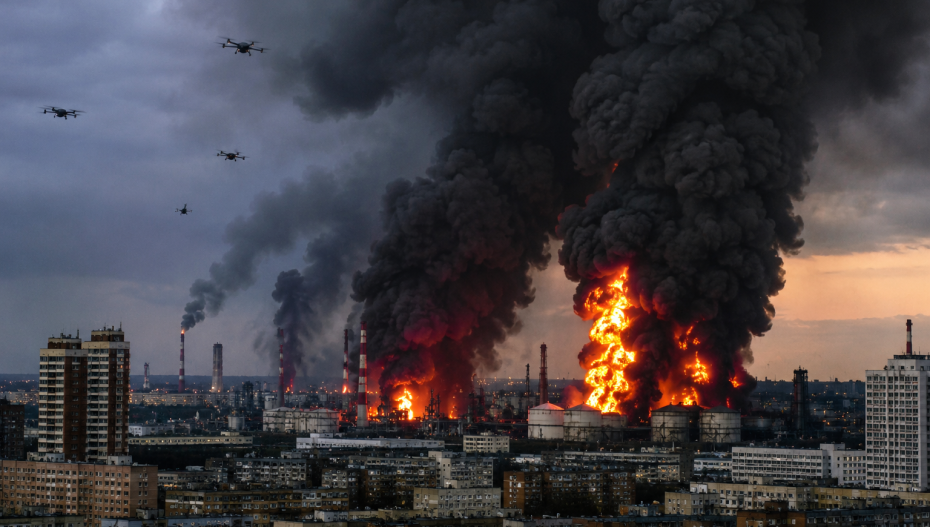
Moscow witnessed one of the largest Ukrainian drone attacks since the start of the full-scale war, with nearly 200 drones launched towards the Russian capital. The attack caused fires, damaged key infrastructure, disrupted air travel and left residents alarmed as thick black smoke rose over parts of the city.
One of the main targets was the Kapotnya oil refinery in south-east Moscow. The refinery was hit for the third time in a month and for the second time in the same week. Videos circulating online showed a huge explosion at the site, with the top of a large oil storage tank being blown off and thrown dozens of metres into the air.
Following the strike, large columns of black smoke could be seen rising high into the sky. Residents living nearby reported seeing a light drizzle that left black oily spots on clothes and other surfaces. Some people described finding small black specks on jackets and other belongings after stepping outside.
However, Moscow authorities denied reports that “oil rain” had fallen over the city. At the same time, the city’s official Telegram channel advised residents in the affected district to keep their windows closed. Families with children, elderly residents and people suffering from asthma were urged to leave the area as a precaution.
According to Moscow region Governor Andrei Vorobyov, at least 17 people were injured during the attacks. A nearby shopping centre also caught fire, reportedly after debris from a drone fell onto the building.
Several videos posted on social media showed drones flying over Moscow in broad daylight and explosions taking place in industrial areas on the outskirts of the city. One verified video showed a drone crashing into the upper floors of a high-rise building, sending glass and debris falling into the courtyard below.
Another video showed a dark oily coating covering part of a car park, while the ground beneath parked vehicles appeared untouched.
Many residents described frightening experiences during the attack. One woman said she noticed black spots appearing on her clothes after stepping outside. Another resident living near the refinery said he woke up at dawn when his building started shaking. He later smelled burning in the air and struggled to breathe.
Russia’s Defence Ministry said that almost 1,000 drones and four Ukrainian cruise missiles were intercepted and destroyed across the country within 24 hours. However, some drones still managed to reach their targets. In Russia’s southern Rostov region, an oil depot was struck and one person was killed.
The attacks also caused major disruption to air travel. Moscow’s four airports were temporarily closed, while more than 500 flights were either delayed or cancelled.
Ukrainian President Volodymyr Zelensky said the drone strikes were a response to a recent Russian attack on Kyiv that damaged the historic Pechersk Lavra monastery. He said Ukraine did not want the war but warned that if Ukrainian cities continued to suffer attacks, Russia would also feel the consequences.
In response, Russian Foreign Minister Sergei Lavrov said Russia would continue carrying out large-scale strikes against Ukraine, adding that words alone were no longer enough.
Military experts say Ukraine has increasingly used large numbers of reconnaissance and decoy drones to identify weaknesses in Russian air defence systems before launching major attacks. This strategy has become more common as Ukraine expands its long-range strike capabilities.
Drone attacks on Moscow, located around 500 kilometres from the Ukrainian border, have become more frequent over the past few years. Ukraine first successfully reached the Russian capital with drones in 2023, but those attacks involved only a small number of aircraft. Since then, both the number of drones used and the range of Ukrainian attacks have increased significantly.
Although Russia has strengthened air defences around Moscow, experts note that no defence system can completely stop large-scale attacks involving hundreds of advanced drones. Even when drones are intercepted, falling debris can still pose serious risks on the ground.
The latest attack is likely to raise new questions about the effectiveness of the air defence systems protecting Moscow and its critical infrastructure.
Meanwhile, Ukraine reported that Russia launched more than 200 drones and several ballistic missiles at Ukrainian targets overnight.
Russian President Vladimir Putin, who was attending a summit with Southeast Asian leaders in the city of Kazan, did not publicly comment on the attack.
Ukrainian Foreign Minister Andriy Sybiha later posted a message on social media addressing residents of Moscow. He said many people were asking what was happening in their city and argued that Russia’s invasion of Ukraine had brought the consequences of war closer to ordinary Russians.
More than four years after Russia launched its full-scale invasion of Ukraine, the conflict continues to intensify, with both sides carrying out increasingly large drone and missile attacks far beyond the front lines.
Also Read: Trapped Between Russia And Ukraine, Morbi Man Seeks Indian Government’s Intervention With Putin https://www.vibesofindia.com/trapped-between-russia-and-ukraine-morbi-man-seeks-indian-governments-intervention-with-putin/