


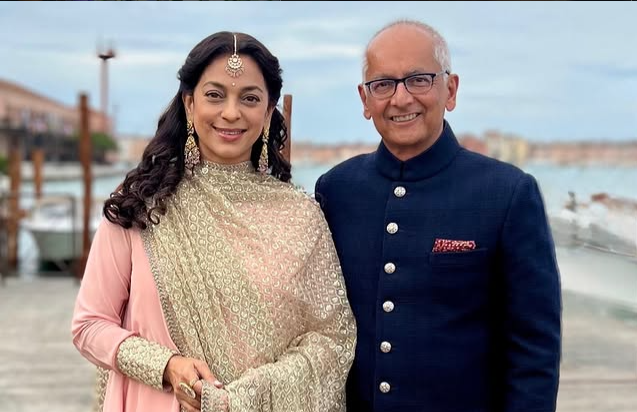
Today, actor and entrepreneur Juhi Chawla is counted among the wealthiest personalities in the Indian entertainment industry. According to the Hurun Rich List, she has an estimated net worth of ₹7,790 crore. Her husband, businessman Jay Mehta, is linked to a business empire valued at nearly ₹17,500 crore. While many people associate the family’s wealth with their former stake in the IPL franchise Kolkata Knight Riders, the foundations of the Mehta fortune were laid long before cricket, Bollywood, or modern corporate India entered the picture.
The story begins more than a century ago with a young boy from Porbandar who left home in search of opportunity and went on to build one of East Africa’s largest business empires. His name was Nanji Kalidas Mehta. His life was defined by courage, vision and perseverance—and according to accounts from business leaders, there was even a time when the newly formed Gujarat government reportedly relied on his financial support during a period of crisis.
A Little-Known Chapter in Gujarat’s Early History
When Gujarat was carved out of the erstwhile Bombay State on May 1, 1960, it marked a historic moment for the region. However, statehood also brought immense challenges. The division of Bombay State into Gujarat and Maharashtra left the newly formed Gujarat government with the difficult task of establishing its own administrative and economic framework.
Many of the major industrial and financial centres remained in Maharashtra, and Gujarat suddenly found itself facing severe financial pressures. The government reportedly struggled to manage day-to-day expenses and meet financial commitments.
According to Satishbhai Vithalani, Chairman of the Lohana International Business Forum, Gujarat’s financial situation had become so difficult that the government faced a payment crisis and reportedly struggled to pay its employees.
Speaking on Sagar Kathrotiya’s podcast, Vithalani recalled a story that has rarely found its way into mainstream history.
He said that Nanji Kalidas Mehta, who had built a vast business empire overseas, came to the state’s aid during this challenging period. As per accounts within the community, the Gujarat government reportedly borrowed money from him to meet its obligations.
If true, it was an extraordinary moment—one where a businessman who had left Gujarat as a young boy eventually found himself in a position to support the very state from which he came.
The 13-Year-Old Who Sailed Across the Ocean
Long before he became an industrial giant, Nanji Kalidas Mehta was simply a determined teenager from Porbandar.
At the age of just 13, he boarded a ship bound for East Africa in the early years of the twentieth century. The journey itself was daunting. He left behind the familiarity of home and arrived in Mombasa, Kenya, with little more than ambition and a willingness to work hard.
His early years in Africa were marked by struggle rather than success. He took up small jobs in shops, ran errands and learned the fundamentals of trade and commerce. Every task became an opportunity to understand how business worked.
What distinguished Nanji was his ability to think beyond immediate survival. While many were content with small trading operations, he saw opportunities in larger markets and emerging industries.
Gradually, he began trading textiles, grains and everyday commodities. The profits were modest at first, but they gave him the experience and confidence to think bigger.
Building an Empire in the ‘Pearl of Africa’
Nanji’s entrepreneurial journey eventually took him to Uganda, often referred to as the “Pearl of Africa.”
During the 1920s, he made a decision that many considered risky. He acquired land in Lugazi, a region that was largely swampy, undeveloped and lacking infrastructure. Most people saw challenges. Nanji saw potential.
He began cultivating sugarcane on the land, but his ambitions extended far beyond agriculture. He understood that real success lay in controlling every stage of production—from growing sugarcane to processing and distribution. It was a bold vision for the time.
In 1930, he established the Uganda Sugar Factory Limited, laying the foundation for what would become one of East Africa’s most successful industrial groups.
The project required enormous effort. Infrastructure had to be built almost from scratch. Roads, transport systems and processing facilities needed to be developed. Yet Nanji remained committed to his long-term vision. His gamble paid off.
Over the following decades, the enterprise expanded rapidly and diversified into numerous sectors. What began with sugar evolved into a sprawling business group with interests in agriculture, sugar manufacturing, cement, packaging, textiles, finance, insurance, real estate, energy and infrastructure.
His success transformed not only his own fortunes but also contributed significantly to industrial development across East Africa.
Never Forgetting His Roots
Despite building a thriving empire abroad, Nanji Kalidas Mehta remained deeply connected to India and especially to his hometown of Porbandar.
As his businesses flourished overseas, he continued investing in India. By the late 1920s, he had started building textile mills in Porbandar, creating employment and contributing to local economic development.
His business interests stretched across Africa and Asia, but his emotional connection to Gujarat remained intact.
For Nanji, success was not merely measured by profits. It was also reflected in the legacy he left behind for future generations and the communities that shaped him.
Swastik Bhavan: A Monument to a Dream
Perhaps the most visible symbol of Nanji Kalidas Mehta’s success is Swastik Bhavan, the grand residence he built in Porbandar in 1936.
Constructed as a sea-facing home for his extended family, the mansion represented a unique blend of traditional Indian values and international influences gathered during his years abroad.
Named after the auspicious symbol of prosperity and well-being, Swastik Bhavan stood as a statement of achievement while remaining rooted in cultural heritage.
The residence was extraordinary in both scale and design.
Built using limestone sourced from nearby quarries, the double-storeyed mansion featured Italian marble flooring, Japanese tiles, European Art Deco glass chandeliers and furniture imported from Africa. Surrounded by landscaped gardens and overlooking the sea, the property reflected the global outlook of a man whose life journey had crossed continents.
Every detail of the house told a story. It was not merely a luxurious residence but a symbol of how far a young boy from Porbandar had travelled—both literally and figuratively.
A Legacy That Lives On
Today, the business empire founded by Nanji Kalidas Mehta continues under subsequent generations of the family, including Jay Mehta. The group’s interests span multiple sectors, including sugar, cement, hospitality, infrastructure, real estate and sports.
While the family’s wealth often attracts attention because of its association with Bollywood and cricket, the real story stretches back more than a hundred years.
It is the story of a 13-year-old boy who left Gujarat with dreams and determination, built a vast industrial empire in Africa, invested in his homeland, and, according to community accounts, even helped Gujarat during one of the most challenging moments in its early history.
In many ways, Nanji Kalidas Mehta’s journey is more than a business success story. It is a reminder of how vision, resilience and a deep connection to one’s roots can create a legacy that endures across generations.
Also Read: Indian-Origin Agent Banned In Australia Over Fraud Findings https://www.vibesofindia.com/sydney-based-indian-agent-loses-licence-over-multiple-violations/