

A growing international investigation into the US fentanyl crisis has put Gujarat’s chemical industry, particularly businesses linked to Surat, under renewed scrutiny. US authorities have taken action against companies and individuals connected to the supply of chemical ingredients used by Mexican drug-trafficking networks to manufacture fentanyl.
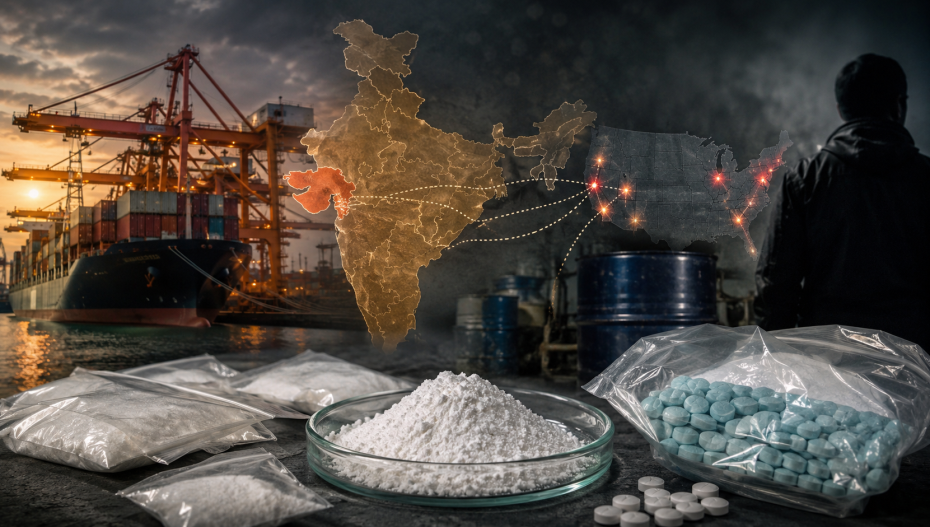
The developments point to a complex supply chain in which chemicals are moved through legitimate-looking commercial channels before being diverted for illegal drug production. Investigators say that as China tightened controls on several key chemicals, trafficking networks increasingly looked towards India for alternative sources.
At the centre of this emerging trail is Gujarat, one of India’s largest chemical manufacturing hubs.
Why Gujarat has entered the fentanyl investigation
Fentanyl itself has important legitimate medical uses. It is a powerful opioid used in controlled settings for severe pain, including during cancer treatment and surgery.
The concern is with illegally manufactured fentanyl and related substances. Even very small quantities of illicit fentanyl can be extremely dangerous, making the drug a major contributor to overdose deaths in the US.
US authorities have now identified entities linked to Gujarat’s chemical sector in cases involving the alleged supply of precursor chemicals to Mexican drug-trafficking organisations.
Investigators are particularly looking at precursors and pre-precursors — chemical building blocks that can eventually be used in the manufacture of fentanyl and its analogues.
The Surat connection
Surat has emerged as an important part of the investigation because of its large chemical manufacturing and trading ecosystem.
The city and wider Gujarat region have thousands of chemical units, along with pharmaceutical manufacturers, traders, distributors and intermediaries. This makes the state an important part of India’s chemical economy but also creates challenges for regulators trying to identify illegal diversion of legitimate industrial chemicals.
Investigators have alleged that some Gujarat-based businesses were involved in supplying chemicals that eventually reached drug-trafficking networks in Mexico.
One US case involved Surat businessman Sathishkumar Sutaria, associated with Surat-based Athos Chemicals. US authorities alleged that Sutaria and an associate were involved in using forged end-user certificates and other documents to facilitate shipments of controlled chemicals.
Another Surat-linked businessman, Bhavesh Lathia, associated with Raxuter Chemicals, pleaded guilty in a US case involving the distribution and smuggling of fentanyl precursor chemicals.
These cases have brought the Surat chemical trade into sharper focus internationally.
From China to India: How the supply chain changed
Investigators say the chemical supply chain began changing after China introduced tighter controls over several fentanyl-related substances.
China imposed class-wide controls on finished fentanyl-related substances and analogues in 2019. More recently, restrictions were tightened on additional precursor chemicals.
As the supply of certain chemicals from China became more difficult, investigators say trafficking networks began searching for alternative suppliers.
India’s huge chemical manufacturing base made it a potential source.
Gujarat is particularly significant because the state accounts for a large share of India’s chemical production and has thousands of chemical and pharmaceutical units. Major ports such as Mundra and Pipavav also provide access to international trade routes.
That combination of manufacturing capacity, trading networks and international connectivity has made Gujarat an important focus for enforcement agencies.
The chemicals are not illegal by themselves
An important distinction in the investigation is that many of the chemicals involved are not illegal products when used for legitimate industrial or pharmaceutical purposes.
The problem arises when legally manufactured chemicals are diverted into the illegal drug supply chain.
Some of the substances under scrutiny are pre-precursors, meaning they are further removed from the final drug than the immediate precursor chemicals. Investigators say traffickers have increasingly moved further back along the chemical supply chain as governments tighten controls on substances closer to the finished drug.
This makes enforcement more complicated because chemicals with legitimate industrial uses can be traded through apparently normal commercial channels.
US action against Surat-linked businesses
US authorities have already taken action against several individuals and entities connected to the alleged supply chain.
In April 2025, the US imposed sanctions on Surat-based Athos Chemicals, along with associated individuals and companies, over allegations concerning the supply of chemicals connected to fentanyl production.
The investigation also involved allegations of false or misleading end-user documentation, which can make it difficult for authorities to determine the ultimate destination and purpose of a chemical shipment.
In another case, US prosecutors said Surat businessman Bhavesh Lathia had been involved in distributing and smuggling precursor chemicals. He reportedly faced severe legal consequences under US law.
The cases demonstrate how an investigation that begins with Mexican drug cartels can eventually reach businesses thousands of kilometres away in Gujarat.
A major enforcement case from Surat
The investigation also connects with a Gujarat Anti-Terrorist Squad case involving Sathishkumar Sutaria and associates.
Investigators alleged that chemicals including certain fentanyl precursor substances were routed through intermediary companies and ultimately linked to Mexican drug-trafficking networks.
In one case cited by investigators, a shipment involving a precursor chemical was connected to a Mexican cartel. Authorities said the quantity involved had the potential to produce a very large number of lethal doses of fentanyl.
The allegations highlight why US agencies are examining not only finished drugs but also the international chemical supply chain behind them.
A 2025 US assessment pointed to India
The US Intelligence Community’s 2025 assessment on illicit synthetic opioids identified India as a growing concern in the procurement of precursor chemicals.
The assessment noted that China remained an important source of illicit chemical supplies but also pointed to India’s expanding role in the international chemical trade.
Investigators have also traced procurement networks that shifted from China towards India after Chinese restrictions made certain chemicals harder to obtain.
The shift does not mean that India’s legitimate chemical industry is involved in illegal activity. Rather, it highlights the difficulty of preventing legitimate industrial chemicals from being diverted by criminal networks.
The unusual Gwalior connection
Another part of the investigation concerns a chemical synthesis method developed by scientists at the Defence Research and Development Establishment in Gwalior.
A scientific paper published in 2005 described a simplified method for producing fentanyl. US enforcement records later identified similarities between the method and processes seen in seized material associated with Mexican trafficking organisations.
The significance of this connection is not that the research itself was illegal. The research was published openly and was intended for scientific purposes.
However, investigators say criminals later exploited publicly available scientific information while adapting their production methods.
For security reasons, the specific chemical recipe and production steps are not reproduced here.
Traffickers are moving further back in the chain
As authorities have tightened controls on chemicals directly used to make fentanyl, criminal networks have increasingly sought substances further away from the final product. This is a major challenge for regulators.
Instead of attempting to obtain a tightly controlled precursor directly, traffickers can look for less-regulated chemical inputs and rely on additional processing later.
Investigators say this has resulted in a constantly changing supply chain in which criminals modify their sourcing strategies whenever governments introduce new restrictions.
India faces a difficult regulatory challenge
The issue creates a difficult balancing act for India.
The country has a large and legitimate pharmaceutical and chemical industry. Thousands of businesses depend on the international movement of chemical products for manufacturing, research and medicines.
At the same time, regulators have to ensure that these same supply chains are not exploited by criminal organisations.
Industry representatives have raised concerns about unusual orders, unusually large quantities and transactions that do not match a company’s normal business activity.
Better documentation, stronger verification of buyers and closer coordination between agencies are therefore becoming increasingly important.
The global fentanyl crisis behind the investigation
The urgency of the investigation comes from the scale of the US opioid crisis.
US authorities say fentanyl is far more potent than heroin and morphine, and illegally manufactured versions have become a major cause of overdose deaths.
The crisis has pushed American agencies to investigate the entire supply chain — from Mexican trafficking organisations to chemical suppliers and international intermediaries.
That is why Gujarat, despite being far from the US drug market, has become part of a much larger international enforcement picture.
What the Surat trail shows
The emerging Surat connection does not suggest that Gujarat’s chemical industry as a whole is involved in fentanyl trafficking. Gujarat remains one of India’s most important centres for legitimate chemical and pharmaceutical production.
But the cases show how criminal networks can exploit the same global trade infrastructure used by legitimate businesses.
The investigation also highlights a changing pattern in the illegal fentanyl trade: when one source is restricted, traffickers look for another; when one chemical is controlled, they search for another building block further up the supply chain.
For India, the challenge will be to protect its legitimate chemical and pharmaceutical industries while making it increasingly difficult for international drug networks to misuse them.
The Surat connection has therefore become more than a local enforcement story. It is part of a much wider global battle over the chemicals, trade routes and networks that feed the world’s deadly fentanyl crisis.
Also Read: Ahmedabad’s Clean-Air Gains Fade As PM10 Pollution Rises Again https://www.vibesofindia.com/ahmedabad-pm10-pollution-rises-clean-air-progress-slows/