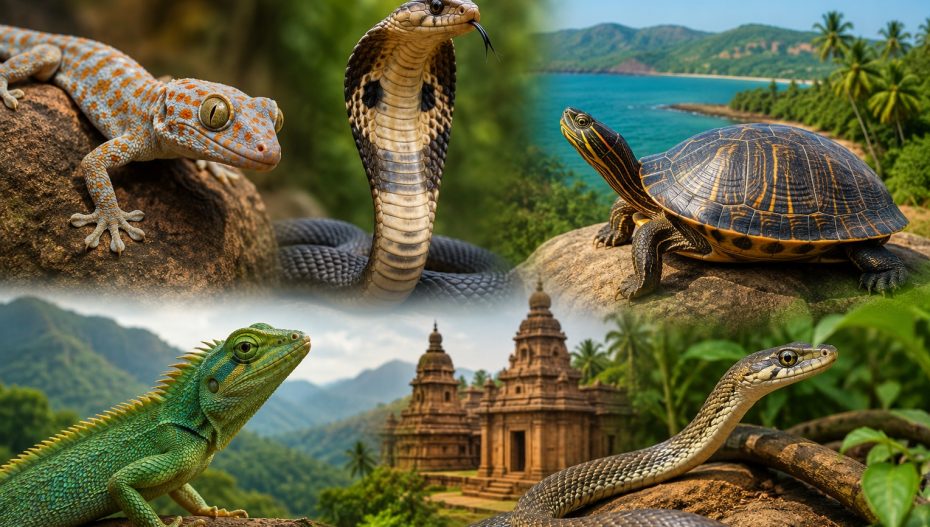
India’s reptiles are not only remarkable for their variety – their names also carry stories of people, places, languages, culture and even popular culture.
A new study examining the names of Indian reptiles has traced the origins and meanings behind the scientific names of 1,047 reptile taxa recorded in the country. The research brings together nearly 260 years of reptile naming, from the beginning of modern zoological classification in the 18th century to an updated list of species recorded up to July 2026.
Among the names are some surprisingly familiar references. One tiny gecko has been named after martial arts star Jackie Chan, while another species carries the name of Goa. Some reptile names come from Indian languages, local places, ancient languages and even mythology.
The study shows that scientific names, which may often look complicated, can actually tell fascinating stories about where a species was found, what it looks like, who it honours or how people understood it.
A Look at 1,047 Indian Reptile Taxa
Researchers from the Leibniz Institute for the Analysis of Biodiversity Change (LIB), Museum Koenig in Bonn, Germany, along with the German Herpetologist Peter Uetz and researchers associated with Virginia Commonwealth University, USA, examined the etymology — or origins — of Indian reptile names.
Their study covers 1,047 reptile taxa, spread across 178 genera, including 839 species and 30 subspecies. The species covered include:
431 lizards
35 turtles
370 snakes
Crocodilians and other reptile groups
The researchers used a comprehensive and updated list of Indian reptiles and examined where their scientific names came from.
The study was published in the international peer-reviewed journal Zootaxa.
Nearly 260 Years of Naming
The story begins with the development of modern zoological naming in 1758, when the formal system of modern zoological nomenclature began.
Since then, scientists have continued discovering, describing and classifying reptiles across India.
The researchers say their work brings together almost 260 years of reptile naming history, tracing names from the earliest period of modern classification through December 2025, with the species list updated to include records through July 2026.
This makes the study more than simply a list of names. It is also a record of how scientific understanding of India’s reptiles has developed over centuries.
Some Names Honour People
One of the most interesting findings is the number of reptile names connected to people.
The study identifies 226 species names as eponyms, meaning they were created to honour or commemorate people.
One of the most unusual examples is Jackie’s day gecko, Cnemaspis jackieii.
The small gecko was named after actor and martial artist Jackie Chan. The name was inspired by the animal’s remarkably quick movements. The gecko is known for moving rapidly across rocks and slipping into small cracks when approached — behaviour that researchers associated with Chan’s famous action sequences.
So, behind what appears to be a complicated scientific name is actually a simple story: a fast-moving gecko inspired a name associated with one of the world’s best-known action stars.
A Gecko Named After Goa
Another fascinating example is Cnemaspis goaensis, commonly known as the Goan day gecko.
As its scientific name suggests, the species is associated with Goa. It is also described as India’s second-smallest gecko species in the study material.
Names such as this are called toponyms, because they are derived from geographical locations.
The research found 215 species names that are connected to places, showing how strongly geography has influenced the naming of India’s reptiles.
Local Languages Also Leave Their Mark
Not all names come from Latin or Greek.
The researchers found numerous examples connected to local names and Indian languages.
The study identified 19 genera and 34 species whose names are linked to local names.
One example is the turtle genus Chitra. The name is connected to the Sanskrit word chitra, meaning colourful, referring to the distinctive pattern on the turtle’s body.
Another example is Batagur kachuga, the red-crowned roofed turtle. The genus name Batagur is linked to the Hindi word kachhua, meaning turtle, while kachuga is connected to a Sindhi word meaning cobra.
These examples show how local languages and traditional knowledge have become part of modern scientific classification.
Latin and Greek Dominate Scientific Naming
Although Indian languages have influenced many names, the traditional languages of science remain prominent.
The researchers found that 121 genera have names derived from Latin, while 85 are derived from Greek.
Latin and Greek have historically played a major role in scientific naming because they allow scientists from different countries and languages to use a common system.
Many species names also describe characteristics of the animal, its habitat, colour, appearance or behaviour.
This means a scientific name can sometimes provide a small description of the species itself.
From Scientists to Places and Culture
The researchers found several broad categories in the origins of Indian reptile names.
Some names honour scientists, researchers or other people. Others refer to places, while some come from local languages.
There are also names connected to mythology and other cultural references.
Modern popular culture has now entered this naming tradition as well. The Jackie Chan gecko is a striking example of how scientific naming can sometimes move beyond traditional Latin terminology and connect with contemporary society.
Why Do Scientific Names Matter?
At first glance, a scientific name may seem like a difficult combination of Latin words that only scientists understand.
But the researchers argue that these names can reveal much more. They can tell us:
Where a species was discovered
What the animal looks like
Which language influenced its name
Which person it honours
What local communities called it
What cultural or historical connection it has
In that sense, scientific names are also small pieces of history.
A name can preserve the memory of a researcher, record the location where an animal was found or carry a word from a local language that might otherwise be overlooked.
India’s Reptile Diversity Is Bigger Than the Names
The study’s 1,047 taxa also underline the enormous diversity of India’s reptiles.
India is home to a wide range of snakes, lizards, turtles and crocodilians, with particularly important reptile diversity in regions such as the Western Ghats, the Himalayas and the Andaman and Nicobar Islands.
Yet the researchers say the important question is not simply how many reptiles live in India.
It is also about what their names mean and where those names came from.
A Scientific Dictionary of India’s Natural History
From a tiny gecko named after Jackie Chan to reptiles named after Indian places, languages and traditional words, the study shows that India’s reptile names form a kind of historical record.
Behind every unfamiliar scientific term may be a person, a village, a landscape, an ancient language or a cultural reference.
The researchers’ work therefore does more than decode complicated names. It shows how science, geography, language and culture have come together over nearly three centuries to document India’s reptile diversity.
And sometimes, the story behind a scientific name can be just as fascinating as the animal itself.
Also Read: A Dry State, A Deadly Drink: How Methanol Turned Gujarat’s Prohibition Into Tragedy https://www.vibesofindia.com/gujarat-methanol-liquor-tragedy-9-dead-how-it-poisons-the-body/