


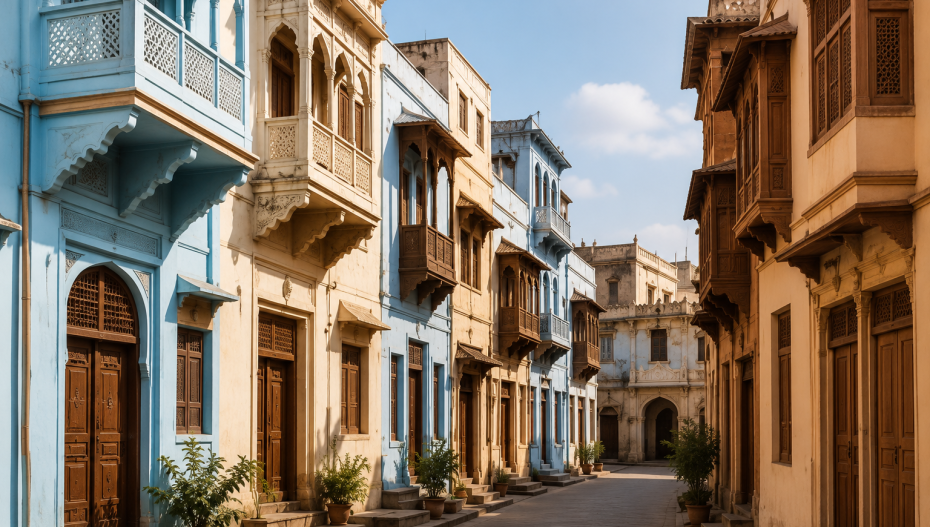
Ahmedabad, India’s first UNESCO World Heritage City, has introduced a new colour policy for its historic Walled City. The move places Ahmedabad alongside heritage cities such as Jaipur, known for its terracotta pink buildings, Paris with its cream limestone architecture, and Venice with its protected pastel shades.
Under the new policy, buildings within Ahmedabad’s Walled City and the surrounding 200-metre buffer zone can now be painted only in three colours—light sky blue, cream and light brown.
The Ahmedabad Municipal Corporation (AMC) said the decision has been taken to maintain visual harmony and create a uniform look across new developments in the heritage area.
Rule Applies to New Government and Private Buildings
AMC officials said the approved colours will be mandatory for all new government and private buildings in the heritage zone.
For heritage structures, owners will be allowed to use other colours only for carvings and decorative elements, while the main façade must follow the approved colour scheme. Officials said the aim is to preserve the heritage character of the Walled City while ensuring new buildings blend with their surroundings.
Heritage Assessment Made Mandatory
The civic body has also made Heritage Impact Assessment (HIA) compulsory before granting permission for any new government or private development project within the 6 sq km Walled City and the designated 200-metre buffer zone.
The assessment is intended to ensure that new construction does not negatively affect the city’s heritage.
UNESCO Visit Led to the New Policy
According to AMC sources, the policy was considered after a two-member UNESCO team visited Ahmedabad in March to assess the impact of major infrastructure projects on the Walled City’s living heritage.
The team reviewed the Kalupur Railway Station redevelopment, the Danapith multilevel parking project and the Geetamandir Bus Terminus project, all of which fall within the heritage buffer zone. The newly approved colours are likely to be used for these projects as well.
The UNESCO team is expected to submit a detailed report to the AMC.
New Guidelines for Future Development
AMC has registered more than 100 architects to carry out Heritage Impact Assessments. It has also introduced urban design guidelines, a design toolkit for new construction and an HIA policy.
A special subcommittee under the Heritage Conservation Committee has also been formed to speed up the scrutiny of HIA applications for non-heritage buildings in the Walled City.
More Measures to Preserve Heritage
The civic body has prepared a Standard Operating Procedure (SOP) for restoring the historic pol gates. It has also approved a proposal to establish an institute for the conservation and maintenance of historical and heritage properties across the country.
Ahmedabad’s Heritage Journey
UNESCO declared Ahmedabad a World Heritage City on July 8, 2017, making it the first city in India to receive the recognition.
The city has 2,692 listed heritage properties and another 382 properties on the tentative heritage list outside the Walled City. These properties are classified as Grade I, Grade II-A, Grade II-B and Grade III, with conservation rules applied according to their category.
AMC is also implementing the Heritage Tradable Development Rights (TDR) scheme to encourage restoration work. So far, 145 heritage properties covering 17,519 square metres have benefited from the scheme.
Also Read: Fatal Within Hours: Chandipura Returns To Gujarat, Claims Three Children’s Lives https://www.vibesofindia.com/chandipura-virus-gujarat-outbreak-children-deaths-explained/