For years, Gujarat, like many other states, has faced a difficult question: how can children be stopped from leaving school after middle school?
The state is now turning to Artificial Intelligence (AI) for an answer.
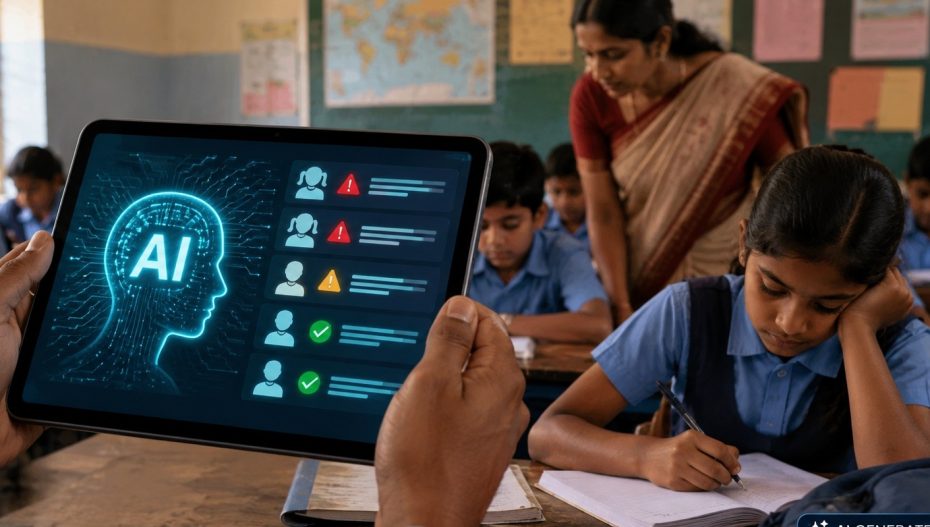
Gujarat has introduced an AI-based Early Warning System (EWS) designed to identify students who may be at risk of dropping out before they actually leave school. The system does not claim to solve the larger problems behind school dropouts, such as poverty, migration, child labour or family difficulties. Instead, its purpose is to identify warning signs early so that teachers and education officials can step in before a child disappears from the classroom.
The system has been developed by the Gujarat government in collaboration with Wadhwani AI and UNICEF India and has been integrated into the state’s existing Child Tracking System (CTS).
How the AI System Identifies At-Risk Students
The system works by analysing information already being collected about students in government and grant-in-aid schools.
The Child Tracking System has been collecting such information since 2022. The data includes several factors that can indicate whether a student may be struggling to remain in school, such as:
Attendance records
Student behaviour
Primary health information
Details about siblings
Parents’ attitudes towards education
Other information connected to a child’s schooling and family situation
The AI system studies these factors and generates a customised probability or risk alert for individual students.
The alerts can then be viewed through a dashboard by education officials at different levels, from senior officials in Gandhinagar to district-level education officers.
The idea is simple: instead of waiting for a child to stop attending school, the system tries to identify the problem while there is still time to act.
More Than 167,000 Students Flagged in 2025-26
The Early Warning System was deployed for the first time during 2025-26.
During that year, the system identified around 167,000 students across Gujarat as being at risk of dropping out. Of these, approximately 55 per cent, or 92,243 students, were girls.
For the current 2026-27 academic year, the system has identified another 118,000 students who may be vulnerable to dropping out.
These numbers do not mean that all of the students flagged by the system will necessarily leave school. Instead, they are being identified as children who may require additional attention, counselling or support.
Dropout Problem Becomes Serious After Class 8
Gujarat’s primary-level school retention picture is relatively strong. The state reports zero dropouts at the primary level, compared with a national average dropout rate of 0.3 per cent.
However, the situation changes as children move into higher classes.
For Classes 6 to 8, Gujarat’s dropout rate is around 4.8 per cent, compared with the national average of 3.6 per cent. This represents roughly 148,000 children.
The problem becomes much more serious in Classes 9 and 10. The dropout rate rises sharply to 15.7 per cent, significantly higher than the national average of 9.5 per cent.
At this stage, the number of children leaving school rises to around 275,000.
The overall picture is even more concerning: only about 54.5 per cent of children who enter Class 1 in Gujarat remain in school until Class 12.
A Real Example: How Early Intervention Helped One Girl
The system’s purpose can be seen through the experience of Mittal Solanki, a 13-year-old Class 8 student from Haradri village in Anand district.
Mittal had remained absent from school throughout June 2025, which led the Early Warning System to flag her as being at risk.
Instead of waiting for her to formally drop out, her class teacher, principal and local education officials intervened.
They spoke to her mother and tried to understand why she was not attending school regularly.
Mittal’s father had died when she was young, leaving the family in a difficult financial situation. While other members of the family worked to earn money, Mittal was increasingly expected to help with household responsibilities.
The school and education officials explained the situation to her mother and also informed her about the Namo Lakshmi scheme, under which a girl student can receive ₹10,000 a year to support her education.
The intervention appears to have made a difference. Mittal returned to school and is now attending Class 9 regularly.
For teachers and officials, such cases show how identifying a problem early can create an opportunity to intervene before a child permanently leaves education.
Teachers Still Remain at the Centre
Although AI is being used to identify warning signs, the system does not replace teachers.
Teachers are often the first people to notice changes in a student’s behaviour, attendance or performance. The difference is that the new system is designed to help them receive an alert before the situation becomes a full dropout case.
The state’s principal secretary for primary and secondary education, Milind Torawane, said teachers often know what is happening with children and counsel them, but intervention traditionally happens after the child has already stopped attending school.
The new approach aims to shift that intervention earlier.
Gujarat Continues Its Annual Enrolment Campaign
The AI system is being used alongside Gujarat’s existing efforts to reduce school dropouts.
Every year in June, the state conducts an enrolment campaign in which legislators, government officials and teachers visit communities and families to encourage children to remain in or return to school.
This year’s campaign also saw minister of state for education Rivaba Jadeja visit homes of children who had dropped out in the hilly villages of north Gujarat.
These efforts are intended to address the problem directly at the family and community level rather than relying only on administrative data.
AI Cannot Solve the Root Causes Alone
Despite the potential of the new technology, activists and education workers caution that AI cannot address all the reasons children leave school.
Many dropout cases are connected to poverty, family responsibilities, migration, child labour, lack of support at home and concerns about the quality of education.
One activist working with the government said the state’s efforts were sincere but argued that technology alone would not be enough. According to the activist, deeper problems include teacher shortages and the quality of education, and solving these issues will require stronger political commitment.
The AI system can identify a student who appears to be at risk, but an alert by itself cannot solve the family’s financial problems or ensure that a child receives good-quality teaching.
A Shift From Reacting to Preventing
Gujarat’s new Early Warning System represents a shift in how the state is approaching school dropouts.
Instead of waiting for attendance to stop and then trying to bring children back, officials can now use existing student data to identify possible problems much earlier.
The real test, however, will be what happens after an alert is generated. If teachers, schools and local officials can respond quickly with counselling, financial support, academic help or assistance to families, the technology could become an important tool in keeping vulnerable children in school.
For Gujarat, the larger goal is not simply to predict who might drop out. It is to make sure that being identified as at risk leads to timely support—and ultimately gives more children a chance to complete their education.
Also Read: Missed Cut-Off By 1 Mark: Gujarat HC Backs GPSC Aspirant Over Arthashastra Question https://www.vibesofindia.com/gujarat-hc-gpsc-aspirant-one-mark-relief-arthashastra-answer/