


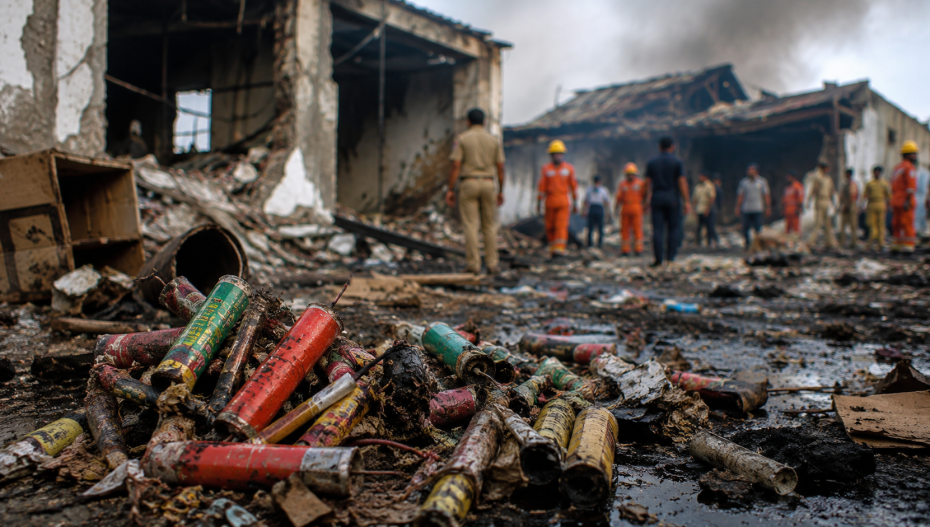
Three major firecracker factory explosions in Gujarat over the last 16 months have claimed 32 lives, exposing what appears to be a troubling pattern of repeat offenders continuing to run hazardous units despite previous criminal cases and police action. The latest tragedy in Ahmedabad’s Ramol has once again raised concerns about whether enough is being done to monitor and stop illegal firecracker manufacturing.
Latest Ramol Blast Leaves 10 Dead
The most recent explosion took place on July 18 at an illegal firecracker unit in Ramol, Ahmedabad, where a powerful blast killed 10 people and left five others critically injured.
During the investigation, police found that one of the accused, Sadik Saiyed, had already been named in another firecracker factory explosion that occurred on June 27 in Kapadvanj, where one worker had died.
Investigators said Saiyed had gone into hiding after the Kapadvanj incident before allegedly joining Ramila Dodiya and Mehul Dodiya in operating the Ramol factory.
According to records accessed during the investigation, the Ramol unit had started functioning nearly 20 days before the explosion, reportedly after the accused had secured fresh orders for firecrackers ahead of the Ganesh Chaturthi festival.
Workers Shifted From Earlier Blast Site
Police suspect that nearly 14 workers who had earlier worked at the Kapadvanj unit were shifted to the Ramol factory before the explosion.
Investigators also believe that, like the Kapadvanj factory, the Ramol unit was operating without the required permissions and licences, making it an illegal manufacturing unit.
This has strengthened suspicions that those involved continued running hazardous businesses despite previous accidents and criminal investigations.
Link to the Deadly Deesa Explosion
The Ramol tragedy has also revived memories of the devastating Deesa firecracker factory blast in April 2025, one of Gujarat’s worst industrial disasters in recent years.
That explosion killed 21 workers, many of whom had travelled from Madhya Pradesh in search of employment.
Investigators had found that the main accused in the Deesa case, Deepak Mohnani, along with his father Khubchand Mohnani, had allegedly recruited workers from Harda district in Madhya Pradesh. Ironically, many of these workers had survived the deadly Harda firecracker factory explosion in February 2024, where 11 people lost their lives, only to die later in the Deesa tragedy after moving to Gujarat for work.
Police had also found that Deepak Mohnani was already an accused in the Harda explosion and had earlier been booked by Gujarat Police in a betting-related case.
Questions Over Monitoring of Repeat Accused
The repeated involvement of individuals previously linked to explosions has sparked fresh debate over how closely authorities monitor repeat offenders.
Investigators have pointed out that despite earlier criminal cases, there appears to have been no detailed scrutiny of the accused persons’ activities, allowing them to continue operating illegal firecracker units.
The latest incidents suggest that people facing serious allegations were still able to set up new manufacturing units and recruit workers without attracting immediate attention from enforcement agencies.
Ramol Factory Had a Troubled History
Police records show that Ramila Dodiya, one of the accused in the Ramol case, had also been named in a 2014 firecracker factory explosion, in which a 14-year-old boy was killed.
Although her licence was cancelled after that incident, investigators said a new licence was later obtained in 2020 in the name of her son, Mehul Dodiya.
Authorities had also shut the Ramol premises in March this year, but investigators believe the owners resumed operations when police resources were diverted to security arrangements for the Jagannath Rath Yatra.
Pattern of Illegal Operations Raises Safety Concerns
The three explosions—in Ramol, Kapadvanj, and Deesa—have highlighted recurring concerns over illegal firecracker manufacturing, weak regulatory oversight, and the continued operation of hazardous units despite previous accidents.
With 32 people losing their lives across these three incidents in just over a year, the focus has now shifted to whether stronger monitoring, stricter licensing checks, and faster action against repeat offenders can prevent similar tragedies in the future.
The investigations into the Ramol explosion are still underway, while authorities continue to examine possible links between the accused involved in multiple firecracker factory accidents across Gujarat.
Also Read: Gujarat In Education ‘Red Zone’ As School Dropout Rate Crosses 15% https://www.vibesofindia.com/gujarat-in-education-red-zone-as-school-dropout-rate-crosses-15/