


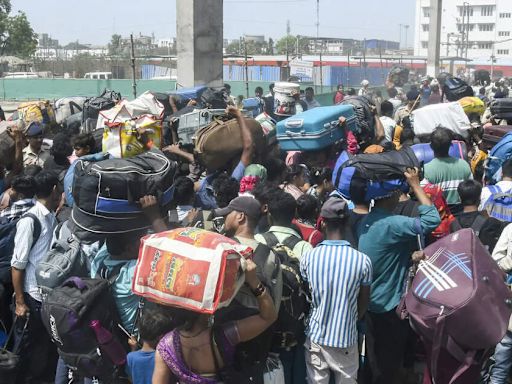
The first passengers began arriving at Udhna Junction on Saturday afternoon. By the time the day closed, Udhna Junction railway station became a sea of migrant workers from Surat’s textile and diamond industries.
They slept on floors and rested with their backs against walls. It had become a long, ardous wait for trains that were hours away. Heat distress and crowd control failures forced authorities to scramble for emergency measures. By Sunday morning, the queue outside had stretched to more than three kilometres.
What unfolded was not just a logistics failure. It was a reminder that crowd management at India’s busiest migrant transit points is not a secondary concern. It is the difference between order and tragedy
For context, the city’s textile mills and diamond-cutting units had been slowing for weeks. Input costs had climbed, market demand had softened, and an LPG shortage (traced back to the conflict in West Asia) had added pressure that many small factory owners couldn’t absorb.
Workers had been heading home since mid-March. Then the schools announced their summer break, and the trickle became a wave.
More than 22,000 people converged on Udhna Junction on the night of April 19, all of them wanting the same thing: a train home. There were simply not enough trains.
Six services had been scheduled for Sunday morning, running to Jaynagar, Madhubani, Brahmapur and other destinations. The first had left as early as 1.10 am, a train to Brahmapur in Odisha, followed by services to Jaynagar in Bihar at 1.30 am and Madhubani at 5.30 am.
Another Jaynagar train departed at 8.35 am, a Thane service at 10.20 am. But six trains cannot carry 22,000 people. The crowd had spent the night on the station premises, in the heat, with very little water. At least two people fainted. Somewhere in that crowd was a man carrying his wife’s ashes, waiting for hours, unable to board.
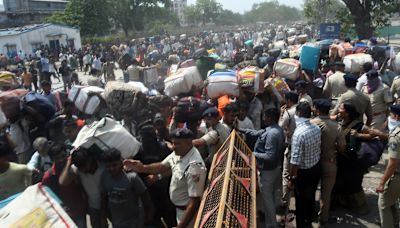
The breaking point came at 11.35 am. A train to Hasanpur in Uttar Pradesh was preparing to leave. The crowd surged. Passengers climbed the barricades, broke through security cordons, and rushed the platform. They simply were not willing to miss that train.
Given how long some had already waited, it is hard to entirely blame them. Security staff were overwhelmed. More police were called in from across Surat city. Lathi charges were used to push the crowd back.
Out of control
Western Railway later said there was no stampede. They mentioned it was just a brief disturbance caused by a small group of unruly individuals. The on-ground reality, reports highlighted, was somewhat starker. The crowd was completely out of control.
There was respite only after the arrival of reinforcements from Surat city police.
Once the situation appeared stable, officials in Mumbai were contacted and emergency arrangements were made. The Bandra-Gorakhpur express was halted at Udhna at 1 pm, and a large number of passengers boarded. A second train, from Valsad to Mau, stopped at 4.05 pm.
Those who still couldn’t get on were told to wait. They would be on a train by Monday morning. Western Railway also had two more trains lined up to leave Sunday night.
Over 300 security personnel were on duty across the day. The deployment included two Deputy Superintendents of Police, four police inspectors and 150 GRP staff, alongside around 150 RPF personnel.
Western Railway Superintendent of Police Abhay Soni told a section of the media that the crowd went out of hand when a train halted at the station. He said security personnel would be increased at the station the following weekend.
By evening, Western Railway said more than 23,000 passengers had been seen off to their destinations. Passengers were advised not to trust unverified information and to wait for official announcements on additional services.
The advice rings a little hollow for anyone who spent 16 hours in a queue in April heat with no guarantee of a seat. Udhna has been here before: during Diwali, during Chhath, at the end of every season when Surat’s migrant workforce decides it is time to go home.
Western Railway has run as many as 77 special trains from this station in a single peak period, and it still hasn’t been enough.
The workers will come back, as they always do. And next time the schools close, or the factories slow, or something shifts back home that makes the journey feel urgent. The queues will form again.
Also Read: Surat’s Powerloom Industry On Ventilator Amid Labour Exodus, Rising Costs https://www.vibesofindia.com/surats-powerloom-industry-on-ventilator-amid-labour-exodus-rising-costs/