


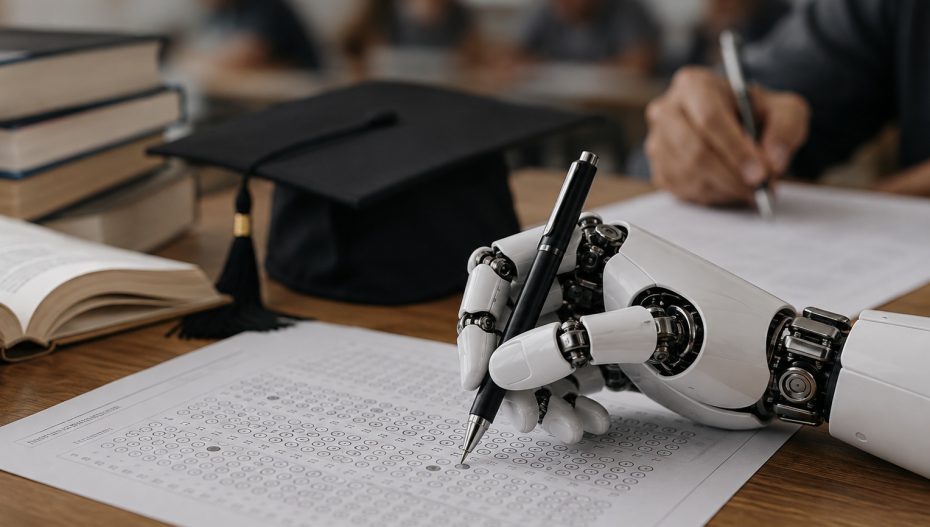
Questions are mounting over how several UGC-NET question papers were prepared after candidates reported unusual errors, poorly framed questions and possible use of artificial intelligence in the examination process. The controversy has become wider after concerns were raised over papers in subjects including English, Commerce and Sociology, with experts questioning whether the National Testing Agency (NTA) had adequate human checks in place before the papers were released.
The issue is not limited to a few incorrect questions. Candidates and subject experts have pointed to repeated questions, incorrect spellings of well-known scholars’ names, awkward translations, questions that appeared unrelated to the prescribed syllabus and, in some cases, answer options that were allegedly retained from earlier examinations.
At the same time, the NTA has denied that generative AI was used to prepare the disputed question papers and has maintained that the papers went through human review.
The controversy has also raised questions about why action was delayed after concerns about the papers emerged.
Questions Over the Use of AI
The controversy began with allegations that artificial intelligence was used extensively while preparing some UGC-NET examination papers.
Subject experts and people familiar with the examination process alleged that AI was used not only for preparing questions but also for translating examination material. According to these claims, the scale and nature of errors suggested that machine-generated or machine-assisted material may not have received sufficient human scrutiny.
The allegations are particularly significant because questions prepared for a national-level examination are expected to go through several stages of expert review before being given to candidates.
However, NTA Director General Abhishek Singh denied that generative AI was used to author the disputed papers. He said the papers were subjected to a “human review” after they were prepared.
When asked about how the errors could have remained unnoticed despite this review, he did not provide a detailed explanation.
This has left one of the central questions unanswered: if AI was not responsible for creating the papers, how did so many unusual errors make it through the examination’s review process?
Experts Question How the Papers Were Prepared
According to people familiar with the process, a panel of around four to five experts is generally involved in preparing a question paper.
The experts select questions, and questions from previous years are also considered as part of the process. But the unusual number of questions that appeared to come from earlier papers has raised concerns about how carefully the final papers were checked.
One major concern is that examiners appeared to have questions available for the subjects they were responsible for setting. If the people reviewing the papers did not have access to properly prepared questions or did not identify the problems during review, questions remain over how the final papers were approved.
Experts have therefore asked for greater clarity on the complete process, including:
Who authorised the use of AI, if it was used at any stage?
What tools or software were used to prepare or translate questions?
Were the questions independently checked by qualified subject experts?
How many levels of human review were conducted before the papers were finalised?
Who was responsible for approving the final question papers?
These questions have become particularly important because the examination affects thousands of candidates seeking eligibility for teaching and research positions.
Six-Week Delay in Cancelling the Papers
Another major issue concerns the delay in taking action after problems with the papers became known.
Education ministry officials and NTA sources indicated that there was a preference to cancel the three affected papers and conduct them again by the end of July or during the first week of August. However, the NTA did not immediately act on this advice.
The cancellation was eventually announced nearly six weeks later. By that time, provisional answer keys had already been released for 84 of the 87 subjects.
The delay has raised concerns among candidates who had already spent time preparing for the examination and were waiting for their results.
It has also raised questions about why the agency continued with the examination process despite concerns surrounding some of the papers.
Errors in the Sociology Paper
The Sociology paper attracted some of the strongest criticism from candidates and experts.
Candidates complained about mistakes involving the names of internationally recognised scholars. Some names were reportedly misspelled, while other questions contained awkward or incorrect translations.
Examples cited included the names of George Ritzer, Talcott Parsons and G.S. Ghurye being presented incorrectly. The name of Martha Nussbaum was also reportedly distorted.
Such errors may appear small on their own, but in a competitive examination they can create confusion for candidates, particularly when the question concerns a scholar’s name, theory or published work.
Candidates also complained that some questions appeared to have little resemblance to the prescribed syllabus.
This has led experts to question whether the paper was properly reviewed by specialists with adequate knowledge of the subject.
English Paper Raises Repetition Concerns
The English paper brought another problem to the surface: the alleged repetition of questions from earlier examinations.
Candidates claimed that around 67 of the 150 questions in the paper had appeared in an earlier UGC-NET examination.
Some candidates also alleged that not only the questions but even the sequence of answer choices had remained unchanged.
If established, such repetition could raise serious concerns about the originality and quality of the question paper. It could also create an unfair advantage for candidates who had previously appeared for the examination or had access to earlier papers.
The allegations have not yet been conclusively established, but they have added another layer to the controversy surrounding the examination.
Commerce Candidates Report Repeated Questions
Candidates appearing for Commerce also raised concerns about questions being repeated from previous examinations. The repeated questions reportedly included topics related to:
Taxation
Break-even analysis
Capital structure
Services marketing
The repetition has again raised questions about the process used to create and verify the papers.
Experts say that while concepts can naturally be repeated in competitive examinations, the concern becomes much more serious when questions are reproduced closely or without sufficient changes.
What Happened to the Answer Keys?
Another issue concerns the answer keys released for the examination.
Officials and sources indicated that the NTA released provisional answer keys for 84 subjects even though concerns had already emerged over the quality of some question papers.
This has led to questions over whether the answer-key process and question-paper review were being handled separately without sufficient coordination.
For candidates, errors in the original question paper can have a direct impact on the answer key and, ultimately, on their examination results.
Experts have therefore called for a transparent review of the complete process rather than simply correcting individual questions.
NTA’s Human Review Claim Faces Questions
The NTA has maintained that the disputed papers were reviewed by humans.
However, the controversy has shifted attention towards what “human review” actually involved.
If experts were involved in reviewing the papers, questions remain about why obvious spelling mistakes, translation problems, repeated questions and other errors were not detected before the examination.
A senior education ministry source indicated that when officials asked why the question papers had not been properly reviewed by experts, the response was that there were effectively no answers available to explain the situation.
This has increased pressure for greater accountability over the examination-setting process.
A Larger Debate Over AI in Examinations
The controversy has also opened up a wider debate about the use of artificial intelligence in high-stakes examinations.
AI tools can help with drafting, translation, organisation and other tasks. But national-level examinations require accuracy, subject expertise and careful human verification.
A faculty member from Jawaharlal Nehru University pointed out that the larger issue is not simply whether automated systems were used. The bigger concern is how much these systems were relied upon to translate, organise and assemble high-stakes examination material, and whether sufficient human academic review took place after that process was completed.
That question could become increasingly important as examination authorities consider using technology more extensively in the future.
NCERT Also Reworks Political Science Textbook Panel
The controversy comes at a time when the NCERT has also reconstituted its panel responsible for preparing political science textbooks for Classes XI and XII.
The new panel has 20 members, with the first two books expected to be ready by November.
The panel includes representatives and experts connected with institutions such as JNU, Delhi University, IGNOU and NLU Delhi, among others.
At least four members of the panel have links, either currently or in the past, with organisations associated with the Rashtriya Swayamsevak Sangh (RSS) or its affiliated bodies.
The development has added another discussion around the preparation of educational material and the importance of expertise, review and transparency in academic content.
Why the UGC-NET Controversy Matters
For students, the issue goes far beyond a few mistakes in a question paper.
UGC-NET is an important examination for candidates seeking eligibility for assistant professor positions and research opportunities. Many candidates spend months preparing for it, often while managing college, employment or other responsibilities.
When a question paper contains errors, repeated questions or unclear translations, candidates can be placed in a difficult position. Even a small mistake can affect how a candidate interprets a question and chooses an answer.
The controversy has therefore created a demand for a detailed examination of the entire paper-setting system.
The key issue now is not simply whether AI was used or not. It is whether the system had enough qualified human experts, proper verification and clear accountability to ensure that the final papers were accurate and fair.
Until those questions are answered, concerns over the UGC-NET examination process are likely to continue.
Also Read: Gujarat Widens Study-Abroad Aid: EWS Income Cap Raised To ₹10 Lakh https://www.vibesofindia.com/gujarat-study-abroad-aid-ews-income-cap-10-lakh/