


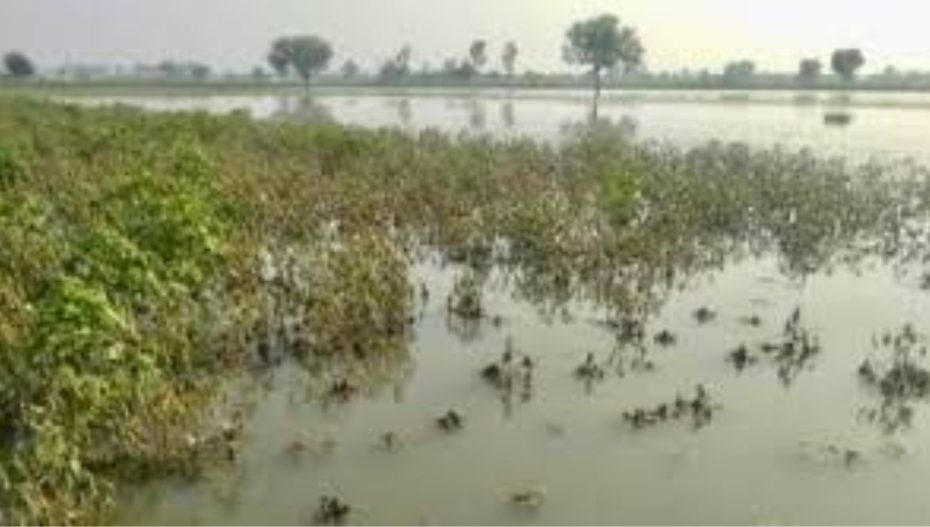
Unseasonal rains sweeping across Gujarat in late October have wreaked havoc on the state’s agriculture, leaving thousands of farmers staring at devastating crop losses.
The heavy and unexpected downpours not only damaged standing crops but also delayed the onset of winter, disrupting the natural rhythm of the agricultural cycle. For farmers who had prepared for the harvest season, the rain arrived as a disaster rather than relief, turning ripe yields of groundnut, soybean, and moong into ruined fields.
Unfortunately, this shift in weather has also affected new crop sowing, as the soil remains too damp and temperatures too high to sustain healthy germination. With over 16,000 villages across 249 talukas reporting losses, the unseasonal rain has emerged as one of the most widespread agricultural calamities in recent years — impacting nearly 90% of the state’s talukas and an estimated 10 lakh hectares of farmland.
Adding to the unusual weather pattern, the beginning of November — typically marked by a crisp chill and cool evenings — has instead brought warm, humid nights.
In a startling development, four cities in Gujarat — Bhuj, Disa, Kandla, and Veraval — have broken 56-year-old records for the warmest November nights. Bhuj registered a minimum temperature of 25.4°C, breaking the previous record set in November 1978. Kandla recorded 26°C, surpassing its 1969 record, while Veraval touched 27.6°C, eclipsing a mark from 1978. Ahmedabad too joined the trend, recording its warmest night in 15 years at 25.5°C — a temperature more typical of late summer than early winter. Meteorologists attribute this anomaly to persistent humid winds that trap heat near the surface, preventing night temperatures from dropping. Although a 2–3°C dip in minimum temperatures was forecast within 24 hours, the loss of November’s early chill has already marked a climatic shift that mirrors the distress felt by Gujarat’s farmers.
For thousands of cultivators, this unseasonal rain has come as the final blow after months of effort and investment.
The state government has acknowledged the scale of destruction. Preliminary assessments released by the Chief Minister’s Office (CMO) reveal that agricultural produce across most of Gujarat’s talukas has been affected.
In response, Chief Minister Bhupendra Patel visited villages in Junagadh and Gir Somnath districts to review the situation and meet affected farmers. “The government stands with farmers with compassion and commitment,” the CMO’s statement read, promising a “generous relief package” after the completion of loss surveys.
Over 4,800 survey teams have been deployed across districts to assess the damage, with nearly 70% of the work reportedly completed. However, farmers continue to urge for faster disbursal of compensation and more comprehensive measures, warning that partial aid may not be enough to recover from the massive blow.
Initially, the government had attempted to carry out digital assessments using satellite imagery and remote data collection. However, the system proved inadequate to capture the extent of physical damage to crops. Officials have now reverted to manual surveys, visiting fields to verify losses directly. “Digital surveys don’t work in such situations,” an official told an English language daily, explaining that the government’s earlier September circular — which mandated completion of digital assessments within 20 days — was temporarily suspended. Now, physical inspections are underway “on war footing,” with the aim to finalize relief calculations within days. The surveys are expected to conclude in most affected districts, especially in Saurashtra — the region hit hardest — by early this week, after which the government is expected to announce compensation measures.
While farmers grapple with the aftermath of the October downpours, the meteorological landscape continues to defy expectations. Data from the India Meteorological Department (IMD) shows that on Monday, the maximum temperature at 20 stations across Gujarat fell by 1 to 4.1°C compared to normal, even as minimum temperatures rose by as much as 8.4°C in some areas — a clear indication of trapped heat and humidity. Diu saw the sharpest increase in minimum temperature at 8.4°C above average, while Naliya recorded the largest drop in daytime temperature.
These imbalances have disrupted not just human comfort but also the agricultural calendar.
Typically, the arrival of winter in late October and early November provides the necessary conditions for sowing Rabi crops such as wheat, cumin, and mustard. But with high humidity and warm nights persisting, many farmers have been forced to delay sowing, risking reduced yields later in the season. The continued rainfall in early November has only aggravated matters.
On Monday alone, parts of Kutch, Bhavnagar, Vadodara, Bharuch, Mehsana, and Banaskantha received fresh showers, with Anjar recording a staggering 81 mm of rain — highly unusual for this time of year. The IMD’s forecast warns of more light to moderate rain and thundershowers in several districts including Anand, Panchmahal, Surat, and Gir Somnath, prolonging the uncertainty.
The unseasonal warmth has not gone unnoticed among Gujarat’s residents, who are accustomed to a marked chill by early November. For many, this year’s weather feels like an extension of summer. The IMD confirmed that four cities broke records standing since the 1960s and 1970s. Bhuj’s 25.4°C minimum surpassed its previous record of November 28, 1978, while Veraval’s 27.6°C overtook its 1978 mark of 27.4°C. Kandla’s 26°C minimum exceeded its record from November 10, 1969. Ahmedabad, though not breaking a half-century record, still saw its warmest night in 15 years at 25.5°C. Experts say that humid winds from the Arabian Sea are preventing the region from cooling after sunset, delaying the onset of cold air from the north.
The IMD expects a 2–3°C decline in minimum temperatures within 24 hours, which might restore some seasonal normalcy. However, this brief relief cannot offset the broader trend of warming winters and erratic rainfall — a pattern that scientists increasingly link to climate change. The combination of unseasonal rainfall, delayed winter, and rising humidity not only challenges agriculture but also underscores how fragile regional ecosystems have become in the face of global climatic shifts.
With the state government promising speedy aid and surveys nearing completion, there is hope that compensation will reach affected farmers soon. Yet, the message from this episode is clear: unseasonal rains and warming nights are no longer rare phenomena but signs of a changing climate. As Gujarat’s skies alternate between heavy rain and unexpected heat, the state stands at the crossroads of agricultural uncertainty — its farmers battling not just the weather, but a future that grows increasingly unpredictable.
Opposition Congress and AAP have been demanding fair and unprecedented compensation for the farmers, who have suffered losses like never before.
Also Read: Gujarat: HC Asks Insurance Companies To Compensate Farmers Against Their Crop Loss https://www.vibesofindia.com/gujarat-hc-asks-insurance-companies-to-compensate-farmers-against-their-crop-loss1/