


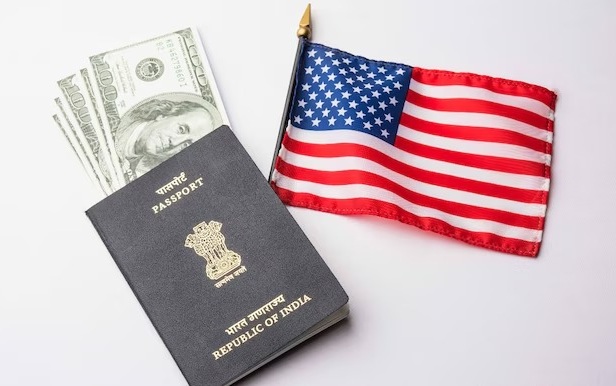
The US government is considering a major change that could affect H-1B visa holders and their spouses, particularly Indian families who have spent years waiting for permanent residency. The Department of Homeland Security (DHS) has added a proposal to its regulatory agenda that could eventually end the work authorisation currently available to eligible H-1B spouses.
However, there is no draft rule yet, no fixed deadline for its release and no final decision to end the programme. The proposal has been classified as a “long-term action”, with its expected timing listed as “to be determined”.
What Is the H-4 Work Permit?
The Employment Authorisation Document (EAD) for certain H-4 visa holders was introduced in 2015 under President Barack Obama.
It allows eligible spouses of H-1B workers to apply for employment authorisation if the primary H-1B visa holder is either already on the path towards a green card or has received an extension beyond the normal six-year H-1B limit.
The provision has been particularly important for families from countries such as India and China, where employment-based green card queues can stretch for many years.
For these spouses, the ability to work has provided an opportunity to build careers and earn independently while their families wait for permanent residency.
Nearly One Million Indian Spouses Have Benefited
The impact of the programme is particularly significant for the Indian community.
According to the analysis cited in the report, more than one million Indians, including dependants, were waiting in the first three employment-based green card categories as of December 2025.
For an Indian applicant whose employment-based immigration petition or labour-certification application was filed in January 2026 or later, the potential waiting period was estimated at 179 years for EB-2 and 38 years for EB-3 under the conditions analysed.
For families caught in such lengthy queues, the H-4 EAD has allowed spouses to remain professionally active instead of having to wait for permanent residency before they can work.
Why the Proposal Is Causing Concern
If the work authorisation is eventually eliminated, eligible H-4 spouses could lose an important route into the US workforce.
For families already facing years of uncertainty over green cards, losing the ability of one spouse to work could create additional financial and professional pressure.
The existing work authorisation has also allowed spouses to build careers, become self-employed, operate bank accounts and obtain driving licences.
Removing the employment benefit could therefore affect more than just a person’s job. It could also disrupt the independence and professional progress that many spouses have built during their years in the US.
The Change Is Not Final Yet
Despite the concern surrounding the proposal, the government has not yet issued a draft regulation.
Before the H-4 EAD programme could be eliminated, DHS would have to publish a proposed rule and open it for public comments. After considering those comments, the department would need to issue a final rule and establish an effective date.
The entire process could take several months, and any final rule could also face legal challenges.
This means the addition of the proposal to the regulatory agenda does not immediately remove existing work authorisation.
A Similar Attempt Failed in 2017
The possibility of ending the H-4 EAD is not entirely new.
Immigration attorney Jonathan Wasden urged H-4 EAD holders not to panic, pointing to an earlier attempt in 2017 to change the programme.
That effort did not become a final rule because of problems related to its economic-impact analysis.
Wasden also noted that if a new rule is eventually introduced, it could potentially apply prospectively. In other words, people who are already eligible for EADs would not necessarily be affected in the same way as future applicants.
Indian Families Face Particular Uncertainty
The possibility of removing H-4 work authorisation has caused concern within the Indian diaspora because many Indian H-1B workers remain in the US for years while waiting for employment-based green cards.
The long green card backlog means that some families can spend a significant part of their working lives in temporary immigration status.
For H-4 spouses, the EAD has provided a way to work and develop professionally during that period. If the programme were eventually removed, finding jobs or securing promotions could become more difficult for affected spouses.
The uncertainty is therefore not simply about losing an employment document. For many families, it could mean another layer of difficulty in an already lengthy immigration process.
What Happens Next?
For now, the H-4 EAD programme remains in place. The DHS action is at the regulatory-agenda stage and is described as a long-term action rather than a proposed rule. If the government moves forward, the process would involve:
Publishing a proposed rule
Allowing the public to submit comments
Reviewing those comments
Issuing a final rule
Setting an effective date
Any final decision could also face legal challenges.
For H-1B families, particularly those from India who are already dealing with exceptionally long green card queues, the proposal has nevertheless raised fresh concerns about their ability to work, build careers and plan their future in the United States.
Also Read: Applying For A US Visa? Incomplete Applications Can Now Be Rejected