

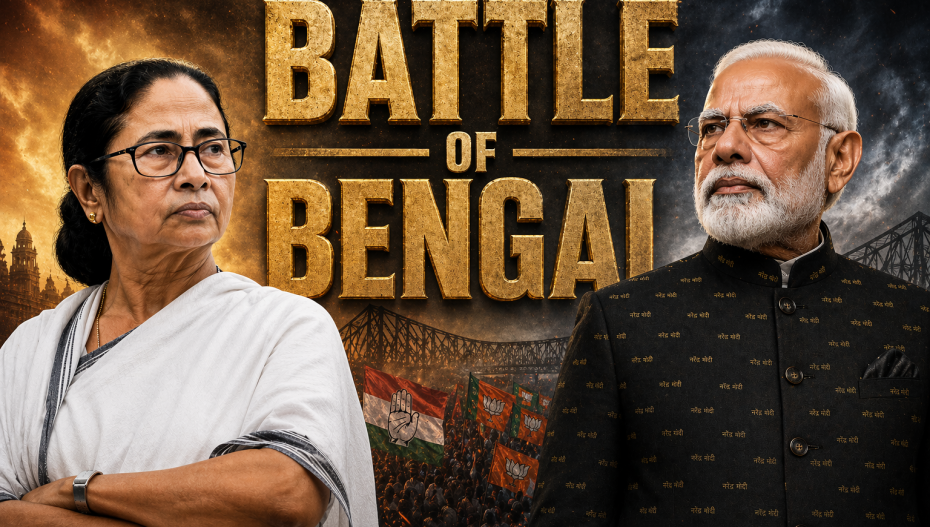
Both are supreme politicians. Both are obsessed with their own image. But when it comes to governing a state — and protecting its soul — Mamata Banerjee has something Narendra Modi will never understand about Bengal.
Let us begin with an uncomfortable truth that neither camp likes to hear: Narendra Modi and Mamata Banerjee are cut from the same flamboyant, impossible, exhausting political cloth. Both are children of India’s streets. Both rose without dynasty or inherited privilege. Both discovered early that the mirror is the most useful political tool in the subcontinent. And both have spent decades cultivating a persona so large, so consuming, that it has swallowed the parties they lead. In the BJP, no one matters but Modi. In the TMC, no one matters but Didi. This is not incidental. This is the design.
But as West Bengal prepares to vote in two phases — April 23 and April 29, 2026 — the battle between these two colossal egos is also a battle between two very different ideas of what power is for. The BJP has left no stone unturned to win Bengal. A victory of W Bengal is very important to garner confidence and morale amongst the workers and cadre of the BJP which suddenly finds that lady luck is not smiling much on Modi. On the other hand, for Mamata Banerjee too, this is a crucial election to win. Victory, even if it comes, is not going to be easy. And rightfully so. From the R G Kar medical rape case to blatant violations, Mamata is no novice when it comes to bending rules. This makes W Bengal elections all the more interesting.
Portrait of a Narcissist, Part One: The Man in the Gold-Threaded Suit
Narendra Modi’s narcissism is, by now, one of the most extensively documented features of Indian public life. Scholar Christophe Jaffrelot, writing for Himal Southasian, noted that BJP propaganda in Gujarat “portrayed Modi’s image constantly” — reflecting what he called Modi’s “narcissistic inclination” and his very high opinion of himself. Modi once appeared in public wearing a suit with his own name stitched repeatedly in gold thread across the fabric. His face adorns every government advertisement, every welfare scheme hoarding, every roadside banner — a feat of self-mythologisation that even Indira Gandhi, in her most imperial phase, never quite attempted.
But as historian Ramachandra Guha argued in Foreign Policy, Modi is not merely consumed by vanity — he is also part ideologue. The narcissism is layered over a genuine, deeply ideological Hindu nationalism cultivated since age eight in the RSS shakhas of Vadnagar. This makes him more dangerous than a simple ego-politician: the cult of personality and the civilisational project have become fused. Every electoral loss is not just a political setback — it is, psychoanalysts have noted, a narcissistic wound requiring retribution. The bulldozing of opposition governments, the weaponisation of the CBI and Enforcement Directorate against rivals, the relentless attempt to swallow West Bengal from Delhi — these are not merely political strategies. They are the reflexes of a man who cannot psychologically tolerate resistance.
The numbers confirm the obsession. Clashes were reported near Modi’s March 2026 Brigade Parade Ground rally in Kolkata. He has personally campaigned in Bengal more than any other Prime Minister in history, inaugurating connectivity projects worth ₹18,680 crore just weeks before the election — a Delhi-funded pre-poll blitz that Mamata has accurately described as “seasonal birds arriving to spread conspiracies.” For Modi, Bengal is not just a state to win. It is the last significant fortress of resistance to his total political hegemony, and its fall is necessary to complete the interior architecture of his self-image.
Portrait of a Tigress: The Woman in the White Sari
Mamata Banerjee’s narcissism is, if anything, more personally colourful. She refers to herself in the third person at rallies. She paints landscapes, writes poetry, and has been known to compose songs that are then sung at party functions. She built the TMC almost entirely around her own persona — there is no TMC ideology without Mamata, no TMC policy without Mamata’s approval, no TMC candidate list that does not reflect Mamata’s personal judgement. She lives, as Open The Magazine observed, by the principle that she has always understood “the power of the powerless” — but she also understands, with flinty precision, the power of being indispensable.
Political violence and muscle power
TMC’s reign in Bengal has been marked by endemic political violence. Opposition workers — Left, Congress, BJP — have been killed, displaced, and prevented from campaigning in large parts of rural Bengal. The culture of “cut money” (local TMC leaders extracting a percentage from government scheme beneficiaries) became so systemic that Mamata herself was forced to publicly acknowledge it in 2019. Booth capturing, ballot stuffing, and intimidation of voters have been documented across multiple elections by the Election Commission and independent observers.
The Abhishek problem
Abhishek’s rise has been no different than Jay Amit Shah’s rise. The institutionalisation of a family hierarchy in a party that was built on her personal struggle is widely seen as a contradiction she has never resolved.
Corruption at scale
The teachers’ recruitment scam — in which appointments to over 25,000 posts were allegedly sold for cash, with merit lists manipulated — resulted in arrests of senior TMC figures and a Supreme Court intervention. The Narada sting videos caught TMC leaders accepting bribes on camera. Sandeshkhali exposed local TMC strongmen allegedly running land grab and sexual abuse networks. These are not isolated incidents. They form a pattern of a party that captured the state and then treated its institutions as private property.
The RG Kar failure
The rape and murder of a trainee doctor at RG Kar Medical College in August 2024 became a defining moment — not just because of the crime itself, but because of the government’s response.
Authoritarianism within the party
The TMC like the BJP has no internal democracy. There are no party elections, no deliberative forums, no dissent tolerated. Mamata’s word is final on candidate selection, policy, and alliances. Leaders who have crossed her — Mukul Roy, Suvendu Adhikari among others — have been systematically marginalised and pushed to the BJP. The irony is that her most formidable opponents in Bengal today are her own former lieutenants, men who know the TMC machine from the inside.
Deindustrialisation and economic underperformance
Over 6,600 companies have moved their registered offices out of Bengal since 2011. Capital formation has fallen from 6.7 per cent in 2010 to below 3 per cent currently. Her declaration that the state would not acquire land for private industry — born from the genuine Singur-Nandigram moment — hardened into a structural disinvestment from industrial growth. Bengal’s debt-to-GSDP ratio is nearly 38 per cent, with outstanding debt projected to exceed ₹8.15 lakh crore. The welfare architecture she built is fiscally sustainable only with continued central transfers, which creates a permanent dependency. Forget the polarisation and saffron insistence on Hindutva, the only reason BJP can come to power is because the public believes that he would be better than Mamata when it comes to creating new jobs.
Yet Mamata’s narcissism carries a different texture. Where Modi’s self-regard translated into centralisation and institutional capture — the hollowing of the judiciary, the press, the Election Commission — Mamata’s self-regard has translated into hyperactive welfare delivery. She needs people to need her. And so, to satisfy that need, she has actually given them things. This is the crucial distinction.
Despite maintaining an austere personal life — living in her ancestral Kalighat home, wearing plain white cotton saris, travelling with a minimal entourage — she has constructed one of the most comprehensive welfare architectures of any Indian state. Kanyashree, her conditional cash transfer scheme for adolescent girls, was ranked the best among 552 social sector schemes from 62 countries by the United Nations in 2017. Child marriage rates have dropped. Girls are staying in school. Lakshmir Bhandar provides monthly cash transfers to over 2.41 crore women — a programme so embedded in Bengal’s domestic economy that its beneficiaries now treat it as a right, not a favour. The Swastha Sathi health insurance scheme covers up to ₹5 lakh per family. Khadya Sathi provides subsidised foodgrain. The Students’ Credit Card funds higher education.
The electoral consequence is stark. According to CSDS-Lokniti data, 53 per cent of women voters backed TMC in the 2024 Lok Sabha elections — 11 percentage points higher than in 2019. Among Muslim voters, who constitute roughly 27 per cent of Bengal’s electorate, TMC received 73 per cent of votes in 2024, a 13-point increase. These are not the numbers of a party in decline. They are the numbers of a welfare state that has, for all its corruption and violence, actually touched lives.
The Case for Mamata: Why Didi Is, Grudgingly, the Better Choice
The argument for Mamata over Modi in West Bengal is not an argument for sainthood. It is an argument about the appropriate scale of power and its appropriate use. Modi governs a nation of 1.4 billion; he has nationalised narcissism, made it a matter of civilisational identity, and in doing so has damaged institutions whose value is precisely their independence from any single personality. Mamata governs a state. Her narcissism is bounded by the limits of statehood — the Courts still function, the press still criticises (loudly), and the opposition, whatever its complaints about TMC muscle, still exists, campaigns, and contests.
More importantly, Mamata has actually governed. Bengal’s GSDP growth is projected at 7.62 per cent for 2025-26 — higher than the national average. The state’s unemployment rate stands at 3.6 per cent, well below the national figure of 4.8 per cent. The government claims to have lifted 1.72 crore people out of poverty and reduced unemployment for those aged above 15 by over 45 per cent in six years. One may argue about the methodology; one cannot argue about Lakshmir Bhandar’s 2.41 crore beneficiaries.
And then there is the matter of Bengali identity. Mamata has understood — with a shrewdness that has repeatedly confounded Delhi strategists — that Bengal is not UP. Hindutva, as a primary mobilisation frame, has limited traction in a state that worships Durga as a daughter, recites Tagore as scripture, and has a 200-year tradition of syncretic culture. The TMC’s 2021 slogan, “Bangla Nijer Meyekei Chay” (Bengal wants its own daughter), was a stroke of genius: it turned the election into a referendum on Bengali asmita (pride) versus Delhi imposition. The BJP won 77 seats on a wave of Hindu consolidation; Mamata won 213 on a wave of Bengali consolidation. Identity beat identity. And Mamata’s identity — the Kalighat daughter in a white sari — is authentically Bengali in a way that Modi’s saffron spectacles will never be.
Why 2026 Is Harder: The Shadows Over Didi
None of this means that the fourth term will be easy. Mamata is fighting with at least three sharp knives embedded in her political back.
The RG Kar atrocity — the rape and murder of a young trainee doctor at a Kolkata government hospital in August 2024 — shattered the TMC’s carefully curated image of women’s safety. Protestors took to the streets for weeks in what became one of the largest spontaneous civil society mobilisations in Bengal’s post-Left history. The anger was directed not just at the perpetrators but at an administration seen as slow, evasive, and more interested in managing the narrative than delivering justice. Anti-incumbency has crystallised around this event in ways that no welfare scheme can easily dissolve.
The teachers’ recruitment scam has sent several TMC figures to jail. The Sandeshkhali incidents exposed alleged abuse of power by local TMC leaders. The party’s debt-to-GSDP ratio is a sobering 37.98 per cent, with outstanding debt projected to exceed ₹8.15 lakh crore in 2026-27. Capital formation has cratered — from 6.7 per cent in 2010 to below 3 per cent currently. Over 6,600 companies, including 110 listed ones, have moved their registered offices out of Bengal since 2011. These are not BJP fabrications. They are the accumulated costs of a government that prioritised welfare spending over industrial investment, patronage networks over institutional reform.
The BJP, meanwhile, has found its sharpest attack vector yet. By framing the election around Hindutva and infiltration — with RSS chief Mohan Bhagwat making a prolonged visit to Bengal to organise at the grassroots — the party is attempting to peel away Hindu voters from the TMC’s coalition. Suvendu Adhikari, who defeated Mamata herself in Nandigram in 2021, provides the BJP with its most credible local face. The contest in Bhabanipur, Mamata’s own constituency, will be watched with unusual intensity.
Political analysts note that replicating the 213-seat sweep of 2021 — or even the 211 seats of 2016 — will be exceptionally difficult in 2026. A majority is achievable; a landslide is not. The TMC will likely win, but it will be a thinner, more contested victory. The era of the unchallenged Didi may be drawing toward its twilight.
The Verdict: Two Mirrors, One Very Different Reflection
History will be complicated about both of them. Modi will be remembered as a transformative force who rebuilt India’s global standing and also damaged its democratic foundations in ways that may take a generation to repair. Mamata will be remembered as the woman who broke the Left’s 34-year stranglehold on Bengal, delivered welfare at scale, and also presided over a culture of political violence and patronage corruption that she showed insufficient will to reform.
But in the immediate question of April 2026 — who should govern Bengal? — the answer is not difficult. A BJP government in West Bengal would be a government run from Delhi, by Delhi, for Delhi. The RSS’s involvement in this election is not the involvement of a civic organisation in democratic politics; it is the advance work of a civilisational project that has no particular interest in Bengal’s plural, syncretic, argumentative culture. Modi’s “Asol Poriborton” (Real Change) slogan is borrowed from the TMC’s own 2011 anti-Left campaign — a sign not of vision, but of strategic vacancy.
Mamata, for all her flaws, is Bengal’s. She was born here, fights here, loses here, wins here. Her narcissism is personal; his is imperial. Her corruption is retail; his operates at the wholesale level of state capture. And crucially: her welfare programmes have names that people say at their kitchen tables. Lakshmir Bhandar. Kanyashree. Swastha Sathi. These are not slogans. They are the lived reality of 2.41 crore women who would struggle without the monthly transfer in their bank accounts.
As a Gujarati, I am not sceptical but convinced that if the BJP gains power in West Bengal, they will slowly but steadily kill the inherent culture there and make it more in lines of Gujarat Model or the closerby Assam Model. From food to philosophy, the Right win would like to control the narratives and the reality, As a woman, I find Mamata Banerjee more dependable and non toxic.
One thing is for sure. Both Modi and Mamata are narcissists. One wants to own it. The other — for all her impossible, exhausting, infuriating complexity — actually belongs to it. Let us see who reclaims it.
Also Read: Public Money as Political Weapon: BJP MP Mitesh Patel’s Warning Raises Alarm in Gujarat https://www.vibesofindia.com/not-a-rupee-of-development-grant-if-you-dont-vote-us-bjp-mps-threat-in-gujarat/