


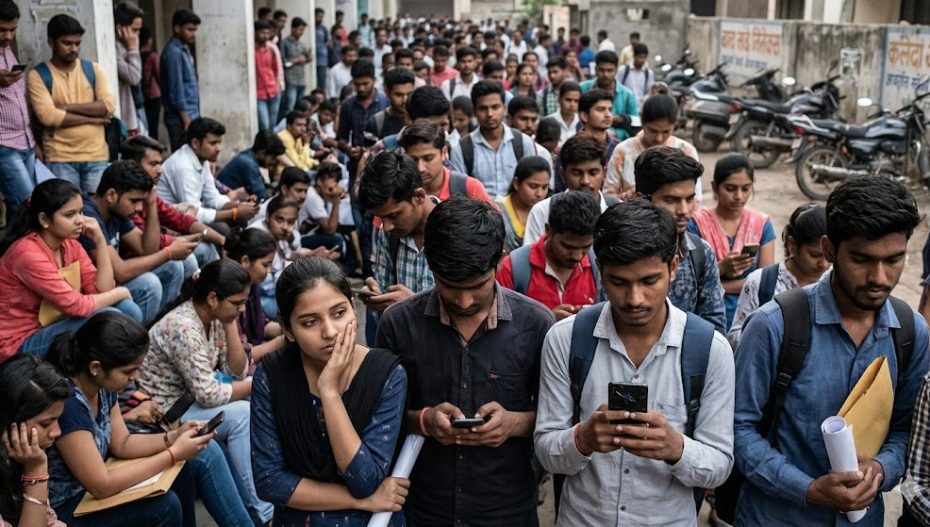
Every other day, I meet young people carrying impressive degrees and even bigger dreams. They walk in—smartly dressed, confident, articulate—but beneath the surface, you see the nerves: sweaty palms gripping folders, eyes darting as they rehearse answers, the hope in their voices mixed with a quiet desperation for a chance.
Since I mostly interact with youngsters from Gujarat, I increasingly see candidates with foreign degrees too. From US, the UK, Poland, the Philippines and even Ukraine. Their families have spent fortunes believing that education abroad guarantees dignity and opportunity. They first ask for jobs, sometimes hesitantly. You can hear the hope in their voices, but also the fear of rejection they’ve perhaps faced before.
When you tell them you cannot afford to hire, they ask for paid internships. And when even that isn’t possible, some—especially those from relatively financially comfortable families—quietly offer to work for free. I remember one young woman, her voice barely above a whisper, asking if she could just sit in the office and learn, so her parents wouldn’t see another blank space on her résumé. Or so that she is not married off early. That moment stays with me.
That is when reality hits hardest. Unemployment is no longer a statistic hidden inside government reports. It wears faces, shakes our hands, emails CVs at midnight, waits outside offices in the heat, refreshes LinkedIn feeds every hour. These youngsters are not lazy. They are not failures. They are sons and daughters, friends, sisters, brothers—people who once believed the world would welcome their talent. And they are certainly not “cockroaches,” as some powerful people casually describe ordinary citizens.
They are evidence of a failed system: an economy unable to produce meaningful jobs, an education model selling expensive dreams but no clear paths, and a society telling youth to work harder while shutting doors.
The tragedy is not just unemployment. The tragedy is watching ambition slowly negotiate with survival—watching bright eyes dim over months of rejection, seeing once-bold dreams shrink to just wanting a call back.
Chief Justice of India Surya Kant recently referred to these youngsters as cockroaches. “There are youngsters like cockroaches,” the CJI said, “who don’t get any employment or have any place in the profession. Some of them become media, some of them become social media, RTI activists and other activists, and they start attacking everyone.”
He had earlier called such people “parasites of society.”
Let us be precise about what happened here. The Chief Justice of India — the head of the institution that is constitutionally the last line of defence for every citizen against the state — described unemployed young Indians who criticise public institutions as cockroaches and parasites. In a courtroom. On the record. While hearing a petition.
The occasion was a lawyer’s aggressive pursuit of a Senior Advocate designation, and the CJI’s irritation at that conduct may well have been justified. But the CJI did not stop at the lawyer. He reached past him to offer a theory of why people become activists and critics of the system. And his theory was: they couldn’t get jobs, so they became pests.
The theory deserves to be tested against reality. The reality is not kind to it.
The Numbers the State Would Rather Not Recite in Court
India’s youth unemployment rate among graduates aged 20 to 24 stands at 44.5 per cent. Not 4.5 per cent. Forty-four point five. Nearly half of India’s young degree-holders are unemployed. This is not a figure from opposition pamphlets or activist websites. It emerges from the government’s own Periodic Labour Force Survey data.
The Centre for Monitoring Indian Economy, which runs an independent, continuous household survey, recorded India’s unemployment rate at 9.2 per cent in June 2024—an eight-month high. By March 2025, it was 7.2 per cent. The government’s preferred official figure, counting anyone who worked even one afternoon last quarter as “employed,” produces a tidier 3.2 per cent. The gap between these numbers illustrates the difference between statistical convenience and lived reality.
The PLFS itself, when using the current weekly status methodology — whether someone actually worked in the past week — put India’s urban unemployment at 6.8 per cent in March 2026. Youth unemployment across the 15-29 age bracket ran at 14 to 16 per cent through 2025. Urban female youth unemployment reached 25.7 per cent nationally. In Kerala, female youth unemployment computed from PLFS data stands at 47.1 per cent. In Lakshadweep, 79.7 per cent. These young women are not cockroaches. They are daughters who studied late under dim lights, who balanced family expectations and ambition. They are the unresolved consequence of a political economy that posted GDP growth numbers while quietly failing an entire generation.
The Promise That Never Came
In 2014, Narendra Modi promised to create 2 crore new jobs a year. Twelve years later, that promise has become one of the most consequential unfulfilled commitments in Indian political history. India’s unemployment hit a 45-year high of 6.2 per cent in 2018, four years into that first government. It has never sustainably recovered to what was promised.
When the government claimed it created 7.8 crore jobs in three years, the footnote revealed the truth: 37 per cent of the women in that data were unpaid family workers, helping on farms or in family shops—without wages, contracts, or prospects. Yet the government counted them. The government called it employment.
Make in India aimed to create 100 million manufacturing jobs by 2022 and lift manufacturing’s GDP share to 25 per cent by 2025. Manufacturing remains below 17 per cent of GDP. The 100 million jobs target has faded from official discourse, replaced by schemes with acronyms, press releases, and, when all else fails, Rojgar Melas — job fairs handing out 75,000 appointment letters to cheering crowds while 30 million seek work weekly.
A 2024 CSDS survey found that 62 per cent of voters believe it is now harder to find a job than five years ago. In urban areas, 65 per cent said so. The young voter who gave Modi landslide mandates in 2014 and 2019 had, by 2024, direct personal experience that contradicted the official story. Not ideology. Experience.
The Logic the CJI Did Not Follow to Its Conclusion
Here is the internal contradiction in what CJI Surya Kant said. If his diagnosis is correct — if unemployed youth with no place in the economy turn to criticism and activism out of frustration — then the cockroaches were made, not born. They were made by a system that takes their fees, gives them degrees, promises them a future and then has nothing for them. They are made by an economy that reportedly grows impressively and distributes that growth with remarkable selectivity. They are made by governments that announce schemes, hold rallies, claim credit, and leave the structural problem untouched.
If that’s true—and the data suggests it is—calling their response parasitism isn’t a legal observation. It is an attempt to pathologise a human reaction to failure by institutions meant to serve them.
The RTI Act, used by some activists to ask tough questions, was not smuggled into law. Parliament passed it in 2005. The Supreme Court has upheld it as key to accountability. The young person filing an RTI about a delayed recruitment exam or missing welfare funds is acting in accordance with the law envisioned. Calling him a cockroach suggests accountability is welcome in principle but inconvenient in practice.
What the Court Did Not Ask
On the day the CJI made his remark, the Supreme Court was not hearing a petition about unemployment. It did not examine why India’s graduate unemployment rate is 44.5 per cent, ask the government to account for the two crore annual jobs that never materialised, or scrutinise why manufacturing jobs—which lift people out of poverty in every country where they exist at scale—have not arrived in numbers to justify a decade of “Make in India” billboards.
It denied a lawyer a designation he pursued too aggressively, which is legitimate. But the Chief Justice’s explanation for critics and activists — unemployment, frustration, nowhere to go — lacked irony, acknowledgement that the court exists within a republic that has produced this exact situation, and recognition that the institution he leads is one that frustrated, unemployed, or displaced citizens are constitutionally entitled to approach.
The court that calls them cockroaches is the same court they have a right to petition.
A Final Reckoning India will add 12 million new workers to its labour force this year. Will the economy and more importantly the Prime Ministers’ favourite industrialists create 12 million formal jobs? The gap will be absorbed—as it has been for years—by the informal sector, by gig work, by the invisible armies of delivery riders, construction labourers and domestic workers who appear in no scheme’s success story. I see them every morning: a young man in a delivery uniform, degree in his pocket, dreaming of a desk job as he weaves through traffic; a young woman teaching tuition classes to neighbourhood children because no school is hiring. Some of the remainder, those with degrees and time and a smartphone, will go online and say something about it.
They can be called cockroaches. Or they can be understood as the predictable product of a political economy that promised them a place and did not provide one.
The Chief Justice chose the first option. The data supports the second. You can call them cockroaches, rodents, morons. Whatever you want. Other than social media, they have no avenue to express themselves. They are too scattered to unite and protest what they are called.
But, I would respectfully want to say that your Honour, these cockroaches have degrees. The question worth asking — from a bench, from a government, from anyone exercising power in this republic — why can’t we give them a better future?
Also Read: Food, Faith and Fascism in New India https://www.vibesofindia.com/food-faith-and-fascism-in-new-india/