report
The C-DEP Research and Center for WTO Studies, Ministry of
Commerce, today released its report titled “Impact of Anti-Dumping Duties in India”, which
examines the effects of Anti-dumping duties on downstream costs, inflation, MSMEs, domestic
capacity, and investments. The report was released by Shri Pritam Banerjee, Head, Center for WTO
Studies, Ministry of Commerce and was presented at a roundtable with leaders of India’s core
domestic industries. The event brought together industry leaders from sectors including chemicals,
polymers, textiles, and other manufacturing, whose domestic manufacturing capacities have been
deeply impacted by dumping from China and other countries. These domestic manufacturers
represent over 2 lakh crores of turnover.
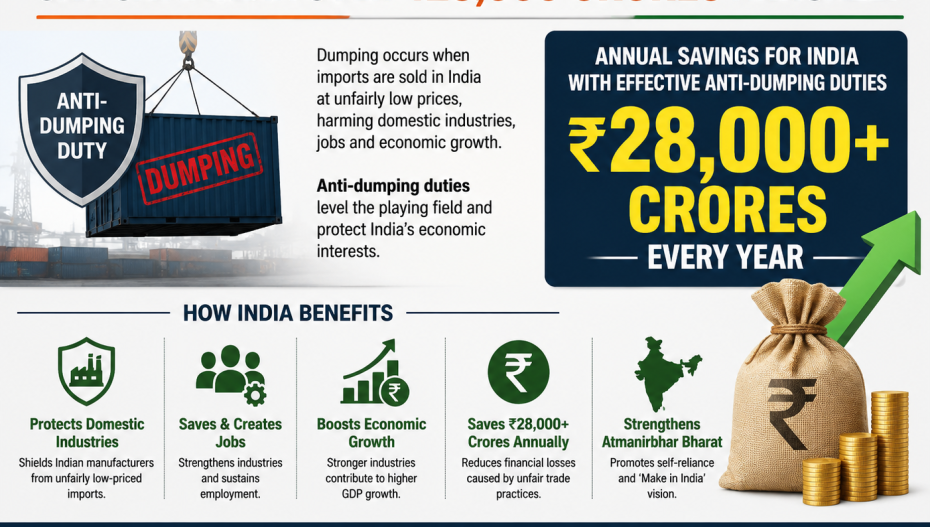
Anti-dumping duties are WTO-compliant trade-remedy instrument that is levied globally by
governments to safeguard their domestic manufacturers from predatory pricing by foreign
exporters, who dump the imported products at prices that are lower than the prices in their home
country.
The report estimates that Imposing anti-dumping duties on the current set of products that are being
evaluated by the government, would lead to an estimated annual forex saving of INR 28,540 crores
(USD 3 billion) and facilitate domestic investments of INR 70,000 crores. A study of 33 products
shows that economic loss from dumped imports in the current period is approximately 1.54 INR
lakh crore, and is projected to rise to between 2.68 INR lakh crore and 2.70 INR lakh crore by
2030, with jobs at risk increasing from around 24,000 today to 38,000–42,000. These findings
shows the long-term consequences on India’s economy and employment from import-driven market
distortions.
The report also finds that anti-dumping duties have negligible impact in downstream cost and has
immeasurably low impact on inflation. Analysis of 56 DGTR-recommended cases where duties
were not implemented indicates that the median effect on final consumer prices would have been
just 0.023 percent, with over 91 percent of cases below 0.10 percent. The inflation contribution of
21 pending anti-dumping duties products remains below 0.01 percentage points, even under a
conservative 50 percent pass-through assumption. This demonstrates that duties do not
meaningfully increase prices for end consumers while helping restore fair competition for domestic
producers.
The report highlights the disproportionate impact of non-implementation of anti-dumping duties on
MSMEs. Sustained dumped imports have forced shutdowns in sectors such as sublimation-transfer
paper, phone back covers, and Nylon Filament Yarn. Non-implementation of anti-dumping duties is
leading to catastrophic impact on domestic industries, including MSMEs, and has led to increased
import dependence and domestic capacity destruction. In contrast, timely anti-dumping duty
interventions in sectors such as cable ties, ceramic ware, and vacuum flasks have allowed domestic
MSMEs to sustain operations, expand production, and attract new investments.
Data analysed in the report shows that India is not misusing anti-dumping duties. On the contrary,
the USA and many other nations are using anti-dumping duties at a much larger scale than India.
The average duration of anti-dumping duties in India is 6.97 years, compared to the global average
of 11.19 years. Duty rates in India typically remain lower compared to countries such as the United
States and China, which have imposed duties as high as 632%. These practices have been consistent
with international norms, as India’s anti-dumping duty recommendations have always been upheld
in a WTO dispute.
The report indicates the need for immediate application of anti-dumping duties that have been
recommended by DGTR, in order to safeguard domestic capacities while reducing the outflow of
precious foreign exchange. It is detrimental for the Indian economy and the Rupee to allow dumped
imports in areas where India has sufficient domestic capacities. Timely imposition of anti-dumping
duties will also ensure adequate investments in domestic capacities today, prevent a large demand-
supply gap by 2030, reduce India’s dependence on imported goods and strengthen industrial resilience.
Also Read: Gujarati Woman Shot Dead in US Store https://www.vibesofindia.com/gujarati-woman-shot-dead-in-us-store/