


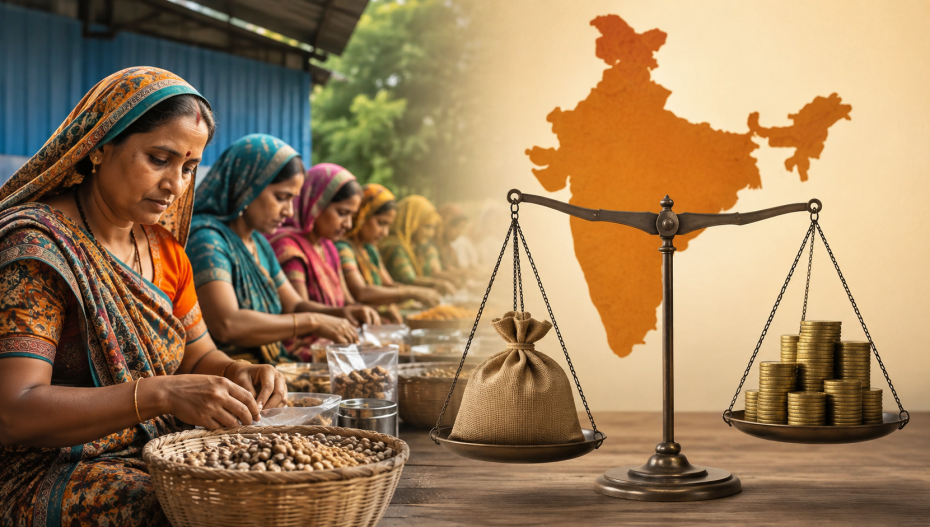
Gujarat has long been known for its strong cooperative movement, with women playing an important role in sectors such as dairy, agriculture, handicrafts, food processing and rural enterprises. Yet the state’s share of financial assistance meant for women-led cooperatives from the National Cooperative Development Corporation (NCDC) has remained remarkably small.
According to data placed before the Rajya Sabha by the Ministry of Cooperation, Gujarat received a total of just ₹1.01 crore in NCDC assistance for women cooperatives over five years. The figure becomes more striking when compared with the sharp rise in funding across other states and Union Territories.
In 2025-26 alone, NCDC assistance to women cooperatives across the listed states and UTs stood at ₹4,926.49 crore. Gujarat received only ₹25 lakh, or ₹0.25 crore, during the same year.
Gujarat’s Funding Remained Extremely Low
The data shows that Gujarat did not see a steady increase in financial support during the five-year period. The state’s annual assistance was:
2021-22: ₹0
2022-23: ₹50 lakh
2023-24: ₹26 lakh
2024-25: ₹0
2025-26: ₹25 lakh
Together, these amounts add up to ₹1.01 crore.
The pattern shows that Gujarat’s funding has remained at very low levels, with support falling to zero in 2024-25 before a small recovery in the latest financial year.
A Sharp Contrast With Other States
The difference becomes much clearer when Gujarat’s allocation is compared with funding received by other states.
In 2025-26, Andhra Pradesh received ₹4,200 crore, while Telangana received ₹500 crore. Rajasthan received ₹190.16 crore, Maharashtra got ₹35 crore, and Madhya Pradesh received ₹0.58 crore. Gujarat, by comparison, received only ₹0.25 crore.
Against the total assistance of ₹4,926.49 crore recorded for 2025-26, Gujarat’s share was only about 0.005%.
This creates a striking contrast between the scale of Gujarat’s cooperative economy and the amount of NCDC assistance recorded for its women cooperatives.
Funding Schemes Are Already Available
The low allocation does not appear to be because there are no dedicated schemes for women cooperatives.
The Ministry of Cooperation has several programmes aimed at supporting women-led cooperative enterprises and strengthening their access to finance.
These include the Swayam Shakti Sahakar Yojana, which supports women cooperatives, and the Nandini Sahakar Scheme, designed to promote women-led cooperatives in areas such as dairy, livestock and food processing.
There is also the Yuva Sahakar Yojana, which focuses on encouraging young entrepreneurs through cooperative institutions.
NCDC can provide different forms of financial assistance, including working capital loans, margin money and term loans, to eligible women cooperatives. The assistance can be provided either through state governments or directly to eligible cooperative organisations.
What Does It Take to Receive Support?
The available funding comes with eligibility conditions.
Generally, cooperatives seeking direct financing from NCDC are required to have been operational for at least three years. They must also have a positive net worth and should not have suffered erosion of their paid-up share capital.
Under the Yuva Sahakar scheme, eligible newer women cooperatives can also receive support, provided they have been operating for at least three months and meet the required conditions.
This means that both established and newer women-led cooperative organisations have potential avenues for financial support.
The Bigger Question for Gujarat
The numbers therefore raise an important question for Gujarat: If funding mechanisms specifically designed to support women cooperatives are available, why has the state’s recorded assistance remained so low?
Gujarat has a deep-rooted cooperative ecosystem and a large number of women involved in collective economic activities. From dairy and agriculture to rural businesses and food processing, women-led groups have significant potential to expand their enterprises when they have access to affordable finance, training and markets.
However, the NCDC figures suggest that this potential has not translated into a substantial share of the corporation’s women-cooperative funding in recent years.
A Funding Gap Worth Examining
The issue is not simply about the amount of money received in one financial year. The larger concern is the absence of a sustained funding flow.
Gujarat received ₹50 lakh in 2022-23, followed by ₹26 lakh, zero funding and then ₹25 lakh. Over five years, the total remained just ₹1.01 crore.
At the same time, overall assistance to women cooperatives across the listed states and Union Territories increased dramatically, reaching nearly ₹4,926.49 crore in 2025-26.
The figures point to a clear need to examine whether eligible women cooperatives in Gujarat are adequately accessing these schemes, whether more applications need to be facilitated, or whether there are administrative and eligibility-related barriers limiting access.
For a state with such a strong cooperative tradition, the extremely small NCDC funding recorded for women cooperatives presents a significant gap between the availability of national financing schemes and their reach on the ground.
Also Read: ‘A Day When India Has A ‘Biological’ Prime Minister’: Justice S. Muralidhar’s Vision For India 2047