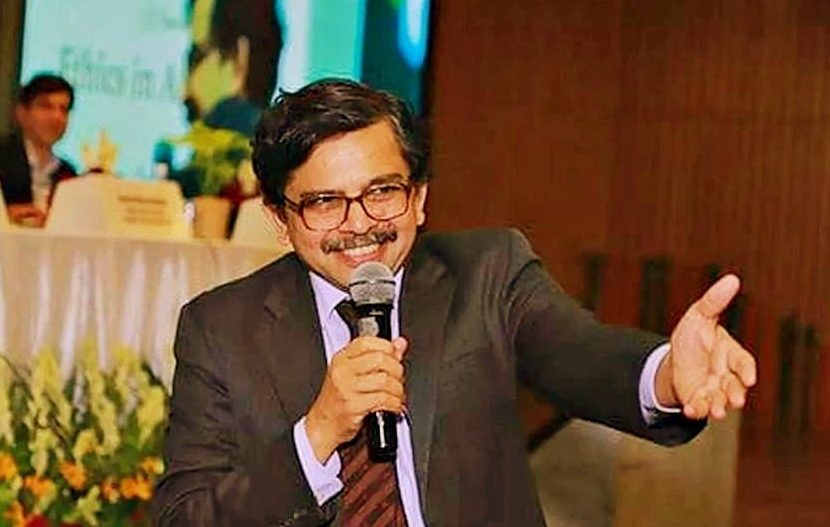
S. Muralidhar
On August 24, 2026, former Odisha high court Chief Justice S. Muralidhar delivered the 28th D. S. Borker Memorial Lecture on the theme “My Vision of India: 2047,” with senior advocate Indira Jaising chairing the session. Looking ahead to the centenary year of India’s Independence, Justice Muralidhar examined the persistent problems facing India’s legal system today, from hiking pendency and vacancies to overwork among judges, delays, legal education, technology and the role of lawyers and the government in the functioning of the legal system.
He emphasised the need to make the legal system more transparent, accountable and centred on the people for whom it was built. “The legal system, with its mystifying procedures and legalese, is designed to alienate, and not welcome, the user of the system. Even today, it is not possible for a litigant to navigate the legal maze without professional legal help,” he remarked. He argued that reform cannot simply mean appointing more judges or introducing new mechanisms, but required a “process re-engineering.”
The following is the full text of Justice Muralidhar’s lecture.
It is a privilege to be asked to deliver this lecture that honours the memory of Dattatraya Shrinivas Borker, a civil servant committed to transparency, constitutional fairness and public welfare. Recognised as an able administrator of uncompromising integrity, Mr. Borker is credited with many pioneering initiatives which included advocating urban planning to provide for parks and safe public zones.
Let me be permitted to take some liberties with the given title and substitute ‘My Vision’ with ‘A few visions of India 2047’. The past 79 years have told us that there are many imponderables and surprises in store that defy a predictable vision of where we are likely to find ourselves in twenty years from now.
Among those who delivered the previous editions of this lecture instituted in 1999 – this is the 28th – there have been two in the field of law. Senior Advocate Colin Gonsalves delivered the 18th lecture in 2015 and Justice A.P. Shah the 25th in 2023. Among the law persons who chaired the lectures, we have had three – Mr. Soli Sorabjee in 2012, Professor Upendra Baxi in 2017 and Justice Sanjay Kaul in 2023. This year it is a total takeover by lawyers. We have Syed Jafar Alam, a practising lawyer, introducing us. I am particularly honoured that Indira Jaising is chairing this lecture. She is an exemplar in the legal profession, having fought (and continuing to fight) for justice for the less privileged, for greater transparency and accountability of our institutions and in challenging the status quo. She has been a torch bearer for many generations of lawyers trying to find their feet. She continues to be an inspiration for many of us.
In today’s lecture I will first speak on the vision of the Indian legal system for 2047 with a particular focus on the judiciary. Here I will speak more about judicial administration, a topic not much discussed, and less on what courts do on the judicial side, a topic that has been much discussed. Thereafter, time permitting, I propose to touch on a few other issues.
The broken legal system that we inherited has remained broken
Legal historians have told us that the Anglo-Saxon adversarial judicial system that was introduced sometime in the 18th century quickly became dysfunctional. In response, after eliciting the views of the then magistrates through a questionnaire, Lord Cornwallis promulgated on December 3, 1790, a scheme that transferred the administration of criminal justice to the hands of the East India Company’s English servants. Soon, this new system too failed. The judicial officers were accepting bribes with impunity, crime was promoted as criminals felt that money could save them from the law; proceedings in criminal courts were dilatory; prisons were overcrowded and insanitary. The 19th century was no different. In William Bentinck’s time in 1833 it was acknowledged that the criminal justice reforms had “failed to achieve the twin objects of a court viz., cheap and quick decision of cases.”
The same scenario played out in the 20th century. One of the first persons to respond to the Civil Justice Committee set up in 1923 to find ways for speedier and more economical disposal of cases conceded that “there is delay, in some cases very great delay, in the disposal of suits and appeals.” He, however, cautioned against short cuts that would compromise a fair procedure for the sake of quick disposal. A decade after independence, the 14th Law Commission of India (LCI), headed by the then Attorney General for India, prepared a comprehensive report suggesting a series of legal reform measures. It noted the pendency of over 10,00,000 civil suits and 40,00,000 criminal trials, excluding cases before the Sessions courts and high courts. The LCI acknowledged that “the present system of administration of justice is alien to our genius” but advised against abandoning it. The true remedy, said the LCI, lies in removing the defects that exist in the system and making it subserve in a greater degree our requirements for the present and the future.” It disagreed that the complexity of the procedural laws was the primary cause of judicial delays but “a host of extraneous and personal factors” like “an inefficient and inexperienced judiciary, insufficient number of judicial officers, and incompetent and corrupt ministerial and process serving agency, the diverse delaying tactics adopted by the litigants and their lawyers, the un-methodical arrangement of work by the presiding judge and the heavy file of arrears.”
The lament by Justice Krishna Iyer in 1992 in his inimitable style was that “for the lay person, the judicial process was a riddle wrapped in a mystery inside an enigma, with its baffling legalese, lottery techniques, habitual somnolence, expensive proclivities, multi-deck inconsistencies, tyranny of technicalities and interference in everything with a touch of authoritarian incompetence.”
So here we are, after 79 years, grappling with the same issues – too many cases, too few judges, costs, uncertainties and delays. The problem is complex, with moving parts that are imperfectly interlocked. Let me attempt helping all of you decipher it.
Not enough judges
To state the obvious, we do not have enough judges. A few statistics need to be noticed. First, the district judiciary. The current pendency is over 5.1 crore cases, 80% of which are pending in the criminal courts. Around 29 lakh cases are instituted every month and every month our judges in the district courts dispose of 24 lakh cases. While the sanctioned strength is around 19,500 judges, at any given point in time the working strength is around 18,200 judges. The per judge load in the district judiciary is a staggering 2750 cases. Around 2.6 crore cases are freshly instituted every year and around 2.4 crore cases are disposed of. There is an unchanging pendency of around 5 crore cases. Basically, our judges in the district judiciary are running hard to stay in the same place.
Turning to the high courts, the current pendency is 65 lakh cases, of which 45 lakh are civil cases. The sanctioned strength is 1122 high court judges but the working strength is only 810. The per judge load is over 8000 cases, whereas the Malimath Committee in the 1980s recommended as feasible a load of 1500 cases for a high court judge. Over 10 lakh cases are instituted annually in our high courts and an almost equal number is disposed of, meaning the overall pendency remains the same. Again, high court judges are running hard to stay in the same place.
In the Supreme Court, the current pendency is nearly 93000 cases. The sanctioned strength was only recently raised to 38. At present there are 34 judges. The case load per judge is above 2400. In 2025 around 62,000 cases were instituted in the Supreme Court and nearly 57,000 cases disposed of.
Yes, the collective pendency of cases is the highest for any judiciary in the world. It reminds us of the work that remains to be done. But that is only part of the story. We need to acknowledge that a lot of work is being done by the existing judicial workforce that is clearly overworked.
While the Supreme Court manages to have a full complement of judges, we never had a full capacity of judges at any time in the district judiciary and in the high courts in our country’s 79-year journey. This is a kind of paradox because judges have to be appointed from amongst the lawyers and we currently have over 20,00,000 lawyers. The question naturally is, can we not find among this huge number of lawyers, a few who can fill up all of the vacancies in all the courts? While the logical answer ought to be in the affirmative, in practical terms the truth is that we are unable to find enough lawyers who fulfil all the requirements for being appointed as judges.
Let me explain this further. In the district judiciary there are two levels of judges – the Junior Division and the Senior Division also known as the Higher Judicial Service. At the Junior Division level the recruitment percentage in the recent past has been more than satisfactory. This is owed to a combination of factors. A better crop of law graduates coming through the five-year law course looking for a career in the judiciary. The selection process is quite rigorous – written exams followed by interviews. The mushrooming of coaching centres for these exams has certainly helped. Since the starting pay packet for a Junior Division judge is reasonably good, and there is security of tenure, this has attracted an increasing number of women law graduates. This augurs well for the system as a whole.
At the Senior Division level in the district judiciary, there are two broad streams of recruitment. 50% is from among serving Junior Division judges through promotion, 25% among them through departmental exams and the remaining 25% are to be filled up directly from among lawyers with a minimum of 10 years’ standing. There are written exams followed by an interview conducted by the judges of the high court. Year after year, a large number of these direct-recruit vacancies go unfilled. This reflects poorly on the competence of lawyers practising in the district judiciary. It also raises serious questions about the quality of legal education. More on this later.
For appointments of judges to the high courts, the procedure is more elaborate, involving the judiciary and the executive. Despite switching over in 1993 to a collegium system that gives primacy to the view of the CJI in the matter of appointments both to the Supreme Court and the high courts, there is now a general agreement that this has not served the objective of getting the best possible candidates. The appointment process has in the past twelve years witnessed unexplained interference by the executive. Compounding this is the vagueness about the criteria, a lack of transparency and an overall inefficiency. Let me explain the last bit. Although we know for certain what the date of retirement of each serving judge is, we are unable to select and keep the replacement ready to take over so that there is no vacancy. A few years ago, at the prodding of the National Court Management System (NCMS), we simply increased the sanctioned strength, without improving the appointment process. This made the vacancy position even worse. The prospect of never being able to catch up, even by 2047, is real.
The disclosure by the Supreme Court [during Justice Sanjiv Khanna’s tenure as Chief Justice of India (CJI)] of the criteria (called the Performance Appraisal Template) for evaluating candidates for appointment both to the HC and the SC is only a half-way house to transparency. We still need to know whether the candidates found eligible satisfied the criteria. We owe that disclosure to the people of this country. They must have the confidence that only the best among those available are being appointed to the HCs and the SC. One wishes this happens much before 2047.
The distinction between pendency and arrears
This has been said before, but needs reiteration. Our courts cannot be compared to automobile assembly lines and disposal of cases is not the same thing as assembling cars. It is too simplistic to think that by merely appointing more judges the existing pendency of cases can be effectively tackled. Every case filed in the system is not a pending case because it has to go through different stages before it can be said to be ready for a final hearing and disposal. Further, each category of case has a different life cycle having regard to its complexity. A murder case cannot be compared to a motor accident or a traffic violation case. There has to be, therefore, a scientific method of first determining what is the optimum time that can be taken for disposing of a particular type of a case and then finding out whether the judge dealing with it is able to meet that standard.
Then there are many cases among the 5.5 crores in the formal legal system that are actually dead cases; where the parties are no longer alive, the subject matter does not exist, the law has changed, the government’s position on the issue has changed irreversibly. Then there are absolutely petty and pointless cases. For example, booked for merely carrying 5 litres of illegally brewed alcohol or found with 5 kg of illegally felled firewood. These kinds of cases are pending for years on end and the ones harassed most are some poor tribals who have no means of defending themselves. There are cases pertaining to enforcement of sureties where the main criminal case is long over or an execution petition for recovery of a sum as low as 1000. These cases clog the system and serve no real purpose. If these are eliminated, we can arrive at a realistic figure of the actual live cases that can be considered arrears if they have crossed their life cycle. And that won’t take, as the popular myth goes, 300 years to be disposed of.
So, how do we go about doing this? For this to happen we need to engage an army of Law Researchers or young law graduates, and in some states, retired judicial officers. They can delve into the court records and categorise cases that are dead, those that need a formal ritual of disposal and so on. In criminal cases, this will require the cooperation of the police. And of course, the lawyers will have to help. We can also persuade governments to drop cases of little monetary value. Our judges can spend their energies on far more serious cases that require urgent attention. These measures will reduce the pendency docket considerably. This can certainly be done in the next five years if we begin now. The 2047 docket position will look much more manageable if we manage to achieve this.
Judges alone are not responsible for the delays in disposal of claims
This is a myth and needs to be broken. The statistics tell us that judges are doing their best possible with CCRs being 90% and over. Yes, there are judges who are shirkers but then there are those among them who are ant-like and do the heavy lifting of the overall court caseload. It would be fair to state that at all levels of courts in our country, there are around 20 to 30% of the serving judges who are punctual, punctilious, conscientious, hard-working, efficient in court and case management. We should be worried about the remaining that aren’t.
There are several pressure points that affect the output of judges. The pressure of case overload, anxiety about disposal, recalcitrant and unhappy lawyers and litigants, anonymous complaints about the judge being on the take, intense media glare, strictures from the high courts and the Supreme Court. The list can be endless. Above all this is the stress that judges undergo in dealing with human problems day after day, hour after hour. It is both an emotional and a mental drain. The mental fatigue of judges is seldom acknowledged or accounted for within the system.
Then there is a problem, a real problem, of uneven distribution of work. Certain courts in major cities have a disproportionate caseload compared to their counterparts in other districts. For instance, in a medium-sized State like Odisha, the courts of the judicial magistrate in Cuttack will have a caseload of say 1.25 lakh cases whereas the counterpart in, say, a remote district like Nuapada will have a load of not more than 10,000 cases. As much as a huge load can slow down even the most efficient judge, lack of work can frustrate even the lazy judge. This is true of the high courts too. Those in some of the NE States have hardly a caseload of 3000 cases. The entire pendency in the high court at Sikkim is 328; in the high court at Tripura, it is 1409 and the high court at Meghalaya it is 1996. Whereas the Allahabad high court has a case load of over 12 lakh cases with 40% of those being over 10 years old.
Judges have to be multi-taskers. It is of course a myth that outside of court working hours judges have a jolly good time. Most of the judges, and at all levels, are working beyond court hours attending to administrative tasks: examining building plans for new court rooms, purchasing computers and furniture, choosing uniforms for staff, examining complaints against judges in the district judiciary and deciding on whether to order an enquiry, fixing the menu for the next grand event being hosted by the court; preparing for lectures to deliver at judicial academies.
For district judges all this, as well as having to be on high alert not to displease the boss, i.e., the high court judge who has to write their ACR. And then there are growing instances of women judges facing the trauma of sexual innuendoes and harassment at the hands of senior male colleagues. We are yet to devise satisfactory mechanisms of fairly dealing with these complaints. We should remember that all of this applies to court staff as well. They are seldom acknowledged. Judges in the district judiciary are not truly independent. They are totally dependent, in their day-to-day functioning, on the cooperation of the local police and local administration. In sum, our judges and their staff in the courts have always been overworked – punching way above their collective weight, in working conditions that are far from ideal.
So then, who else contributes to the delay in disposal of cases?
First and foremost, the state, by which I mean the governments both in the states and at the centre. By their actions of taking arbitrary decisions, or not deciding at all, or by unthinkingly criminalising normal activities in a democracy like peaceful protests and unnecessary arrests, governments drive people to courts. This explains why despite the delays, costs and uncertainties in the court system, the filings have grown over the years. The other problem is that the State’s capacity to litigate can outmatch even the richest conglomerate.
If the state loses a case, at any level, it will appeal, and keep doing that till the Supreme Court. It could be an increment of Rs 100 given to a mali in a government department or a pension of Rs 300 to a widow of the deceased government servant. Everything has to be appealed. And if the private individual succeeds there is no guarantee that the government will accept and comply with the court order. The contempt roster in our courts is burgeoning. Repeated litigation policies of the State, meant to curb the filing of cases by the government, have remained on paper. There is no real will to implement such policies.
The lawyers engaged by the governments are also to accept the blame to some extent because it is they that advise the government on the next course of action. The fear of being blamed later for favouring an individual litigant makes both bureaucrats and government lawyers play it safe and advise going in appeal. Also, since the fee is low, and tied to the volume of work, this is an incentive to file cases, however frivolous. At another level, government will not employ enough counsel, and on time, and hand them the relevant records and instructions.
Many of these appointments are distributed as largesse with no real relevance to the expertise required. All this leads to numerous adjournments on account of non-availability of the counsel, be it a prosecutor, a government pleader or a law officer. If they do appear, they are instructed poorly or not at all. Reply affidavits are seldom filed in time; records are never produced within the time stipulated. Judges at all levels are deeply frustrated by this intransigence but can do little about it since very often no real progress can be made in a case without the participation of the government counsel. As a result, most judges are forced to accommodate the request by the government’s counsel for an adjournment. All this can and has to change if there is to be a better-functioning judicial system in 2047.
Private lawyers fare no better. In the market place of lawyers, 80% of the work in any court is with 20%, if not less, of the lawyers in that court. At the level of the district judiciary, especially in the remote towns and districts, full-fledged trials of civil and criminal cases rarely take place. There is an increasing tendency to only argue interim injunction applications in civil cases and bail applications in criminal cases. If an eye witness stands her or his ground and cannot be won over, the lawyers find ways of deferring the trial. In a court of a Junior Division judge, the local bar can be domineering.
A judge who refuses adjournments is unpopular, is labelled as arrogant and insensitive. Strike calls are given over trivial issues. Most lawyers who practise in these courts have other avocations that keep their income flowing. And we have weak Bar Councils which are reluctant to hold enquiries into complaints of professional misconduct and in good time. These lawyers also resent the provision of free legal services, mediation and appointment of salaried defence lawyers employed by the legal services authorities.
It is not always as bad as it seems. Just like there are a few judges at all levels who are conscientious and consider themselves accountable, there have always been, and I am sure there will continue to be, a relatively small number of lawyers, almost in every bar, who view the legal profession more as a service to society and less as an opportunity for career progression. These lawyers take up cases at reduced or no fee and sometimes offer their services pro bono. This is apart from the panel lawyers of the legal services authorities which is the state-funded public arm of institutionalised legal aid. We have had, and continue to have, private lawyers’ collectives and civil society organisations offering free legal services.
Some of these have been the Lawyers’ Collective, Majlis (in Bombay), the Legal Aid Society of West Bengal founded by Justice D K Basu, The Jagdalpur Legal Aid Society, and more recently Project 39 A which has now been relocated to NALSAR Law School as Square Circle. This cannot of course match the demand for such services across the country. The government clampdown through the amendments to the Foreign Contribution Regulation Act is a dampener. These are nevertheless good examples for the younger lawyers to emulate and for the Bar Council of India (BCI) to encourage. It is significant that the recent Gen Z protests have had the consequence of shaking up the top brass of the BCI.
The Supreme Court has, on the judicial side, been attempting to bring about reforms in the functioning of the BCI. The present Chief Justice of India (CJI) is taking a special interest in this. But for the changes to be lasting and consistent, the changes must come from within and follow a democratic process. A bar controlled by the judiciary does not augur well for either.
The vision for the bar of 2047 is this. A reformed BCI that is democratic in its functioning, insulated from interference by the executive and the judiciary, responsive to the needs of the litigant public, prompt in dealing with complaints of professional misconduct by lawyers and is an upholder of constitutional values and human rights.
Legal education in need of reform
It is trite that for a better crop of lawyers, and judges, we need better qualified law graduates. Despite four decades of NLUs, not all of the law graduates passing from there are entering the field of litigation in courts. Corporate offices and firms are still more attractive to most of them. Those that have passed through the NLUs, or have done a five-year or a three-year course from premier legal institutions, and choose to litigate are discernibly infusing quality in the bar. Their internships expose them to the workings of the legal system, preparing them better to take on its challenges. Yet, it is a cause for concern that the quality of legal education in the country is not uniform. There is a growing gap between the top-ranking law colleges and those that constitute the vast majority of the rest.
It is time to acknowledge that the present system of having the BCI determine the curriculum for legal education has not worked. It is time to decouple this link and set up a truly autonomous body for legal education that can set minimum standards that are not diluted in their application. Even the utility of having sitting judges of the HC and the SC in the governing bodies of the NLUs needs a rethink. It is time to question the mindless expansion of NLUs particularly since there is a real shortage of good law teachers. With students being better equipped than their teachers there is a mismatch in most NLUs (other than the top four or five) leading to discontentment and disenchantment.
The vision for the legal system of 2047 is of law students who have learnt to spot and fight against injustice; who have imbibed constitutional values; and have developed the ability to question power and authority. Such students are more likely to be fearless and independent lawyers and they in turn will hopefully be the lot from among whom our judges will be chosen.
The various attempts at legal reform
So, what has been done in the past 79 years to tackle the mess? What has worked and what hasn’t?
The three evils that have plagued our formal legal system are costs, delays, uncertainties. Right from the 1920s there have been numerous commissions and committees (apart from the LCI) and more recently a clutch of private legal research bodies that have studied the data, done the analysis and made recommendations to fix the problem. We have on top of this a National Court Management System (NCMS) (with corresponding systems in the states) entirely managed by the judges of the Supreme Court and the high courts respectively. We also have e-committee of the Supreme Court monitoring the e-Courts Mission Mode Project. So, one thing is clear, we do not need any more commissions or committees. There is already enough material for us to study and act upon.
Special Courts and Fast-Track Courts
The attempts at setting up Special Courts exclusively to deal with certain types of cases, of having exclusive CBI courts, Courts for MP/MLA cases, for terror-related cases, Fast-Track Courts for old cases and so on have not served the purpose since no additional judge strength has been provided for these courts. The existing judges are simply redesignated as the special courts. The same story as far as the commercial courts are concerned. It earned us a couple of notches higher in the world bank’s ease of business rankings. That’s it. The existing judges are additionally dealing with commercial cases.
Tribunals
Take the entire system of tribunals. What late Professor Marc Galanter termed as by-passes from the highways. We diverted cases from our court system to judicial tribunals set up by statutes comprising retired judges and non-judicial members. We today have a plethora of them: administrative tribunals for deciding employment disputes involving government servants; a separate set of tribunals for those concerning service disputes of the armed forces; separate tribunals for income tax, GST, consumer disputes; company and insolvency disputes; debt recovery by banks; telecom; electricity; real estate; environment and competition.
And now we have a National Tribunal Commission which is tasked with regulating all these tribunals. The fact is that these tribunals quickly accumulate arrears of cases, a large number of vacancies of members and staff remain unfilled, budgets are scarce, and above all they have short tenures and lack independence. When I spoke of the pendency figures I did not include the Tribunals. Absence of reliable data is a problem. In terms of procedures, they mimic the formal court system. They too are controlled by lawyers and lawyers’ habits.
The decisions of these tribunals are challenged in appeals. And then these cases are back in the high courts and the Supreme Court by the losing parties with litigating capacity. They are poor substitutes for courts. The by-passes themselves get choked and end back in the main highway which is well, even more choked now. Tribunals exacerbate, and certainly do not mitigate, costs, delays and uncertainties, the three evils that plague our court system. And yet, our governments persist with the creation of more and more tribunals.
Arbitration
We have also diverted cases from courts to private adjudicatory spaces where willing parties submit themselves to arbitration by a former judge or other expert or a tribunal comprising one or three of them. While we have been promoting India aggressively as an international arbitration hub, the fact remains that domestic arbitration has not provided the viable and efficacious alternative to the formal court system. The winning party in an arbitration has to return to the courts for enforcement. The three major indicators of the failure of the formal legal system viz., costs, delays and uncertainties, have afflicted arbitration as well.
Court-annexed mediation
The active promotion of court-annexed mediation as an alternate mode of dispute resolution has met with limited success in certain types of disputes. These include family disputes and disputes amongst business partners. It is difficult for it to work where the government is the opponent whether the case is civil or criminal. It certainly will not help deal with cases involving grave criminal offences. Nevertheless, it can help reduce the waiting time in court. The biggest incentive for litigants is the possibility of a finality to disputes. It is the court that is taking the initiative of training lawyers and judges to be mediators. The actual success rate of mediation, however, has not been uniform across the country. While in Delhi it is well above 30% it is much less elsewhere.
Lok Adalats and other ADR processes
One other ADR process is the organising of mega and monthly or half-yearly lok adalats by the legal services authorities at the state and national levels. The cases sought to be settled here are largely those involving grant of compensation. In reality a majority of the cases ‘settled’ are traffic violations. The persons waiting for compensation under the MV Act and land acquisition law are offered negative reasons for accepting a settlement that is far lower than their expectation. To quote Marc Galanter again, this is the equivalent of ‘bread for the poor’. It’s like saying: Take this now or you may never get anything in the long run. Imagine, the three failures of the formal legal system (costs, delays and uncertainties) are themselves touted as incentives to settle for less. How can this be justice?
We have tried experimenting with the Gram Nyayalayas which are the modern versions of the traditional Nyaya panchayats to deal with ‘small causes’ in the rural countryside. Only 258 courts across 10 states are supposedly functioning but are hampered by lack of funding, infrastructure and trained nyayadhikaris. Basically, a failed experiment.
The other ADR methods we have are police personnel turning mediators. The Crime Against Women Cell of the Delhi Police is the first port of call for many a quarrelling couple. To be fair, a small percentage of such disputes do get settled at this stage. Then we have merchants and traders and money lenders eager to convert a regular money dispute into a criminal case of cheating. An obliging cop looking for an opportunity to earn something extra is only too happy to help in unleashing the coercive criminal law process. A plain misuse of the law. This too cannot be an effective alternative in the longer run.
The informal legal system
In the informal legal system domain, we still have the panchayats that mete out verdicts that can be unacceptable from a constitutional point of view. Then we have god men, gurus, community leaders, cult figures, and local mafia dons with an impressive criminal track record offering their dispute resolution services. All outside the rule of law framework. But the mess of a failed legal system is too complex to be unscrambled in these ways.
Court Managers
Judges are notoriously poor managers. To quote Krishna Iyer J. again: “A grocer’s shop is better managed than a munsiff’s court. Judges, wise in other ways, are infants in judicial business management.” Much of the issues I spoke about involve management of resources, of time, of courts. Most judges are trained in judicial work but have neither the time nor the inclination for this. The problem is that they will neither manage nor let others who are more qualified do it for them.
The scheme of having court managers commenced in 2010 with temporary central funding. It was expected that MBAs would study the workflows of cases, assess the workload per judge, point out which of the cases require to be prioritised and help arrange rosters of individual judges while coordinating with the lawyers. But this did not work for a variety of reasons.
First, they were not adequately oriented to work in a court system which has its own peculiar practices and traditions. Secondly, there was no clarity on how they fitted in the administrative hierarchy of the court system. The processes of their selection were not foolproof and transparent. Most importantly, judges refused to delegate to the court managers the case management function. They were seen as being either interfering or obstructionist. The scheme really never took off.
Use of technology
Since the early 1990s we have been using computers in courts. First, we used them as substitutes for typewriters, then gradually to collate data that we fed into the system to produce cause lists, then we fed data on to court websites. We graduated to online filing and paperless courts in Delhi since 2010. The launch in 2013 of the National Judicial Data Grid was a promising start in making judicial data concerning the district courts accessible in granular form. The e-court project in the meanwhile has entered its third phase with a budgetary outlay of over 7000 crores. This needs to be stated upfront. There is no shortage of money for judicial reform. Very often the judiciary is returning monies unspent, whether for digitisation, court infrastructure or even legal aid. The problem then is to learn how to spend it.
Covid-19 brought in a sea change in how courts at all levels functioned. Online hearings, e-filings, scanned files, use of digital devices, and live transmission of court hearings became almost routine. Much of this has continued since, although it does still meet with some resistance from a section of the lawyers, judges and the court staff.
And yet, all across the country the e-courts project is not progressing as well as it should. It seems to have stalled. The most identifiable reasons are the digital divide amongst lawyers (not all of them are able to afford smart devices like iPads), the reluctance of some of the judges, lawyers and staff to adapt to the changed style of working, the uncertainty over power supply and network connectivity, and above all the over centralisation of the management of the digitisation project by the e-committee of the Supreme Court. The insistence by courts that lawyers should, apart from e-filing the case, also supply hard copies of the paperbook is a disincentive. By now we should have had paperless courts at all levels of the judiciary, digitalised all court records, past and present. We could have had a dedicated cadre exclusive to the judiciary for technical support services. This transformation is even now possible. This is the only way forward if our courts have to stop being paper guzzlers with overflowing records spilling into every available floor space.
Artificial Intelligence (AI) was deployed by the e-committee for the translation of SC judgments into regional languages and for transcribing oral arguments in cases before the Constitution Benches of the SCI from February 2023 onwards. But one must be cautious about its adoption for judicial work. Lawyers are already using ChatGPT and Claude in their work. With every judge of the HC and the SC now being assisted by a team of LRs, the use of AI in judgment writing is becoming increasingly discernible. Over a period of time, when AI stops hallucinating, the distinction between a human dictated judgment and one prepared by AI may be hard to tell.
There are many other challenges too. Redundancy of the software used to create the electronic record and the non-availability of hardware devices to read such documents is another possibility. Then there is the serious issue of ensuring the security and confidentiality of large volumes of personal information forming part of the case record which is available in the servers used by the judiciary.
This would require periodic security audits, but as of now, there appears to be no clear set of binding advisories issued by the e-committee. Clear protocols and governance frameworks are essential for controlling the use of technological tools. Establishing accountability mechanisms for errors or misuse ensures responsible implementation. Transparency in processes, decisions and the functioning of technology is vital for maintaining public trust and confidence in the judicial system’s integrity. At the end of the day, a user of the judicial system has to have a satisfactory answer to the following question: Will these measures improve both access to justice as well as the quality of justice? How can we set this right?
Reasons why these measures have not worked
By now it should be obvious why many of these measures have not been able to satisfactorily resolve the issues that trouble the system of administration of justice. One major reason is that they are not litigant-centric. The legal system, with its mystifying procedures and legalese, is designed to alienate, and not welcome, the user of the system. Even today, it is not possible for a litigant to navigate the legal maze without professional legal help. The entire legal system, which includes the judiciary, revolves around the convenience of lawyers, judges and, of course, the state. Every attempt at legal reform, without inputs from the actual users of the system, is bound to fail. The harsh truth is that the system of judicial administration in these 79 years has not been as democratic and accountable to its users as it ought to be. This therefore needs fixing. The institution needs to talk to the people and be prepared to take the hard knocks they are bound to deliver about its functioning.
A vision of the legal system of 2047 would be the completion of the unfinished task of process re-engineering. This is the first step towards standardisation of procedure across courts and across jurisdictions. This should result in the generation of reliable data, that is constantly updated. By 2047 we should have completed this task with the help of technology and based on hard data. This time it must happen in an open, transparent manner, and in consultation with the users of the system.
Secondly, we must acknowledge that we are not a society that is attuned to accepting a rule of law paradigm. The complete internalisation of constitutional values at a personal and societal level is yet to take place. Social democracy as envisioned by the Constitution makers is still a work in progress. Babasaheb Ambedkar’s prophesy of our country entering into a life of contradictions on January 26, 1950, should hopefully not hold true for January 26, 2050.
A cause for concern is that even 79 years after independence those in power continue to betray Ambedkar’s vision of constitutional morality. Today’s citizen is very often alarmed to find that those in power themselves do not adhere to the rule of law. The prospect of State anarchy is precisely why we have a Constitution. Its primary purpose is to place checks on the abuse of state power. The judiciary’s track record in delivering on the constitutional promise of being a bulwark between the people and an anarchic state has, at best, been inconsistent and quite often, disappointing. The attempts at creating a false equivalence between fundamental rights and fundamental duties misses the point about the obvious imbalance between the mighty powerful state that monopolises the use of force and a citizen seeking the protection and enforcement of the basic survival rights to life and human dignity.
Thirdly, our law-making processes are by and large top-down. The people likely to be impacted are seldom consulted. The language of the law makes it difficult to comprehend. Very often laws are passed without any meaningful debate or discussion by our MPs. Where one regime is successful in bringing laws using the bottom-up approach (like the Right to Information Act 2004, the Right to Fair Compensation and Transparency in Land Acquisition, Rehabilitation and Resettlement Act 2013, the National Food Security Act 2013, the Forest Rights Act 2006 and the Mahatma Gandhi National Rural Employment Guarantee Act 2005 (MGNREGA)); the succeeding regime will work to undermine it, dilute it, and make it ineffective. Where the attempt is to bring about social transformation through law, the process of top-down law making easily alienates the people. Naturally, people are reluctant to accept them as binding norms of social behaviour. This explains perhaps the failures of the Dowry Prohibition Act, 1961, the Child Marriage Restraint Act, 1939 the Bonded Labour Abolition Act, 1986 and a few other similar enactments. The courts can do little to persuade acceptance of laws by the people. It is often saddled with the consequences of their failure.
Fourthly, the governments and the legislature have failed to take seriously the concept of judicial impact assessment, on which two expert committees have submitted reports. Every change in an existing legislation and every new enactment has the propensity to increase the workload of the courts manifold. The amendment to the NI Act carried out in 1988, hundred years after it was first enacted in 1888, is a case in point. This amendment introduced Sections 138 to 142 which made cheque bouncing a punishable offence. A majority of the complainants were banks, financial institutions and with every bounced cheque constituting a separate complaint and with their having enormous litigating capacity, the dockets of the magistrate’s courts exploded. We today have nearly 40 lakh such cases making up nearly 40% of the total pendency of criminal cases. Therefore, decriminalising this offence and restoring the status quo ante is a no brainer.
Fifthly, all reform in our pyramidal structure has to start at the top. The initiative has to come from the CJ of a HC or the CJI. If we are going to have persons in these positions not even last for a few months (sometimes it is for a few days), then the kind of reforms one needs for the complete overhaul will simply not happen. If the CJI shows interest in accelerating the pace of digitisation uniformly across all courts, it is likely to happen. Alternatively, the next best thing to do is to learn to delegate, broaden the system of judicial administration, have a continuous monitoring of the implementation of the numerous reports that have already been submitted and are waiting to be acted upon.
Both the e-committee and the NCMS should not be the sole preserve of senior-most judges of the Supreme Court. It should have judges lower in the pecking order, judges from the high courts who are likely to remain in the system for 10 years or more and a fair representation of domain experts that can help steer the reform implementation process. The process must be consultative. It cannot just be a three-way dialogue between the bar, the bench and the government. The judiciary must take the initiative to organise the conduct of surveys to find out what the users of the system need and would want to change. Our reforms have to be litigant centric.
Lastly, the vestiges of both patriarchy and feudalism in judicial administration are palpable to anyone who has seen its inner workings. There is an obsession with protocols, archaic forms of address and usage of expressions. This is an anachronism inherited from the colonial past that has survived 79 years. This needs to be acknowledged, interrogated and dismantled.
What else must we do today?
I move on to the concluding part of this lecture. What else must be done by not just the judiciary but by the other branches to have a properly functioning legal system?
Let me at this stage acknowledge that if there are many aspects touching on legal reforms that I have not talked about, it is both for want of time and the fact that they have been discussed extensively in public fora. For example, I have not talked about the much-needed reforms in the criminal justice system which comprises the police and the prisons. I have also not adverted to the inconsistencies in the approaches to various issues of constitutional importance by different benches both in the high courts and in the Supreme Court. This undoubtedly contributes to uncertainties and in turn adds to the growing pendency of cases. In this section I propose to talk about a few other aspects which I believe need to also be accounted for.
The practice of criminalising choices that an individual makes about whom to marry or live with should be halted. The case in point is the enactment of a spate of Uniform Civil Code legislation in several BJP-ruled states. Law should not be used to target a group for what they wear and what they eat. The India of 2047 would be better served if the law of today does not permit criminalising honest criticism of a government or those running it, of lampooning those running it in cartoons or joking about them through stand-up comedy. The India of 2047 would be better served if the government of the day stops weaponising law to punish those who peacefully protest about the denial of basic rights and if it stops labelling them as sinister acts of conspiracy to destabilise the government. The India of 2047 will be better served if the plethora of preventive detention laws and the draconian bail-denying provisions of the UAPA, the PMLA and other similar enactments are repealed. In 2047 such enactments should be accessible only in parliamentary and judicial archives.
The judiciary of 2047 will be better served if today’s judges act swiftly on complaints of grave state excesses. The Supreme Court of 2047 will hopefully not wait for over four years to decide whether reducing a state to a union territory is constitutionally valid; over six years to decide whether an overnight decision to demonetise currency was legally permissible; over six years to decide whether anonymous contributions to political parties through the device of electoral bonds was valid.
Our future generations should be able to recall as things of the past the low points of our judicial history, never to be repeated: the judicial stamp of approval to the draconian emergency of 1975, the inability to deal with cases of mass crimes whenever they occurred, the gross injustice in the case of mass torts like the Bhopal Gas Disaster, the failure to take up and decide in good time habeas corpus petitions complaining of unlawful detentions, petitions complaining of encounter killings and disappearances, of arbitrary demolitions of homes of dissenters and minorities, of brutal crackdown on tribals protesting against locating of projects in their habitats, signalling their imminent displacement.
In 2047 an Indian should be astonished to discover that in India’s past there was a time when laws would punish the poor for who they were and not for what they did; when a sex worker and not her exploiter would be punished; when a neglected juvenile and not her tormentor would be punished; when seeking alms would be a crime as would be sleeping on a pavement for want of shelter. They would, I suppose, also be astonished that the Supreme Court would, after declaring unreasoned orders of internet shutdown to be unconstitutional, refuse to enforce its judgment; after declaring that unannounced and arbitrary demolitions of the homes of protestors, and those merely accused of crime, particularly members of minorities, to be legally impermissible, fail to enforce its own directions.
In this vision of an India of 2047 a sincere effort by our generation to revitalise the constitutional values of social justice and fraternity would have borne fruit. There would be no more manual scavenging, no more sewer cleaning by human beings, no more rag picking on landfills by tiny children, no exploitation of labour whether bonded labour or child labour, no dowry burnings, no female foeticide, no witch hunting, no sex selective abortions. Our generation should have in the ensuing decade worked towards ending mob lynching and public humiliation of Dalits by the upper castes, targeting of religious minorities in the name of god, and an aggressive assertion of religious superiority by the dominant groups.
If the judiciary of 2047 should be relevant to the people and be able to offer them meaningful redress to their grievances, our present Judicial Academies should orient our judges on issues of law and poverty and organise courses that serve to remind them that the judiciary is there to protect people against the excesses of the state and powerful dominant groups, strengthen their arms in demanding greater accountability and transparency from the State. If Courts themselves and their processes turn into sites of oppression it will undermine the faith of the people in the justice system and its ability to deliver fair and equal justice.
Challenges and hope
The growing inequality in wealth and power both outside and within the country is a cause for concern. And so is the bitter truth that our governments are controlled by corporate oligopolies here and abroad to serve their interests. Worrying also is that the democratic processes can be subverted to install elected autocracies that soon thereafter seize control of all institutions of accountability.
That technology can be weaponised to keep an entire people in a permanent state of surveillance and reduced to a string of digits that serve as their only identity. To top this, that a few powerful foreign corporate powers can control all the information about us and share it at their will with oppressive regimes that have little respect for the rule of law. All this is here and now. And I have not even mentioned yet climate change and the impending catastrophes on that score.
But, as history reminds us, there is hope. The recent protests by our Gen Z assure us that democracy in India will not be allowed to die and that people will turn to the Constitution and safeguard it in order to preserve this country’s future. The week of July 20 this year was one of relief and joy. It was reassuring to know that our young generation will not be swayed by rhetoric and propaganda, by powerful oratory reminiscent of the Goebbelsian polemic, and empty promises of acche din and viksit bharat.
They remained undeterred by the demonising of the dimagi naxal. It told us that this generation values giving, compassion and adherence to truth. It does not hesitate to ask questions of those in power. Above all, it is soul-satisfying to know that Gen Z has a wonderful sense of humour. The irreverence of the Gen Z is a sure sign of democratic progress.
A dream and an awakening
Let us now give ourselves something to cheer about. Let us collectively dream of August 24, 2047. A day when we find there is no Trump, no Putin, no Xi, no Erdogan, and India has a biological PM! India is at peace with her neighbours. Delhi’s pollution has disappeared. The Ganga and the Yamuna are clean. The south is still part of India. India’s colours, smells, food and flavours, music, dance, art and festivals, languages, dialects, vibrancy, inclusivity, plurality, its gods, godmen, religions, cults, sports heroes, its madness about cricket and obsession with films and film stars and above all the resilience and never-say-die spirit of her people are all intact. India’s borders are not forbidding. There is peace. Everlasting peace.
And yet to shake us up from this reverie, just to remind us that this is India, there is chaos, anxiety, stress, the endless traffic jam, vehicles coming on the wrong side, there is jugaad…and somewhere in some part of India there still is an overburdened court, with its lawyers on strike and somewhere in that court is a lost elderly litigant, unable to comprehend the mystifying court process and even more mystifying court language. Tired of waiting for his lawyer to turn up, he steps forward to argue his case in the local tongue. After indulging him for a while, the Chief Justice remarks: “Dekho Babuji, jo aap keh rahe hain, hamein samajh nahi aa raha hai. Aap vakeel rakh lo.” [Look, sir, we are unable to understand what you are saying. You should engage a lawyer.] The elderly litigant, clearly puzzled, remarks: “Kamaal hain. Samajh aapko nahi aa raha hai, aur vakeel mujhe rakhna hain?” [How strange. You are unable to understand the case, and yet I am expected to engage a lawyer?].
Also Read: Gujarat’s Nuclear Power Push: Dhuvaran Could Get 7,000 MW Mega Project