


New Covid Variant Is Making Headlines…Here’s What We Know
The world had just about started to breathe again. Masks were off. Life had moved on. Covid felt like a chapter closed. But now, reports of another Covid strain have surfaced. Not alarming enough to fear the worst but something that should make us curious.
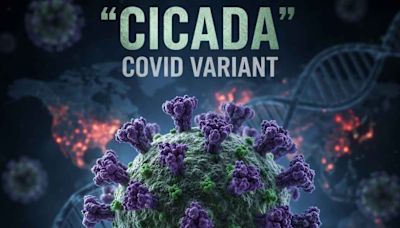
Called Cicada, it’s named after an insect that burrows underground for years before suddenly surfacing. This new Covid-19 strain has an unsettling resemblance to its namesake.
According to reports, it was first spotted in South Africa in November 2024. It stayed under the radar for months, and is now showing up in surveillance systems across roughly 22 countries, including the US.
“It is possible we will see Cicada become the dominant strain in the U.S., but that is by no means certain,” Dr Robert Hopkins Jr, medical director of the National Foundation for Infectious Diseases, was quoted as saying.
“Low vaccination rates and little to no public health effort toward stopping COVID infections and spread leaves us vulnerable,” he added.
Omicron family
Scientists have formally classified it as BA.3.2. It belongs to the Omicron family, descending from the BA.3 branch that circulated alongside the better-known BA.1 and BA.2 waves in late 2021 and early 2022.
What’s making researchers sit up is the mutation count. Cicada carries around 75 mutations. That’s about twice as many as the JN.1 variant. A significant chunk of those mutations is on the spike protein, the part of the virus that latches onto human cells and the same part that vaccines train the immune system to fight.
Lab studies suggest BA.3.2 is better at slipping past that immune defence than earlier strains were.
Antibodies (whether from vaccination or a previous infection) appear less effective at neutralising it.
That said, scientists are clear that real-world data is still limited, and firm conclusions will take time.
America’s first confirmed case turned up in June 2025. A traveller flagged at San Francisco International Airport arriving from the Netherlands. More cases surfaced through wastewater tracking and airport screening.
By January 2026, three patients had been confirmed in the US. All recovered. Authorities say there is no indication, so far, that Cicada causes more serious illness than its predecessors.
Symptoms will feel familiar: fever, a nagging cough, fatigue, headaches, muscle pain, and congestion. Some patients have reported losing their sense of taste or smell. Others have had nausea or breathlessness. A severe sore throat, though, is emerging as the detail that keeps coming up.
The US Department of Health and Human Services has noted that the variant was probably circulating at low levels well before surveillance systems flagged it, which is how it got this far.
“Monitoring the spread of BA.3.2 provides valuable information about the potential for this new SARS-CoV-2 lineage to evade immunity from a previous infection or vaccination,” the CDC wrote in its Morbidity and Mortality Weekly Report.
No alarms are being sounded just yet. But the world is watching.
Also Read: COVID-19 Is Five Years Old But for ‘Long Haulers’, The Problems Are As Fresh As Ever http://COVID-19 Is Five Years Old But for ‘Long Haulers’, The Problems Are As Fresh As Ever