

Ninama’s story is not an exception. In 2018, he was convicted in a custodial torture case dating back to 2001 and sentenced to a year in jail. The conviction did not impede his career; he continued to rise, eventually becoming the Inspector General in 2024.
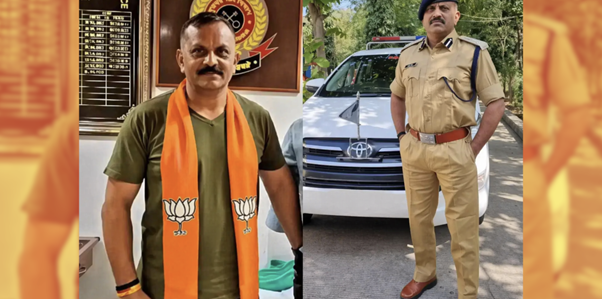
Manoj Ninama, former Inspector General of Police, Traffic Branch, Gandhinagar, joined the BJP in Gujarat.
Manoj Ninama was the Inspector General of Police, Traffic Branch, Gandhinagar. Within 48 hours of a voluntary retirement from the police force, he traded khaki for kesari. In Gujarat, the road from bureaucratic to political power is well paved, well lit, and it appears to run in only one direction. Not only was Ninama’s resignation accepted but he also secured a ticket from Odh village in Arvalli district for the upcoming district panchayat elections in Gujarat.
On the other hand, Kannan Gopinathan, a young IAS officer of the AMUT cadre, has been fighting for more than six years for his resignation to be accepted.
Advertisement
Ninama’s story is not an exception, nor is it a surprise.
A timeline
In 2018, he was convicted in a custodial torture case dating back to 2001 and sentenced to a year in jail. He allegedly beat a man in a police station to pressurise him to withdraw objections to a land deal. The conviction did not impede his career; he continued to rise, moving from the Intelligence Bureau to the State Reserve Police Force, and eventually becoming the Inspector General 2024.
In 2015, he was suspended for rigging a police sub-inspector recruitment exam, in which two women candidates allegedly entered a 1,600-metre race midway. The act was caught on CCTV, the junior officers who flagged it were reportedly pressured into silence. What followed was a cosmetic inquiry – neither surprising nor unexpected in Gujarat. He was reinstated and promoted.
His last high-profile assignment, heading the special investigation team into the Harni Lake tragedy where 14 people, mostly children on a school picnic, died. The case led to the arrests of the contractor’s partners but left the chain of official negligence within the BJP-run VMC and state government entirely unexamined. Months after that probe, in April 2024, Ninama was promoted to the IGP post.
Advertisement
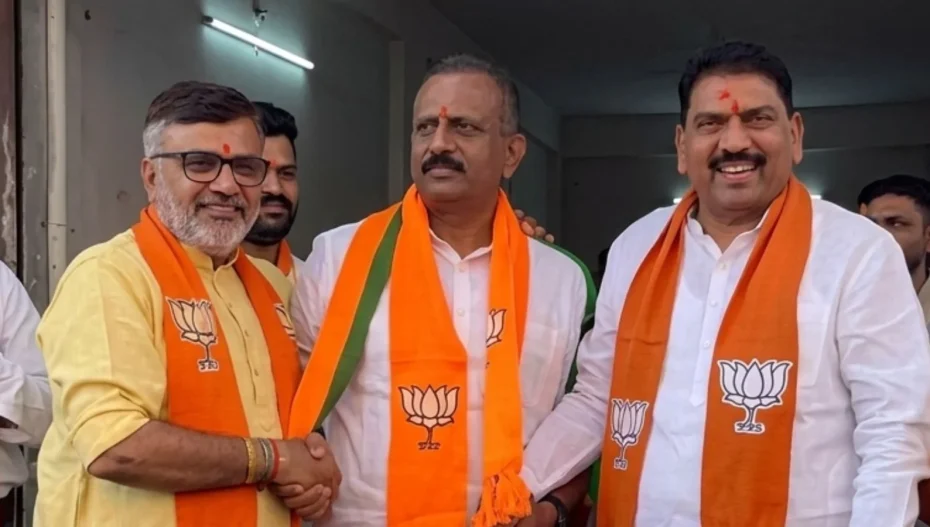
While he retired the uniform eventually, the alignment only got clearer. His ceremonial induction into the Bharatiya Janata Party (BJP), led by former IPS officer-turned-minister P.C. Baranda, surprised no one in Gandhinagar.
What is worth noting is that Ninama was actually senior to Baranda – both from the 2007 batch – the junior had shown the way to the rank of a minister, and returned to welcome the senior into the fold. This revolving door is a Gujarat specialty, accelerated sharply after 2002.
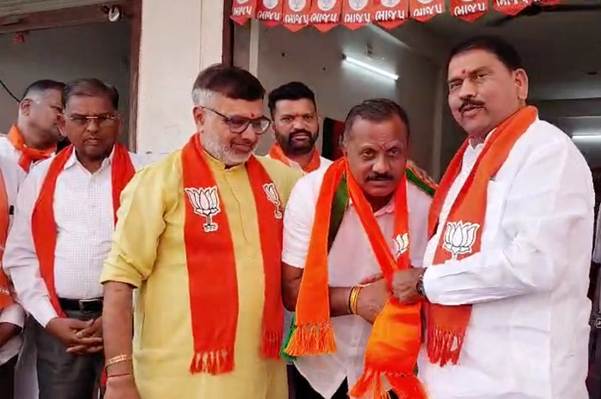
Manoj Ninama officially joined the BJP in Gujarat on April 9, 2026, two days after taking voluntary retirement from the police force. Photo: By arrangement
D.G. Vanzara, the 1989-batch officer dubbed an encounter specialist, spent eight years in judicial custody for alleged fake encounters before being acquitted. His story shows both the reach and the limits of this model – the party opens the door when it serves its interests, and closes it just as quickly.
When Vanzara sought a BJP ticket ahead of the 2022 assembly elections and was denied, he launched his own outfit, accused the BJP of becoming “corrupt and inefficient”, and won nothing. The arrangement is not a bond of loyalty; it is a transaction, reviewed at each election cycle.
The same pipeline has carried others.
Harikrishna Patel, 1999 batch, retired as Vadodara Range IGP and joined the BJP in 2021, citing his desire to “strengthen the hands of Prime Minister Modi”. A.I. Sayed, former IPS, was active on the party’s state executive before he died of Covid.
For the BJP, ex-officers bring credibility with voters who conflate official authority with governance ability, and insider knowledge of regions, communities and networks that no party worker can replicate from scratch. But the counter-narrative is equally instructive, and it runs through officers who either refused the arrangement or were considered threats to it.
Those unlike Ninama
Satish Verma, the former IPS officer who investigated the Ishrat Jahan and Sohrabuddin Sheikh encounters, became a target after his findings pointed in inconvenient directions. Rajnish Rai, an IPS officer of the Gujarat cadre, ran into sustained institutional resistance over his handling of the Sohrabuddin case and was effectively marginalised for pursuing an inquiry the political establishment wanted contained.
Rahul Sharma, a 1999-batch Gujarat cadre IPS officer, preserved call data records from the 2002 riots and submitted them to an inquiry commission – records that pointed to the coordination of violence. His career was subsequently stunted in ways that required him to approach courts for relief.
All three of these cases form a pattern as coherent as the khaki-to-saffron pipeline, only running in the opposite direction as the officers chose to serve the Constitution.
Kuldeep Sharma, the 1976-batch officer who accused then-Gujarat home minister Amit Shah of accepting a bribe in a major bank fraud case, was transferred out of the Criminal Investigation Department. He eventually joined the Congress after Modi became prime minister. In February 2025, a court convicted him in a 41-one-year-old case of alleged misconduct. The prosecution had moved at a glacial pace until Sharma became a visible political opponent. His fate serves as a warning: alignment is rewarded, dissent is invoiced.
Legally, there is nothing to prevent a retired officer from joining a political party. The Constitution guarantees the right to political participation to every citizen. But the absence of any meaningful cooling-off period between retirement and political candidacy creates a structural incentive for officers to begin managing their post-service futures while still in uniform. When a serving officer watches his colleague being welcomed into a party by a minister who made the same journey, the calculation is not difficult to make. Investigations are calibrated. Inquiries are scoped. Transfers are endured with an eye on what comes after.
The message
The Ninama case concentrates this logic into a single, compressed sequence – custodial torture conviction in 2018, recruitment scam suspension in 2015, Harni Lake SIT in 2024, IGP promotion in April 2024, BJP induction in April 2026. Each step follows from the previous one with the coherence of a system working exactly as designed.
His exit from service was processed in under three working days and almost immediately, he was welcomed into the BJP. Speed in bureaucracy is rarely accidental – files don’t move fast on their own, they are moved.
The contrast is not procedural but political. One resignation gathers dust for years, another is fast-tracked in days. One individual is kept outside the electoral field, another is ushered straight into it. Clearance is a signal, not a process. This is where the system stops pretending to be neutral.
The public, as usual, pays the price at both ends: during service, when policing is shaped by post-retirement calculations; and after, when the same men who held the law return wearing party colours, their authority intact, their accountability reset to zero.
Back to Kannan Gopinathan whose resignation has been pending for over six and a half years. His last posting was in Dadra and Nagar Haveli. In the meantime, he joined the Indian National Congress, but without formal acceptance of his resignation, he remained in limbo and was unable to fully participate in electoral politics, including his intended entry into Kerala’s political arena.
Delay here is not inertia; it is intent. It is a decision.
Neutrality ends where political preference begins. The system remembers where you are headed. When exits are filtered by politics, service itself is quietly reshaped. If any IAS, IPS, judge or income tax officer wants to join the BJP, they will not have to wait like Kannan. The message is clear. Align early – with the BJP – or wait indefinitely, if you dare to join the Congress, the TMC, the Samajwadi Party, or any opposition of consequence.
Also Read: Food, Faith and Fascism in New India https://www.vibesofindia.com/food-faith-and-fascism-in-new-india/