


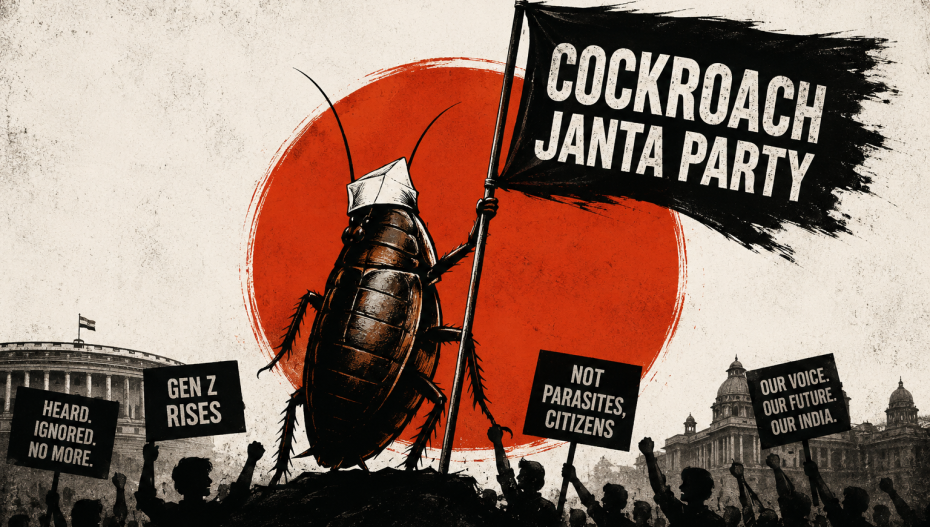
How a Supreme Court remark turned a generation’s frustration into a viral political movement — and why its founders are now fighting to keep it from being swallowed by the very establishment it set out to challenge.
A week earlier Abhijeet Dipke was living the kind of life thousands of young Indians abroad dream about. Fresh out of Boston University with a degree in public relations, the 30-year-old was polishing résumés, sending job applications and trying to secure a stable future in America. Politics, at least publicly, seemed to belong to a previous chapter of his life — one that had briefly included a stint with Aam Aadmi Party between 2020 and 2023. Then one remark detonated across Indian social media. When the Chief Justice of India compared sections of online youth to “cockroaches” and “parasites”, the comment did not merely trigger outrage. It struck a raw nerve among a generation already simmering with frustration — over unemployment, shrinking opportunities, political polarisation, institutional distrust and a feeling of invisibility in national discourse. Among those listening thousands of miles away in Boston was Abhijeet. Within days, the young graduate who had been applying for jobs suddenly found himself at the centre of one of the internet’s strangest and fastest-growing political movements — the “Cockroach Janta Party.” The name was deliberately provocative. Abhijeet decided that if the establishment wanted to dismiss young Indians as cockroaches, then the insult itself would become a banner of defiance. What began as anger quickly mutated into viral momentum. Instagram pages exploded. Memes multiplied by the hour. Registrations flooded in. In barely three or four days, the movement claimed lakhs of followers and over two lakh registrations. And suddenly, the man introducing himself, half sarcastically and half seriously, as “the cockroach,” had become the unlikely face of Gen Z political frustration. “A generation that once stayed silent is now becoming openly vocal — but the louder it gets, the more attractive it becomes to parties that have ignored them for years.
THE DEEPER WOUND
In an interview, Abhijeet said the outrage was not merely about personal offence. It was about who had spoken those words. Had a politician from the ruling establishment said it, few would have been surprised. But hearing such language from the constitutional head of India’s judiciary — a figure meant to protect freedom of expression — felt fundamentally different. To him, that was the deeper wound. He described a generation that increasingly believes nobody in power actually listens to them. Young Indians, he argued, are acknowledged only during elections or reduced to social media stereotypes afterwards. Their anxieties over jobs, education, rising competition and economic uncertainty rarely become central political issues. Now, according to him, they were being called parasites for expressing frustration. The movement quickly became a curious mix of internet culture, political rebellion and generational anger. One moment it appeared absurd — a political platform proudly embracing the word “cockroach.” The next moment it was making serious accusations about democratic institutions, media concentration and public accountability. Abhijeet himself admitted the movement was still improvising in real time. Three days earlier, none of them had expected this scale of response. Had they anticipated lakhs joining, they would have built structures, funding systems and strategy in advance. Instead, they found themselves scrambling to keep pace with a movement growing faster than its founders could define it.
THE POLITICAL ECONOMY OF YOUTH
Yet beneath the chaos and memes, a clear political theme emerged. Abhijeet repeatedly argued that India’s public discourse has become trapped in endless cycles of religious and identity conflict while younger generations want conversations about jobs, technology, artificial intelligence, education, semiconductors, clean energy and the future economy. Having spent time in the United States, he contrasted the debates he observed there with those dominating Indian politics. In America, he said, students discuss AI expansion, renewable energy and industrial innovation. In India, he argued, television and politics remain consumed by “Hindu-Muslim” battles. For him, the NEET examination paper leak symbolised everything broken in the system. He spoke emotionally about a 17-year-old NEET aspirant who died by suicide after the controversy. To Abhijeet, the tragedy represented more than administrative failure. It reflected a political culture where institutional collapse rarely leads to accountability. He contrasted India with Europe, citing reports of ministers resigning abroad over comparatively smaller failures. In India, he argued bitterly, even catastrophic failures affecting millions of students rarely produce resignations or consequences. “In India, even catastrophic failures affecting millions of students rarely produce resignations or consequences. Elsewhere, ministers step down for far less.”
CONTRADICTIONS AT THE CORE BUT THEN CJP IS EVOLVING.
The movement also revealed the contradictions at its heart. On one hand, Abhijeet through his Cockroach Janta Party (CJP) has repeatedly insisted this was not about joining existing opposition politics. Despite his previous association with Manish Sisodia and the Aam Aadmi Party, he maintained that Gen Z supporters were deeply suspicious of all established political parties. According to him, many young supporters explicitly warned him not to allow traditional parties to hijack the movement. On the other hand, the rhetoric itself was intensely political. The party’s early agenda included demands ranging from preventing post-retirement rewards for Chief Justices to media reforms, stronger institutional independence and 50 percent reservation for women in Cabinet positions. Critics dismissed these proposals as unrealistic internet populism designed for clicks. Abhijeet defends them as aspirational demands meant to provoke debate about the ideal shape of Indian democracy. Supporters argue this is not just another short-lived outrage cycle. According to them, something deeper had shifted psychologically among young Indians. The current moment, they believed, is merely the first stage of something larger. The movement has drawn comparisons with youth-driven unrest seen in neighbouring countries like Bangladesh, Nepal and Sri Lanka. Abhijeet has insisted any mobilisation in India must remain democratic and peaceful. Also, the CJP is evolving so it would be unfair to attribute any motives to it.
THE HIJACKING FEAR
But there is another anxiety beneath the movement’s surface noise — one its own founders speak about with unusual candour, and one that points to a structural reality of Indian electoral politics. Youth is the most coveted political commodity in a country where the median age hovers around 28 and where roughly 18 million new voters enter the electoral rolls every year. Every major party — from the BJP and Congress to the AAP and the regional formations — has invested heavily in youth wings, youth rallies and youth rhetoric precisely because the demographic dividend translates directly into ballot returns. A sudden, decentralised, ideologically fluid movement claiming two lakh registrations in under a week is, in that context, not merely a cultural curiosity. It is an asset to be acquired. Abhijeet is aware of this. He has said, with a directness that suggests he has thought about it seriously, that several overtures have already been received. He has not named names. But the warning he issues to his own supporters is pointed: the moment this movement enters formal alliance with any established party, it ceases to be what it set out to be. It becomes another youth wing. Another masthead change without a change of ownership. The fear has a historical basis. India’s political landscape is littered with the remains of movements that began as genuinely independent energies and ended as absorbed appendages of larger parties. The Anna Hazare agitation of 2011, which arguably created the political soil for Arvind Kejriwal’s own rise, is the most obvious antecedent. What began as a citizens’ movement against corruption ended, within a few years, as a political party — and that party’s own internal journey since then has been a study in the compromises that formal politics demands. “India’s political landscape is littered with movements that began as independent energies and ended as absorbed appendages. The founders know this. So do the parties circling them.” The concern is structural. A leaderless or lightly led movement with viral reach but no institutionnal architecture is, paradoxically, more vulnerable to takeover, not less. Without formal membership registers, financial accountability, internal decision-making processes or ideological clarity beyond its founding anger, it offers few internal defences against a well-resourced party that decides to organise within it, fund its infrastructure or simply wait for the founding moment’s energy to dissipate before offering its platform as a lifeline. Several of the movement’s younger supporters have articulated this anxiety themselves. They joined, they say, precisely because it was not associated with any party. The AAP connection in Abhijeet’s own past has already generated questions in some corners. His consistent insistence that this is categorically different, that his own political history does not define what the movement becomes, is treated with cautious credulity rather than full faith. There is also the question of what a takeover would look like from the other side. Political parties are sophisticated in their absorption techniques. They rarely announce acquisition; they accelerate it. They offer resources, amplification, candidates, infrastructure — and then, gradually, framing. The movement’s language of jobs and institutions and AI and semiconductors is, at its best, a challenge to the identity-politics dominance of Indian electoral competition. A party that adopts it as cosmetic vocabulary while continuing its actual politics would be a different thing entirely from a movement that forces that language into the centre of national debate.
WHO SPEAKS FOR GEN Z?
One uncomfortable question lingers beneath the excitement surrounding the movement: who actually represents India’s Gen Z today? The answer seems increasingly unclear. There is no shortage of claimants. Student unions, mostly captured by the youth wings of major parties, have for decades purported to represent campus politics. Social media influencers with millions of followers construct youth opinion one reel at a time. Startup founders are routinely celebrated as the voice of aspirational India. Political parties conduct expensive demographic surveys and conduct rallies addressed by leaders young enough to be photographed with mobile phones. And yet something clearly remains unaddressed, because a remark by a Chief Justice in a courtroom — not a manifesto, not a campaign promise, not a policy announcement — was sufficient to produce two lakh registrations within 96 hours. The movement drew comparisons with youth-driven unrest seen in Bangladesh, Nepal and Sri Lanka in recent years. Abhijeet was careful to distance the Cockroach Janta Party from anything resembling that trajectory, stressing constitutional methods and rejecting confrontation. But the comparisons themselves are instructive. In each of those cases, the formal political system’s failure to absorb and address genuine generational anxiety eventually produced something that the formal system could no longer manage. Whether the Cockroach Janta Party survives, collapses, radicalises or dissolves into internet memory, nobody yet knows. It may become a serious political force. It may remain a spectacular viral moment born from a single judicial remark. Its fate will be shaped as much by what established politics does to it as by what its own founders do with it. But its sudden rise has already exposed something that neither memes nor manifestos can fully contain. It revealed a generation increasingly convinced that India’s institutions speak at them, not to them; that electoral politics discusses religion more comfortably than unemployment; and that young people, despite forming the country’s demographic majority, remain politically underrepresented unless they become either influencers, trolls or statistics. And so, out of an insult, a strange new political identity was born. Not polished. Not structured. Not fully ideological. But angry, online, restless and very aware of its numbers. The only question now is who gets to those numbers first. And the fear that no established political party should hijack the Cockroach Janta Party that indeed can become the voice of youth in India.
Also Read: Your Honour, Some Cockroaches Have Degrees https://www.vibesofindia.com/your-honour-some-cockroaches-have-degrees/