


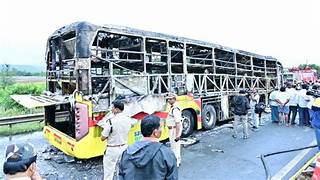
When a private sleeper bus caught fire on the outskirts of Kurnool early Friday, passengers had little warning before the vehicle was swallowed by flames. Within minutes, 19 lives were lost on National Highway 44 — in one of southern India’s deadliest road accidents this year.
What began as a minor road obstruction — a fallen bike on the highway — quickly spiraled into a chain reaction of explosions, fire, and toxic smoke. But investigators now believe it wasn’t just the motorcycle’s fuel tank that ignited the blaze. A hidden cargo of smartphones stored in the bus’s undercarriage may have turned a survivable accident into an uncontrollable inferno.
🔎 The Chain Reaction: From Fallen Bike to Explosive Fire
According to police, the V Kaveri Travels sleeper bus was heading from Hyderabad to Bengaluru when it ran over a two-wheeler that had been lying on NH-44 after a previous crash near Chinna Tekur village. The friction and impact reportedly caused sparks and ruptured fuel leaks, instantly igniting a fire.
In most highway fires, flames remain localized. But this one escalated with unnatural speed.
Forensic experts later discovered that the bus’s luggage compartment was filled with 234 brand-new smartphones, part of a consignment worth nearly ₹46 lakh, being shipped by a Hyderabad-based trader named Manganath.
When the fire reached this compartment, multiple explosions were heard — not from fuel, but from lithium-ion batteries inside the smartphones.
“These phones, packed tightly and exposed to extreme heat, may have triggered a series of explosions,” said P. Venkataramana, Director General of Andhra Pradesh Fire Services. “Eyewitnesses reported popping and bursting sounds, typical of lithium battery failures.”
⚡ The Science Behind the Sparks: How Phones Can Fuel Fires
Smartphones are powered by lithium-ion batteries — compact, rechargeable power units found in almost every modern electronic device.
While safe under normal use, they carry a built-in fire risk: if damaged, overheated, or improperly stored, they can undergo thermal runaway — a chain reaction in which internal temperatures rise uncontrollably, leading to combustion or explosion.
Here’s what likely happened inside the Kurnool bus, according to fire investigators and battery experts:
- Extreme heat and compression: As the bus’s underside scraped the road and caught fire, the luggage bay above was exposed to high heat.
- Battery rupture: The smartphones’ lithium cells expanded, cracked, and short-circuited.
- Thermal runaway: A single battery ignited, releasing flammable gases and radiant heat.
- Cascade effect: Nearby phones caught fire in quick succession, amplifying the intensity of the blaze.
In confined environments — such as a bus luggage compartment — these explosions can act like small firebombs, each releasing oxygen and heat that accelerates combustion.
“Each phone battery contains enough energy to ignite its surroundings if it fails,” said a Hyderabad-based battery engineer. “Two hundred of them failing in proximity can behave like a chain of micro-explosives.”
🔋 More Than Phones: AC Batteries and Fuel Added to the Fire
Investigators also suspect that two 12 KV batteries powering the bus’s air-conditioning system exploded due to the extreme heat, further worsening the situation.
“The main ignition point was near the exit door,” said Kurnool Range DIG Koya Praveen. “The motorcycle’s fuel tank burst there, and just behind it were the bus’s own batteries. They exploded almost immediately.”
In addition, spilled petrol from the bike, metallic paint on the bus exterior, and highly flammable interior fittings created a lethal mix that turned the vehicle into a furnace within moments.
🧯 Why This Matters: Lithium Batteries Are Everywhere
The Kurnool tragedy exposes a growing safety blind spot in India’s logistics and passenger transport industry: the unchecked movement of electronic goods — including smartphones, laptops, and batteries — in passenger vehicles.
Under DGCA and road transport safety norms, lithium batteries are considered hazardous cargo and should be shipped under controlled temperature and pressure conditions. Yet, in practice, thousands of long-distance buses and courier services routinely carry them as regular parcels.
“Lithium batteries are classified as ‘dangerous goods’ for a reason,” said a senior fire safety official. “They must not be transported in bulk inside passenger vehicles, especially in enclosed, poorly ventilated spaces.”
🧩 Lessons from Kurnool: The Hidden Hazards of Everyday Tech
The forensic probe into the Kurnool accident is ongoing, but the emerging evidence highlights a critical lesson: as electronic devices become more common, so do new types of fire risks.
- Thermal overload: Heat from vehicle engines or external fires can trigger battery explosions.
- Overpacking: Tight storage without ventilation accelerates heat buildup.
- Impact sensitivity: Even minor crushing or bending can cause internal short circuits.
- Ignition amplification: Once one cell catches fire, nearby ones ignite in a chain reaction.
Experts suggest that public transport operators should ban or tightly regulate electronic shipments on passenger buses, and that manufacturers should improve thermal containment in lithium battery designs.
⚠️ A Wake-Up Call on the Highway
By the time rescue teams arrived, the V Kaveri Travels bus had been reduced to a charred shell. Forensic teams are still analyzing debris to confirm whether the smartphones triggered or merely worsened the blaze.
But one thing is clear: this was not just a road accident — it was a convergence of mechanical impact, flammable fuel, and volatile technology.
The Kurnool fire stands as a stark reminder that in the age of smart devices, even a few hundred phones can turn a highway accident into a lethal inferno.