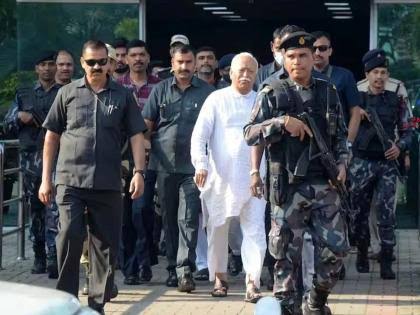
In the RTI response, while the ministry cited concerns regarding security and privacy, the CISF declined to share the details, asserting that it is an organisation exempt from the purview of the law.
In response to Right to Information (RTI) applications filed to ascertain how much the Union government spends on the security of Rashtriya Swayamsevak Sangh (RSS) chief Mohan Bhagwat, both the Ministry of Home Affairs and the Central Industrial Security Force (CISF) have declined to provide the requested information.
While the ministry cited provisions related to security and privacy, the CISF refused to disclose the details, asserting that it is an organisation exempt from the provisions of the RTI Act.
It is important to note that Bhagwat does not hold a constitutional office. He serves as the Sarsanghchalak (head) of the RSS, a non-governmental organisation. Yet, he is afforded high-level security protection by the Union government. So it is natural and pertinent to inquire about the actual expenditure incurred on his security.
This matter pertains not only to the security arrangements for an individual, but also to the broader principle of transparency regarding the utilisation of public funds and state resources.
What did the RTI application seek?
On April 16, 2026, this correspondent filed an RTI application with the Union home ministry, requesting information on seven specific points. The application sought details regarding the total expenditure on Bhagwat’s security to date; the annual costs incurred since 2015; the expenses covered by the CISF, state police forces, and other agencies; costs associated with vehicles, communication systems, weaponry, travel, and other logistical arrangements; as well as the additional costs incurred following the upgrade of his security cover, among other details.
Concerning this particular matter, a separate application submitted to the CISF also sought information regarding about the initial deployment of force for the security of Bhagwat, the total number of personnel assigned, the breakdown of personnel by rank, whether a specialized security unit has been designated for him, and the overall count of VVIPs/VIPs currently under CISF protection.
What was the ministry’s response?
In a reply dated May 7, 2026, the VIP Security Unit of the home ministry replied saying the information requested in the application is exempt under Sections 8(1)(g) and 8(1)(j) of the Right to Information Act, 2005, and therefore cannot be furnished.
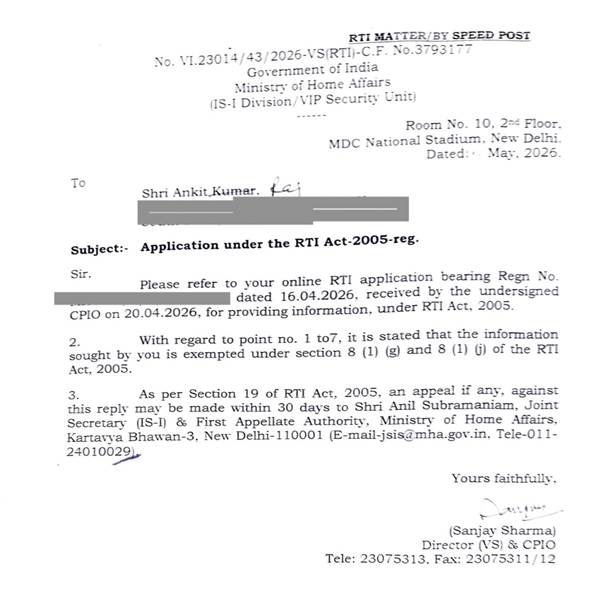
The Ministry of Home Affairs’ response to RTI application..
In other words, the ministry did not supply any figures related to the expenditure, nor did it provide any clear details about the security level, and it also failed to share the Standard Operating Procedures (SOPs).
What do these sections imply?
Section 8(1)(g) stipulates that information may be withheld if its disclosure would endanger the life or safety of any person, or if it would reveal the identity of sources providing assistance for law enforcement or security purposes.
Section 8(1)(j) pertains to personal information. According to this provision, a request for personal details may be denied if the information does not bear a direct relation to any public activity or public interest, or if its disclosure would constitute an unwarranted invasion of an individual’s privacy.
By invoking these two sections, the home ministry indicated that revealing information regarding the expenditure, resources, and security arrangements might potentially pose a security risk or lead to privacy concerns.
Advertisement
However, RTI activists have consistently argued that disclosing the overall public expenditure is distinct from revealing the strategic details of security operations. For example, stating the total annual expenditure incurred on an individual’s security does not necessarily entail the disclosure of operational specifics.
What did the CISF say?
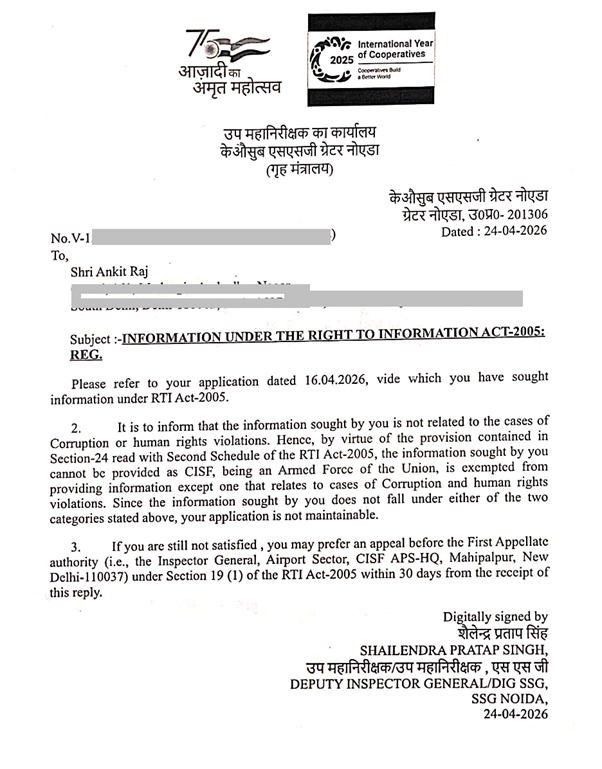
The CISF’s response to RTI application.
In its response dated April 24, 2026, the CISF stated that, in accordance with Section 24 and the Second Schedule of the RTI Act, it is an entity exempt from the obligation to furnish information on routine matters. The CISF further stated that information can be disclosed only in cases involving corruption or human rights violations. Since the information sought does not fall under these categories, the application is deemed ‘not maintainable.’
Under Section 24, certain intelligence and security agencies of the country have been granted a broad exemption from the purview of the RTI Act. The CISF invoked this very provision.
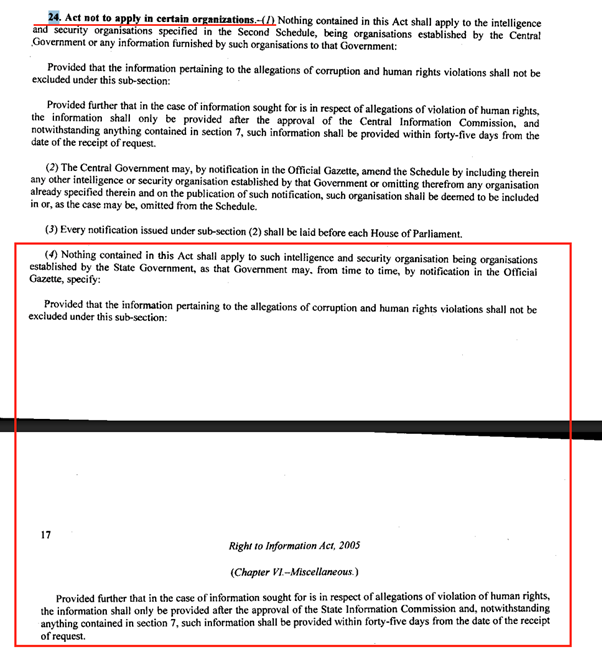
Section 24 of the RTI Act.
What do these responses signify?
Together, the two responses clearly indicate that citizens have almost no access to information regarding the public spending related to Bhagwat’s security. The home ministry cited security and privacy concerns, whereas the CISF relied on institutional exemptions.
Advertisement
This scenario raises the following questions: when security expenses are funded by taxpayers’ money, shouldn’t at least consolidated financial details be made public? Does disclosing the total expenditure truly jeopardise the security apparatus? And, has VIP security in India transformed into a sphere where accountability is significantly restricted?
A timeline of Mohan Bhagwat’s security enhancement
Bhagwat has held the position of RSS Sarsanghchalak since 2009. However, over the past decade, his security arrangements have evolved and been bolstered in several phases. These modifications were not solely based on evaluations by security agencies; they also sparked political and public debates.
According to reports, Bhagwat was granted ‘Z-Plus’ category security in 2012, during the UPA government’s tenure. During that period, the Maharashtra Police held the primary responsibility for his security, while the role of central forces remained limited. As per the reports, the Union government had directed the Maharashtra Police to deploy the required personnel, including a role for the CISF.
The same reports noted that the CISF’s Special Security Group (SSG) did not immediately assume full responsibility. The stated reason for this was that the force lacked adequate manpower and preferred that the responsibility for security be placed clearly in the hands of a single agency.
A CISF official had said at the time, “It is preferable that the responsibility for security be assigned to a single force.” This was the reason why the CISF did not become directly involved in providing security cover for a considerable period even after the decision had been reached.
In June 2015 – just one year after the Narendra Modi government assumed power at the Centre – the Ministry of Home Affairs decided to hand over the responsibility for Bhagwat’s security entirely to the CISF. According to reports by The Hindu, CISF commandos subsequently began providing security cover for Bhagwat at the RSS headquarters in Nagpur, at his residence, and during his travels across the country.
With this transition, several new elements were incorporated into the security protocol. Approximately 60 trained commandos were deployed round-the-clock to provide security for Bhagwat. The CISF’s VVIP commando unit assigned to this task was reportedly equipped with modern weaponry – including AK-series rifles – as well as advanced communication systems and anti-sabotage technology. Furthermore, the vehicles in his convoy were upgraded to meet the specific standards prescribed for ‘Z-Plus’ category security.
In August 2024, after receiving fresh threat inputs from intelligence agencies, an ‘Advance Security Liaison’ (ASL) component was added to Bhagwat’s existing ‘Z-Plus’ security detail. This additional security arrangement is granted only to select high-threat individuals. At the time, Home Minister Amit Shah was reported to be the second individual to receive ASL security cover.
Under the ASL protocol, a specialised team visits the relevant location prior to any tour, coordinate with the local police and administration, assess potential threats, pinpoint weaknesses, and establish a multi-layered security cordon. This encompasses everything from the travel route and venue to medical support and emergency response protocols.
According to reports, security agencies had received intelligence inputs suggesting that certain banned organisations might attempt to target the RSS chief. Consequently, the home ministry conducted a security review and issued directives to further bolster his protection.
BJP leader questions Bhagwat’s security
Questions regarding the enhancement of Bhagwat’s security were raised not only by the opposition but also from within the BJP itself. According to a BBC Hindi report, Kailash Nath Bhatt – the then-spokesperson for the Rajasthan BJP – raised questions in a Facebook post asking why the Sangh Chief had been granted ‘Z-Plus’ security cover, and whether this move would not serve to distance him from the ordinary volunteers.
In a Facebook post dated June 8, 2015, Bhatt wrote: “I do not know why ‘Param Pujya’ [Most Revered] Sarsanghchalak ji has been accorded Z-Plus security, and whether he has accepted it or not. Today, even the security personnel of the nation are not safe; just recently, more than 20 of our soldiers were martyred in Manipur. During times of grave peril, it was God who protected ‘Guru-ji’ and ‘Balasaheb Deoras-ji.’ The late Smt. Indira Gandhi was also assassinated by her very own security personnel. God has taken upon himself the responsibility for everyone’s safety; what, then, is there to fear? Please consider this: will this security arrangement not distance you from the common volunteers? Will this arrangement not come to be perceived as a mere status symbol? I apologize for any offense caused, but I felt compelled to express my thoughts.”
This remark sparked a controversy within the party. Following this, Bhatt issued an apology, but he was forced to step down from his post and the state leadership accepted his resignation. This highlights how the issue of Bhagwat’s security has generated a sense of unease even within the BJP and the larger Sangh Parivar.
Matter reaches the court
In recent years, a legal challenge regarding Bhagwat’s security also emerged. A Public Interest Litigation (PIL) was filed in the Nagpur Bench of the Bombay high court, demanding that the cost of the ‘Z-Plus’ security cover provided to the RSS chief be recovered from the Sangh itself. The petitioner argued that public funds should not be expended on the security of a private organisation.
However, the bench dismissed the petition, observing: “We perceive no public interest in this petition, which has been presented as a Public Interest Litigation.” Representing the state government in court, Government Pleader Devendra V. Chauhan had opposed this PIL.
This article first appeared on The Wire Hindi. It has been translated by Naushin Rehman.
Also Read: Food, Faith and Fascism in New India https://www.vibesofindia.com/food-faith-and-fascism-in-new-india/