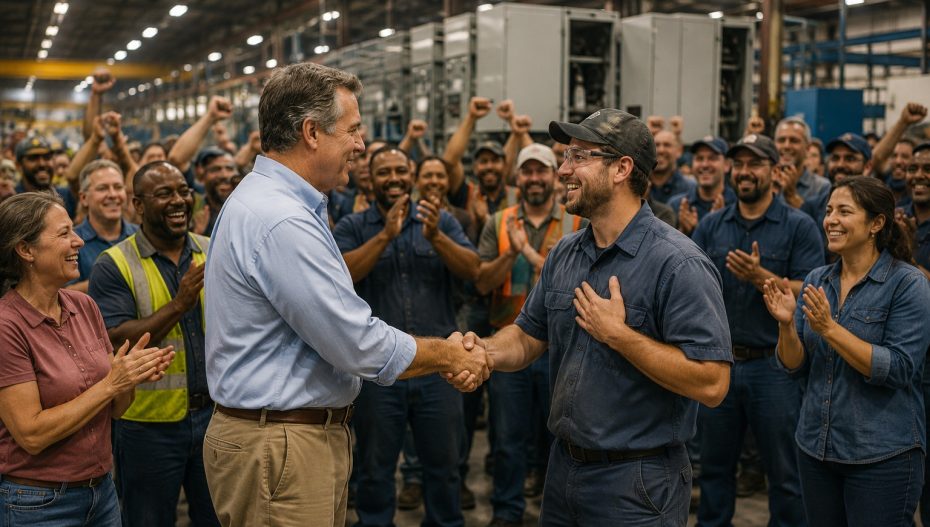
In a remarkable story of corporate generosity, a small-town American family has sold its electrical equipment manufacturing company for $1.7 billion (approximately ₹14,600 crore) and shared a significant portion of the proceeds with its employees, turning hundreds of factory workers into millionaires.
The company, Fibrebond, based in Minden, Louisiana, was acquired by power-management giant Eaton after being run by the Walker family for 43 years. Before signing the deal, former CEO Graham Walker insisted on one condition that would forever change the lives of the company’s workforce: 15% of the sale proceeds had to be distributed among employees.
As a result, Fibrebond’s 540 full-time employees collectively received $240 million (around ₹2,060 crore). On average, each worker received approximately $443,000, or nearly ₹3.8 crore, despite not owning a single share in the company.
The 12-Word Clause That Created Hundreds of Millionaires
The employee bonus programme was not a one-time cash handout. Payments began arriving in June and are spread across a five-year retention period, meaning employees must continue working with the company to receive the full amount.
However, employees aged 65 and above were exempt from the retention requirement, allowing many long-serving workers to retire immediately while still collecting their full payouts.
When Graham Walker was asked by The Wall Street Journal why he chose to allocate 15% of the proceeds, instead of 10% or 20%, he offered a simple response: “It’s more than 10%.” The announcement left employees stunned. Many initially struggled to believe the news was real.
According to reports, workers stared at their payout letters in disbelief. One employee reportedly asked whether hidden cameras were recording the moment. Another drove away in a golf cart with his fist raised in celebration.
Business-development executive Hector Moreno described the experience as surreal. “It was surreal, it was like telling people they won the lottery,” he told The Wall Street Journal.
A Company Built Through Fire, Recession and Loyalty
Fibrebond’s story began in 1982, when Graham Walker’s father, Claud Walker, founded the company. Initially, the business manufactured structures used to house telephone and electrical equipment along railway tracks and other infrastructure networks.
The company faced major setbacks throughout its history.
In 1998, a devastating factory fire destroyed its manufacturing facility. Soon afterward, the collapse of the dot-com boom severely reduced demand for its products.
The downturn forced the company’s workforce to shrink dramatically—from approximately 900 employees to around 320.
Despite the financial pressure, employees later told The Wall Street Journal that the Walker family continued paying salaries and supporting workers through the toughest periods. That commitment helped build a culture of loyalty that lasted for decades and ultimately played a role in Walker’s decision to share the proceeds of the sale.
The ₹1,290 Crore Bet That Changed Everything
Fibrebond’s fortunes turned after the company made a bold investment of $150 million (approximately ₹1,290 crore) in data-centre infrastructure manufacturing.
At the time, the move was considered risky. However, the explosion in cloud computing during the Covid-19 era validated the investment.
As businesses increasingly shifted operations online, demand for data centres surged. The rise of artificial intelligence further accelerated the need for digital infrastructure.
Fibrebond became a major supplier of specialised structures and enclosures used in data-centre projects. Demand was also boosted by construction linked to Liquefied Natural Gas (LNG) export terminals across the United States. The results were dramatic.
Over the past five years, the company’s sales reportedly increased by nearly 400%, attracting the attention of larger industrial players and eventually leading to Eaton’s acquisition offer.
Life-Changing Wealth for Workers
For many employees, the payouts have been transformational. Lesia Key, who joined Fibrebond in 1995 earning just $5.35 per hour, used her money to pay off her mortgage and open a clothing boutique. Hong Blackwell, 67, retired after 16 years with the company and purchased a Toyota Tacoma for her husband.
Hector Moreno used part of his payout to take 25 family members on a holiday to Cancún, Mexico. Many other employees reportedly used the money to clear debts, strengthen retirement savings, support their children, and secure long-term financial stability.
Walker Family Still Receives More Than ₹8,600 Crore
Even after distributing more than ₹2,060 crore to employees, the Walker family still received over $1 billion (more than ₹8,600 crore) from the transaction.
Graham Walker officially stepped down as CEO on December 31, marking the end of the family’s direct leadership of the company after more than four decades.
The Wall Street Journal, which first reported the story, noted that the employee payouts are among the most generous examples of wealth-sharing ever seen in a private-company sale.
At a time when many corporate acquisitions are associated with layoffs, restructuring and uncertainty, the Fibrebond story stands out for a different reason. Rather than keeping the entire windfall for themselves, the owners chose to reward the workers who helped build the company through fires, recessions and decades of growth.
The result is a rare corporate success story in which hundreds of factory workers became wealthy alongside the family that owned the business—proving that long-term loyalty and shared success can still exist in modern capitalism.
Also Read: When Gujarat Ran Out Of Money, It Turned To Juhi Chawla’s In-Laws For Help https://www.vibesofindia.com/juhi-chawla-in-laws-nanji-kalidas-mehta-gujarat-loan-story/